The Listening Grove · Aesop's Fables
Fable 22: The Sheep and the Pig
A Charlotte Mason fable lesson. Press play, with the lesson.
What is Aesop's fable The Sheep and the Pig about?Parent review
Aesop's Fable 22, The Sheep and the Pig, is a story about how easy it is to be brave when nothing is at stake. A shepherd catches a fat pig in his meadow, and the pig squeals and struggles with all its might. The calm sheep, who are often carried off themselves, are amazed and ask why the pig makes such a fuss. The pig answers that when the shepherd catches them he only wants their wool, but when he catches the pig, he wants its bacon.
Say what you remember!
Tell what you remember from the last fable.
What happened in Aesop's fable The Farmer and the Stork?Have a look
In the last fable, The Farmer and the Stork, a trusting Stork joined a party of thieving Cranes in a farmer's field and was caught with them in the net. Though the Stork pleaded that he was honest, the Farmer said he had caught him among the thieves, and so he must share their punishment.
Back to the previous lesson: The Farmer and the Stork →The Books come Alive!
Read or listen to The Sheep and the Pig, the Kindred Thicket Revised Edition.
Read by Kindred Thicket, from the Kindred Thicket Revised Edition.
Read along with the fableRead along
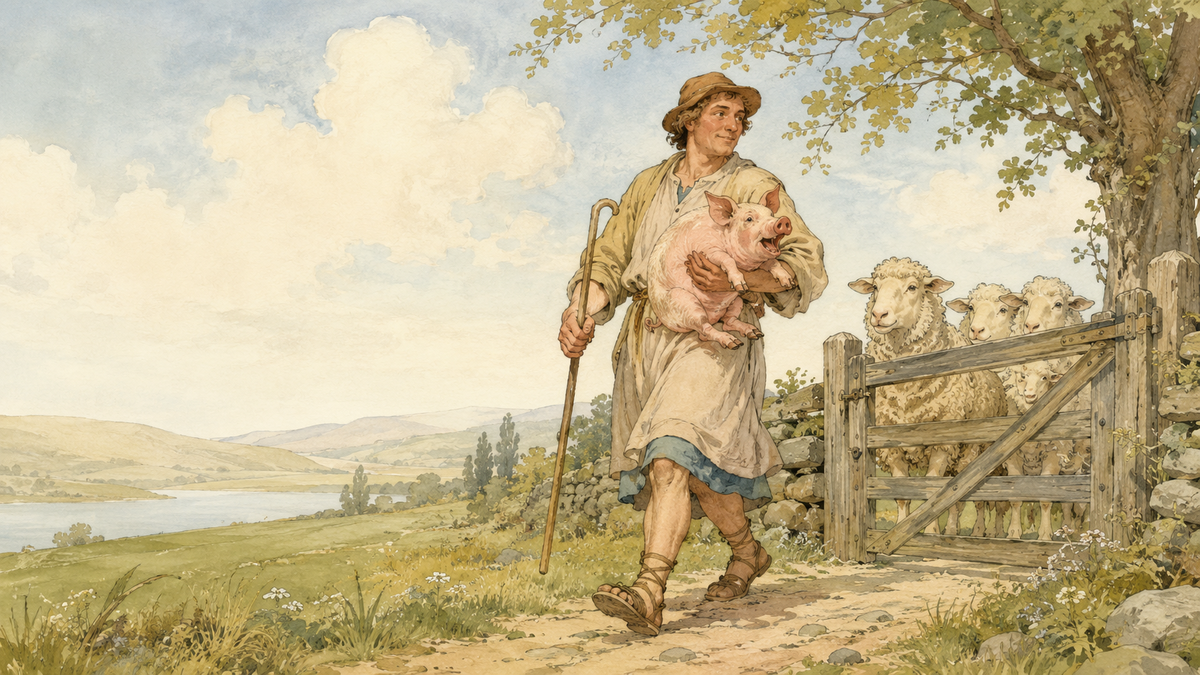
One day a shepherd discovered a fat Pig in the meadow where his Sheep were pastured. He very quickly captured the porker, which squealed at the top of its voice the moment the Shepherd laid his hands on it. You would have thought, to hear the loud squealing, that the Pig was being cruelly hurt. But in spite of its squeals and struggles to escape, the Shepherd tucked his prize under his arm and started off to the butcher's in the market place.
The Sheep in the pasture were much astonished and amused at the Pig's behavior, and followed the Shepherd and his charge to the pasture gate.
"What makes you squeal like that?" asked one of the Sheep. "The Shepherd often catches and carries off one of us. But we should feel very much ashamed to make such a terrible fuss about it like you do."
"That is all very well," replied the Pig, with a squeal and a frantic kick. "When he catches you he is only after your wool. But he wants my bacon! gree-ee-ee!"
Memory becomes Action!
Use the character cards* to remember who is in the fable. Choose one way to narrate.
*Character cards are free with the email list; the Composition Prompt and Drawn Narration Sheet are in the Companion Guide.
What is the list of the names, people, characters, and places that are important in Aesop's fable The Sheep and the Pig?The Pig, The Sheep, The ShepherdHave a look
- The Pig: The fat pig who squeals and struggles, knowing the shepherd is after its very life.
- The Sheep: The calm sheep who wonder at the pig's fuss, since the shepherd wants only their wool.
- The Shepherd: The shepherd who catches the pig and carries it off to market.
What is the moral of Aesop's fable The Sheep and the Pig?Have a look
“It is easy to be brave when there is no danger.”
The sheep thought the pig a coward for struggling, but the shepherd wanted only their wool and the pig's very life. It is easy to be calm and brave when there is nothing truly at stake.
The Sheep and the Pig Q & A
Common questions about this fable: the other titles it goes by, where it comes from, its lesson, and how to help your child narrate it.
Is this fable also called something else?
It is usually called "The Sheep and the Pig," and sometimes "The Sheep, the Lamb, and the Pig" or simply "The Pig and the Sheep." Whatever the title, it is the story of the squealing pig and the puzzled sheep, who learn that the pig has far more to fear than they do. The read-aloud on this page gives you the full text.
Where does this story come from, and where else will my child meet it?
The Sheep and the Pig is found among the fables gathered under Aesop's name and retold in many collections since. Its sharp little lesson, that courage is cheap when nothing is at risk, has kept it popular with storytellers for centuries. When your child meets it, she is meeting a shrewd old observation about bravery.
What is the lesson of this fable? Do I need to explain the moral?
The sheep think the pig a coward for squealing, until the pig reminds them that the shepherd wants only their wool but his very life. You do not need to spell this out. Charlotte Mason found that children "readily appropriate the moral" of a fable on their own (Towards a Philosophy of Education, Vol. 6), and a fable does its best work when a child reaches the point herself. Read it well and let it do its quiet work.
How do I help my young child narrate this fable?
Read it through once, without stopping to quiz, then invite your child to tell it back in her own words. Mason believed a single hearing was enough, noting that "few grown-ups could 'tell' one of Æsop's Fables with the terse directness which children reproduce" (Towards a Philosophy of Education, Vol. 6). If she stalls, one gentle prompt restarts her: "Why did the pig squeal so? Why were the sheep not afraid?" For a child who is not yet writing, drawn narration works beautifully here, letting her draw the shepherd carrying off the squealing pig, or the sheep watching from the pasture. And if she needs something to hold while she tells, the character cards in our free bonus materials give her the pig, the sheep, and the shepherd to point to as the story unfolds.
Should I go over the vocabulary before we read this fable?
Usually not, and this is where fables differ from history or science. In those subjects a single unfamiliar word can carry the whole meaning of a passage, so it is worth a quick look beforehand. A fable works the other way. Its gift is exposure, and the way a child quietly infers what a word means from the story around it. So read this one straight through and let the context do the teaching. If a word truly blocks understanding, say what it means in a breath and read on, keeping the whole of the story in one piece.