The Listening Grove · Aesop's Fables
Fable 6: Belling the Cat
A Charlotte Mason fable lesson. Press play, with the lesson.
What is Aesop's fable Belling the Cat about?Parent review
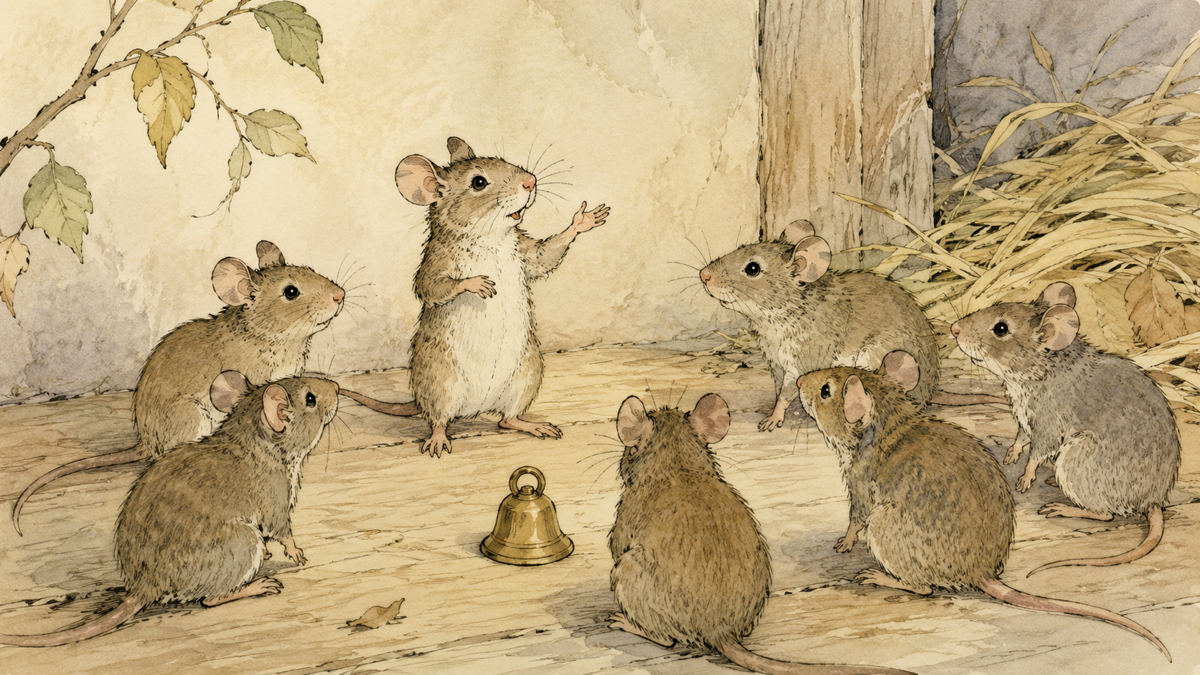
Aesop's Fable 6, Belling the Cat, is a tale about how easy it is to suggest a plan and how hard it is to carry it out. The Mice hold a meeting to decide how to escape their enemy the Cat. A very young Mouse proposes a fine plan: hang a bell around the Cat's neck, so they will always hear her coming. Everyone is delighted, until a wise old Mouse rises and asks a single question, "Who will bell the Cat?"
Say what you remember!
Tell what you remember from the last fable.
What happened in Aesop's fable The Dog, the Rooster, and the Fox?Have a look
In the last fable, The Dog, the Rooster, and the Fox, a Dog and a Rooster set out together to see the world. When the Rooster's dawn crowing woke a hungry Fox, the Fox came with flattering words hoping for breakfast. The Rooster sent him to the porter at the foot of the tree, where the Dog was waiting, and the trickster was caught in his own trick.
Back to the previous lesson: The Dog, the Rooster, and the Fox →The Books come Alive!
Read or listen to Belling the Cat, the Kindred Thicket Revised Edition.
Read by Kindred Thicket, from the Kindred Thicket Revised Edition.
Read along with the fableRead along
The Mice once called a meeting to decide on a plan to free themselves of their enemy, the Cat. At least they wished to find some way of knowing when she was coming, so they might have time to run away. Indeed, something had to be done, for they lived in such constant fear of her claws that they hardly dared stir from their dens by night or day.
Many plans were discussed, but none of them was thought good enough. At last a very young Mouse got up and said:
"I have a plan that seems very simple, but I know it will be successful. All we have to do is to hang a bell about the Cat's neck. When we hear the bell ringing we will know immediately that our enemy is coming."
All the Mice were much surprised that they had not thought of such a plan before. But in the midst of the rejoicing over their good fortune, an old Mouse arose and said:
"I will say that the plan of the young Mouse is very good. But let me ask one question: Who will bell the Cat?"
Memory becomes Action!
Use the character cards* to remember who is in the fable. Choose one way to narrate.
*Character cards are free with the email list; the Composition Prompt and Drawn Narration Sheet are in the Companion Guide.
What is the list of the names, people, characters, and places that are important in Aesop's fable Belling the Cat?The Mice, The young Mouse, The old Mouse, The Cat, The mice's meeting placeHave a look
- The Mice: The council of mice who meet to find a way to escape their enemy, the Cat.
- The young Mouse: Proposes the clever-sounding plan of hanging a bell on the Cat.
- The old Mouse: The wise elder who asks the one hard question: who will actually bell the Cat?
- The Cat: The mice's dreaded enemy, whose silent approach they hope the bell would warn them of.
- The mice's meeting place: The place the fable happens: the gathering where the mice hold their council against the Cat.
What is the moral of Aesop's fable Belling the Cat?Have a look
“It is one thing to say that something should be done, but quite a different matter to do it.”
The young Mouse's plan to bell the Cat sounded perfect, and every mouse cheered, until the old Mouse asked who would actually do it. Saying a thing should be done is easy; doing it is quite another matter.
Belling the Cat Q & A
Common questions about this fable: the other titles it goes by, where it comes from, its lesson, and how to help your child narrate it.
My book calls this "The Mice in Council." Same fable?
Yes. It goes by "Belling the Cat," "The Mice in Council," "The Mice and the Cat," and "Who Will Bell the Cat?" Look for the mice who agree to hang a bell on the cat, until one old mouse asks who will actually do it. That is this one.
Where does this fable come from, and where else will my child meet it?
This is one of the most quoted fables in the language. To "bell the cat" is still an English expression for taking on a dangerous task no one else will, and the story of the rats and the cat was famous enough to appear in the medieval English poem Piers Plowman and to earn a Scottish nobleman the nickname "Bell-the-Cat." Your child will meet the phrase, and the idea, for the rest of her reading life.
What is the lesson, and do I need to explain it?
The mice have a fine plan until they ask who will carry it out, so the fable teaches, in the old words, that it is one thing to say a thing should be done and quite another to do it. The old mouse's single question makes the point. You need not repeat it.
How do I help my child narrate this one?
Read it, then ask her to tell it back. A prompt if she needs one: "What was the mice's clever plan, and what did the old mouse ask?" The turn at the end is satisfying to retell. A drawing of the council of mice, or the old mouse speaking up, works as narration, and the free character cards give her the mice and the cat to gather for their meeting.