The Listening Grove · Fifty Famous Stories Retold
Chapter 28: Horatius at the Bridge
A Charlotte Mason read-aloud lesson. Press play, with the lesson.
What is Fifty Famous Stories Retold Chapter 28, Horatius at the Bridge, about?Parent review
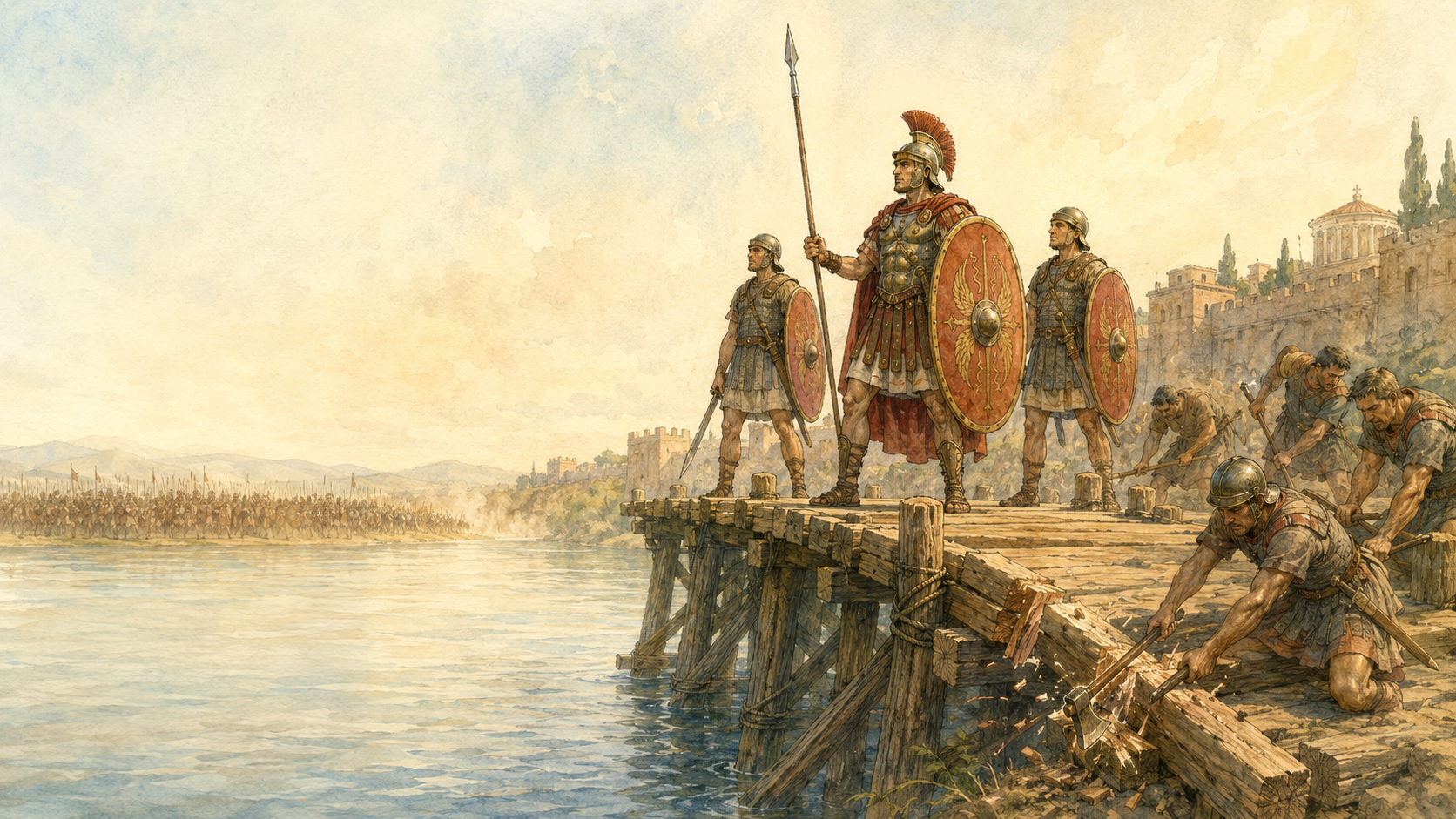
Fifty Famous Stories Retold Chapter 28, Horatius at the Bridge, is a stirring old Roman tale of courage. When Porsena, king of the Etruscans, marched a great army on Rome, only a wooden bridge over the River Tiber stood between the city and the foe. The brave Horatius and two companions held the far end of the bridge while the Romans hewed it down behind them. As the bridge fell, Horatius, wounded in the eye, cast his spear, leaped into the river in his heavy armor, and swam safely to his own side. Rome honored him with a statue and a gift of land. It is a story of standing firm for the common good.
Say what you remember!
Tell what you remember from the last chapter.
What happened in Fifty Famous Stories Retold Chapter 27, Androclus and the Lion?Have a look
In the last chapter, Androclus and the Lion, a runaway slave hid in a cave and found a lion in pain. Androclus gently drew a large thorn from the lion's paw, and the grateful animal fed him and became his friend. Later Androclus was captured and, by the law of the day, condemned to face a hungry lion before a great crowd. The lion turned loose in the arena was his old friend, who greeted him kindly instead of harming him. Amazed at the sight, the people set both the slave and the lion free. It was a tale of kindness returned with kindness.
Read the previous lesson: Androclus and the Lion →Show what you know!
Use your printable Lesson Guide. Fill in the vocabulary you know, then click to check your work and learn some new words today.
What are the difficult or advanced vocabulary words in Fifty Famous Stories Retold Chapter 28, Horatius at the Bridge?hew, shield, falter, gratefulHave a look
- hew: to cut down with blows of an axe
- shield: a broad piece of armor carried on the arm
- falter: to hesitate or lose your nerve
- grateful: feeling and showing thanks
Locate it on the map!
Use your printable Lesson Guide. Use an atlas and fill in the blank map if you can find the geographic location, then click to check your work.
What important geographic location connects with Fifty Famous Stories Retold Chapter 28, Horatius at the Bridge?
- Find The Tiber River (Lazio, Italy): the river that runs by Rome, spanned by the bridge Horatius defended
See it on the mapHave a look
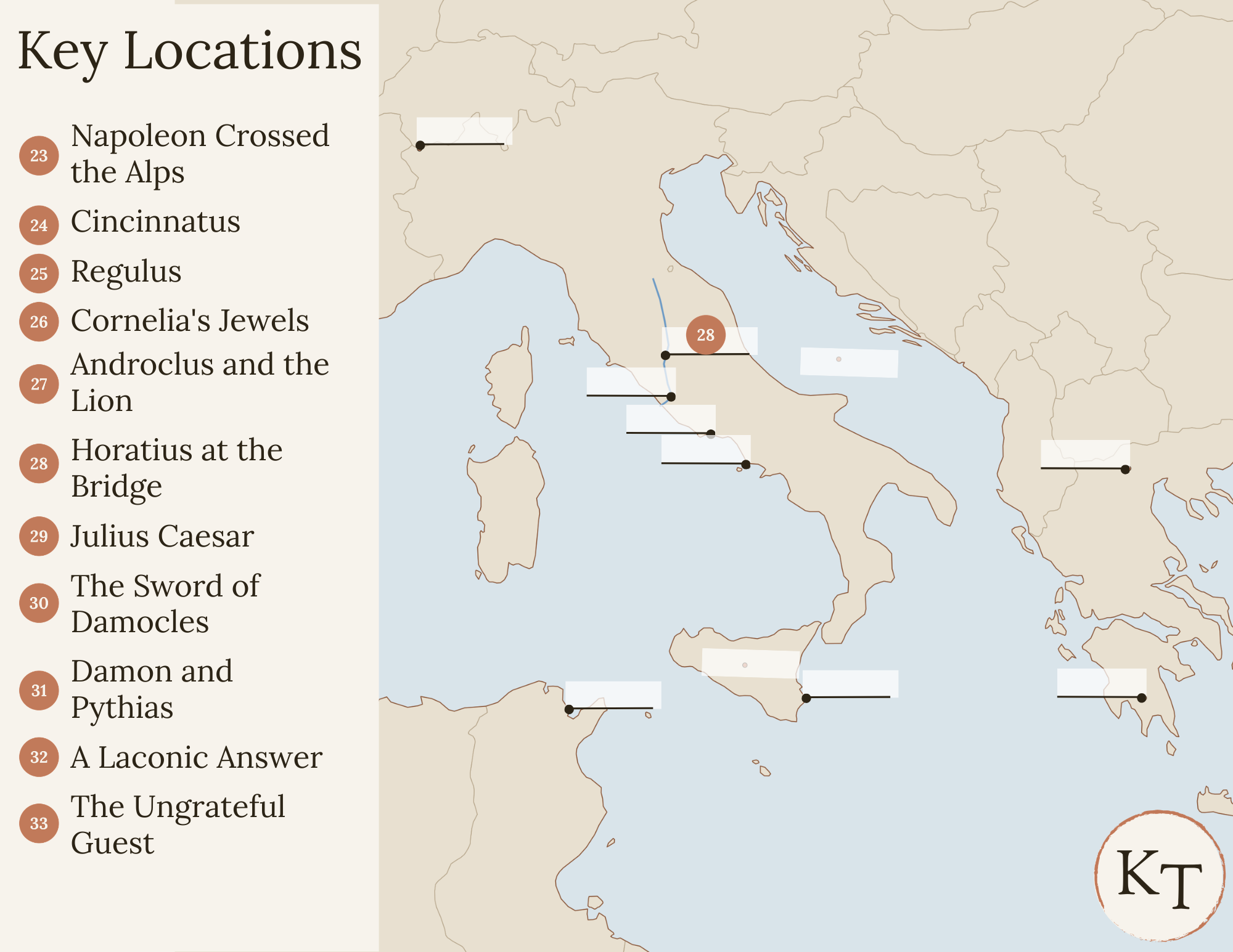
This matches the map in your Lesson Guide.
The Books come Alive!
Read or listen to Chapter 28 of Fifty Famous Stories Retold, the Kindred Thicket Enhanced Edition, read by Laura Caldwell.
Read by Laura Caldwell for LibriVox (public domain), professionally adjusted and trimmed by Kindred Thicket.
What do the Teacher’s Notes tell us about Chapter 28 of Fifty Famous Stories Retold?Parent review
This is a Kindred Thicket Enhanced Edition. Baldwin’s 1896 words are read exactly as he wrote them, and we add Teacher’s Notes with historical and literary context.
- About the whole bookFifty Famous Stories Retold gathers real history together with well-loved legends and traditions. These notes tell you, story by story, which is which.
- This chapterHoratius holding the bridge is a famous old Roman legend, first mentioned by the historian Polybius. The stirring verses here come from a much later poem, Macaulay's Lays of Ancient Rome of 1842, not from ancient times.
Memory becomes Action!
Use the Response Resource* to remember and spell tricky names. Choose one way to narrate.
*Materials in the Lesson Guide.
What is the list of names, people, characters, and places that are important in Chapter 28 of Fifty Famous Stories Retold?Horatius, Porsena, The Etruscans, The Tiber, The two who stood by him, Rome, The white-haired FathersHave a look
- Horatius: A Roman hero of the old stories, called Horatius Cocles, which meant the one-eyed Horatius.
- Porsena: Lars Porsena, king of the Etruscans, who raises a great army and marches on Rome.
- The Etruscans: A real neighboring people who lived in towns on the far side of the Tiber.
- The Tiber: The real river that rolls by the walls of Rome.
- The two who stood by him: The pair of Romans who hold the road beside Horatius while the bridge comes down.
- Rome: The city in the greatest danger it had ever known.
- The white-haired Fathers: The lawmakers of Rome, that is, the Roman Senate.
Chapter 28 Q & A
This is a Kindred Thicket Enhanced Edition. Baldwin’s stories mingle real history with beloved legend, and here is what to know about this one.
Is Horatius at the Bridge true history or a legend?
Horatius holding the bridge is a famous old Roman legend, first mentioned by the historian Polybius. The stirring verses here come from a much later poem, Macaulay's Lays of Ancient Rome of 1842, not from ancient times. So the brave stand is a treasured legend, and the poetry woven in is modern rather than old.
Where do the poem's verses come from?
The ringing lines quoted in the chapter are from Lays of Ancient Rome, a book of poems written by Lord Macaulay in 1842. They are far newer than the ancient legend itself. Baldwin borrows Macaulay's verses to give the story its stirring sound, but they should be read as fine nineteenth-century poetry, not as an ancient record.
Was there really a Horatius?
The Romans told of a hero named Horatius Cocles, whose name meant the one-eyed Horatius, who guarded a bridge over the River Tiber against an invading army. The historian Polybius mentions the tale, but it may well be legend rather than fact. It is best loved as an old story of courage rather than proven history.
Is the part about his eye too frightening for children?
The story tells briefly that Horatius lost an eye to a thrown dart as he defended the bridge. It is stated simply and without any gory detail, so most children hear it as a mark of his bravery. Parents who wish to may look over the chapter first, but the scene is mild and quickly passes.