The Listening Grove · Fifty Famous Stories Retold
Chapter 30: The Sword of Damocles
A Charlotte Mason read-aloud lesson. Press play, with the lesson.
What is Fifty Famous Stories Retold Chapter 30, The Sword of Damocles, about?Parent review
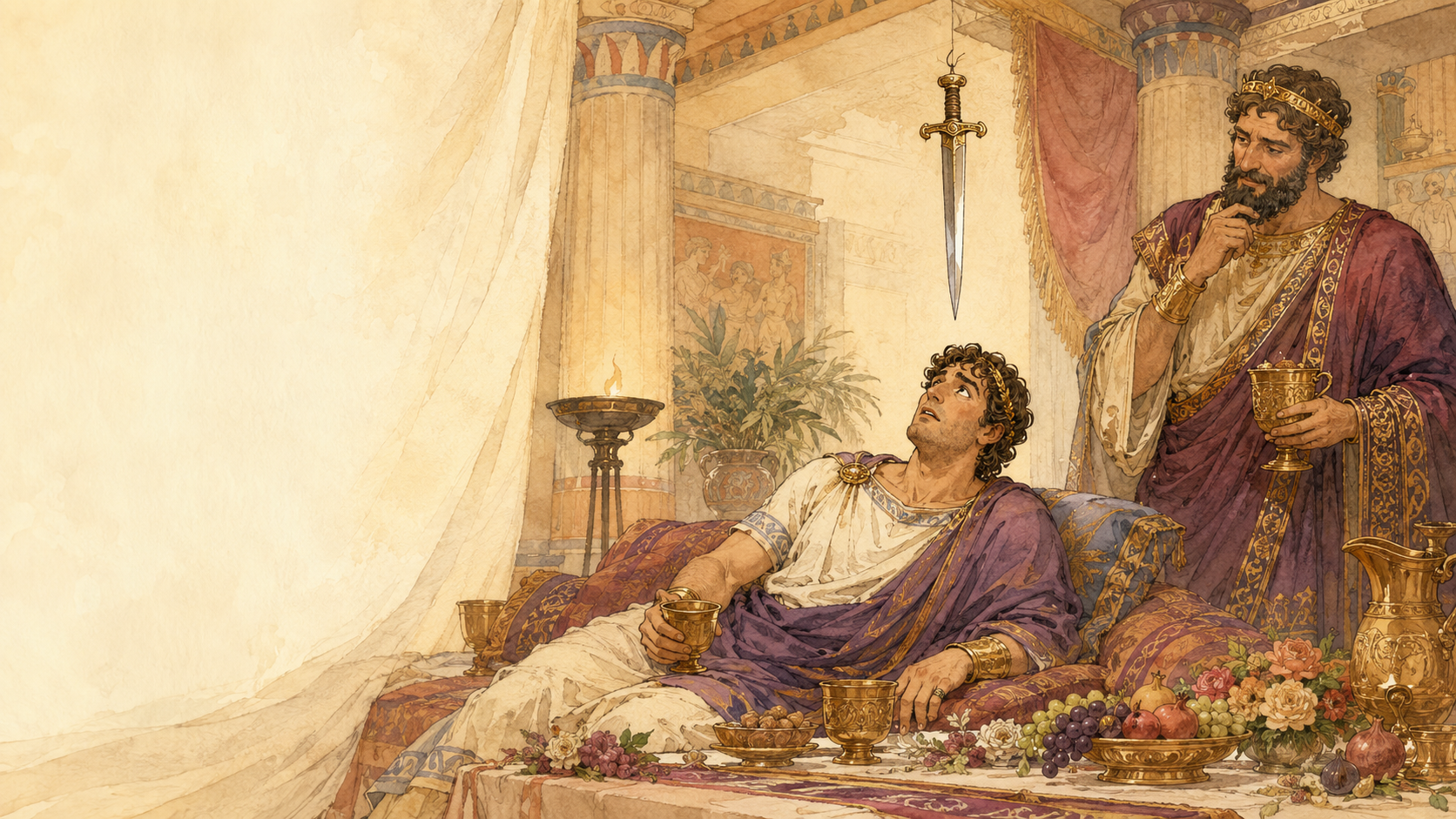
Fifty Famous Stories Retold Chapter 30, The Sword of Damocles, is a short tale about the hidden burdens of power. Dionysius, the ruler of Syracuse, was so harsh that he earned the name of tyrant. His friend Damocles kept saying that no man could be happier than a king. So Dionysius let him take the royal seat for a day, amid rich food, music, and every comfort. But above the seat hung a sharp sword, held only by a single hair from a horse's tail. Damocles could enjoy nothing under that danger and soon begged to leave. He learned that the great and powerful are not as happy as they seem.
Say what you remember!
Tell what you remember from the last chapter.
What happened in Fifty Famous Stories Retold Chapter 29, Julius Caesar?Have a look
In the last chapter, Julius Caesar, we met one of the greatest of the Romans, a brave soldier and conqueror who made himself master of Rome nearly two thousand years ago. Two well-known sayings showed his character. Passing through a poor little village, he said he would rather be the first man there than the second man in Rome. Crossing a narrow sea in a fierce storm, he told the frightened captain there was nothing to fear, for Caesar was in his boat. Together the sayings painted a picture of his great ambition and his steady, fearless courage.
Read the previous lesson: Julius Caesar →Show what you know!
Use your printable Lesson Guide. Fill in the vocabulary you know, then click to check your work and learn some new words today.
What are the difficult or advanced vocabulary words in Fifty Famous Stories Retold Chapter 30, The Sword of Damocles?tyrant, banquet, dangle, dreadHave a look
- tyrant: a ruler who uses power cruelly
- banquet: a grand and lavish feast
- dangle: to hang loosely and swing freely
- dread: great fear of something coming
Locate it on the map!
Use your printable Lesson Guide. Use an atlas and fill in the blank map if you can find the geographic location, then click to check your work.
What important geographic location connects with Fifty Famous Stories Retold Chapter 30, The Sword of Damocles?
- Find Syracuse (Sicily, Italy): the Greek city ruled by the tyrant Dionysius
See it on the mapHave a look
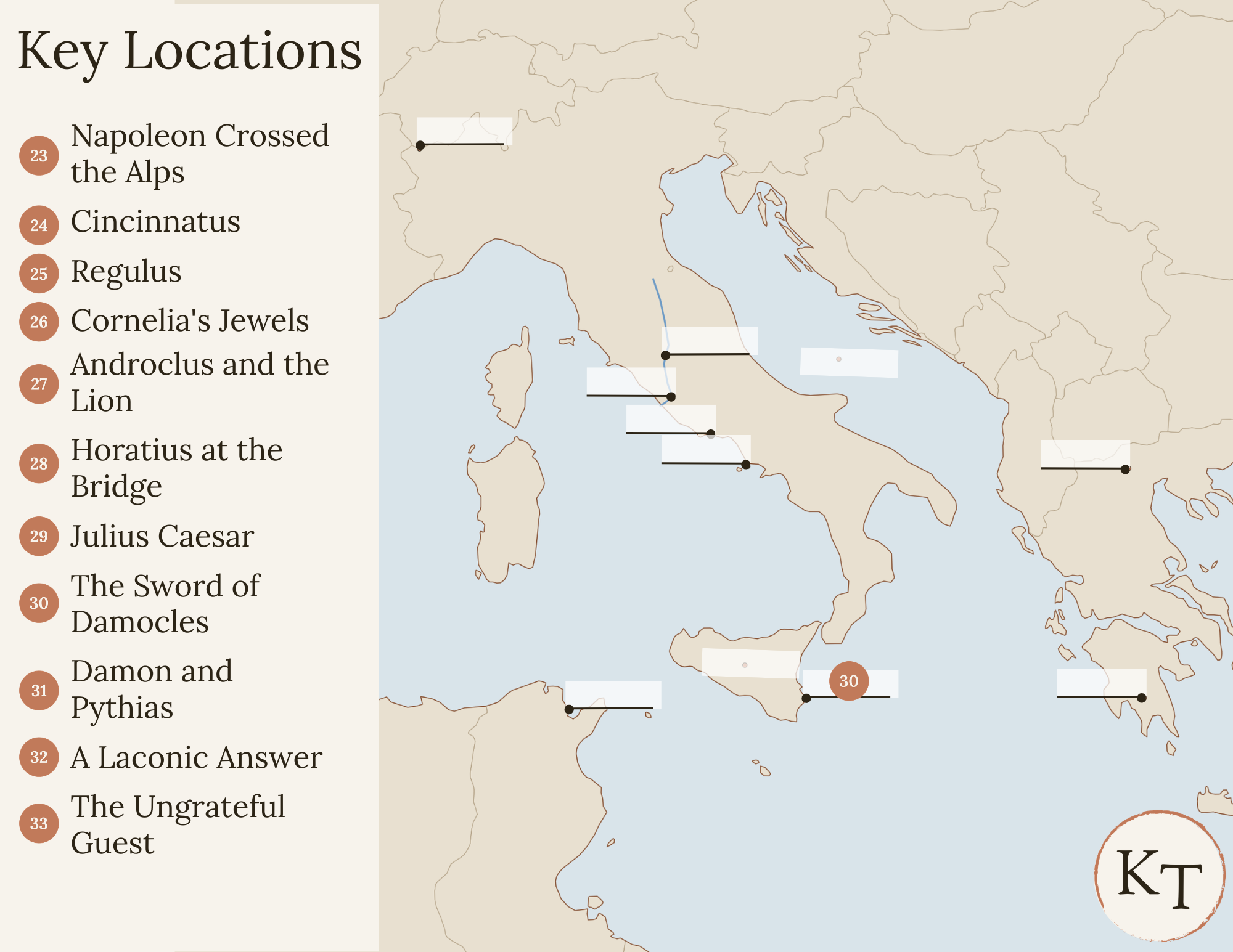
This matches the map in your Lesson Guide.
The Books come Alive!
Read or listen to Chapter 30 of Fifty Famous Stories Retold, the Kindred Thicket Enhanced Edition, read by Laura Caldwell.
Read by Laura Caldwell for LibriVox (public domain), professionally adjusted and trimmed by Kindred Thicket.
What do the Teacher’s Notes tell us about Chapter 30 of Fifty Famous Stories Retold?Parent review
This is a Kindred Thicket Enhanced Edition. Baldwin’s 1896 words are read exactly as he wrote them, and we add Teacher’s Notes with historical and literary context.
- About the whole bookFifty Famous Stories Retold gathers real history together with well-loved legends and traditions. These notes tell you, story by story, which is which.
- This chapterDionysius was a real ruler of Syracuse, but the sword of Damocles is a moral anecdote, first told by the Roman writer Cicero. It is meant to teach that great power carries constant worry, not to record a real feast.
Memory becomes Action!
Use the Response Resource* to remember and spell tricky names. Choose one way to narrate.
*Materials in the Lesson Guide.
What is the list of names, people, characters, and places that are important in Chapter 30 of Fifty Famous Stories Retold?Dionysius, DamoclesHave a look
- Dionysius: A real ruler of the Greek city of Syracuse, so unjust and cruel that he won for himself the name of tyrant.
- Damocles: A friend of the tyrant, who thinks no man alive could be happier than a king.
Chapter 30 Q & A
This is a Kindred Thicket Enhanced Edition. Baldwin’s stories mingle real history with beloved legend, and here is what to know about this one.
Is The Sword of Damocles true history or a legend?
Dionysius was a real ruler of Syracuse, but the sword of Damocles is a moral anecdote, first told by the Roman writer Cicero. It is meant to teach that great power carries constant worry, not to record a real feast. So the ruler is history, while the famous sword is a teaching story.
Who was Dionysius?
Dionysius was a real ruler of the Greek city of Syracuse, on the island of Sicily. He governed so harshly that he earned the name of tyrant. While Dionysius truly lived, the tale of the hanging sword was told about him later by the writer Cicero to make a point about the burdens that come with power.
Who first told the story of the sword?
The anecdote comes down to us from the Roman writer Cicero, in a book where he discussed happiness and the mind. Because Cicero shaped it as a moral lesson, it is remembered as a teaching story rather than a recorded event. Its point is that the powerful live under constant, hidden worry, like a sword hung overhead.
What does the story teach children?
It teaches that riches and power are not as happy as they look from outside. Damocles envies the king until he feels the danger that hangs over the throne, and then he is glad to give it back. The gentle lesson is one of contentment: to be thankful for a simple, peaceful life rather than longing for another's place.