The Listening Grove · Fifty Famous Stories Retold
Chapter 9: The Black Douglas
A Charlotte Mason read-aloud lesson. Press play, with the lesson.
What is Fifty Famous Stories Retold Chapter 9, The Black Douglas, about?Parent review
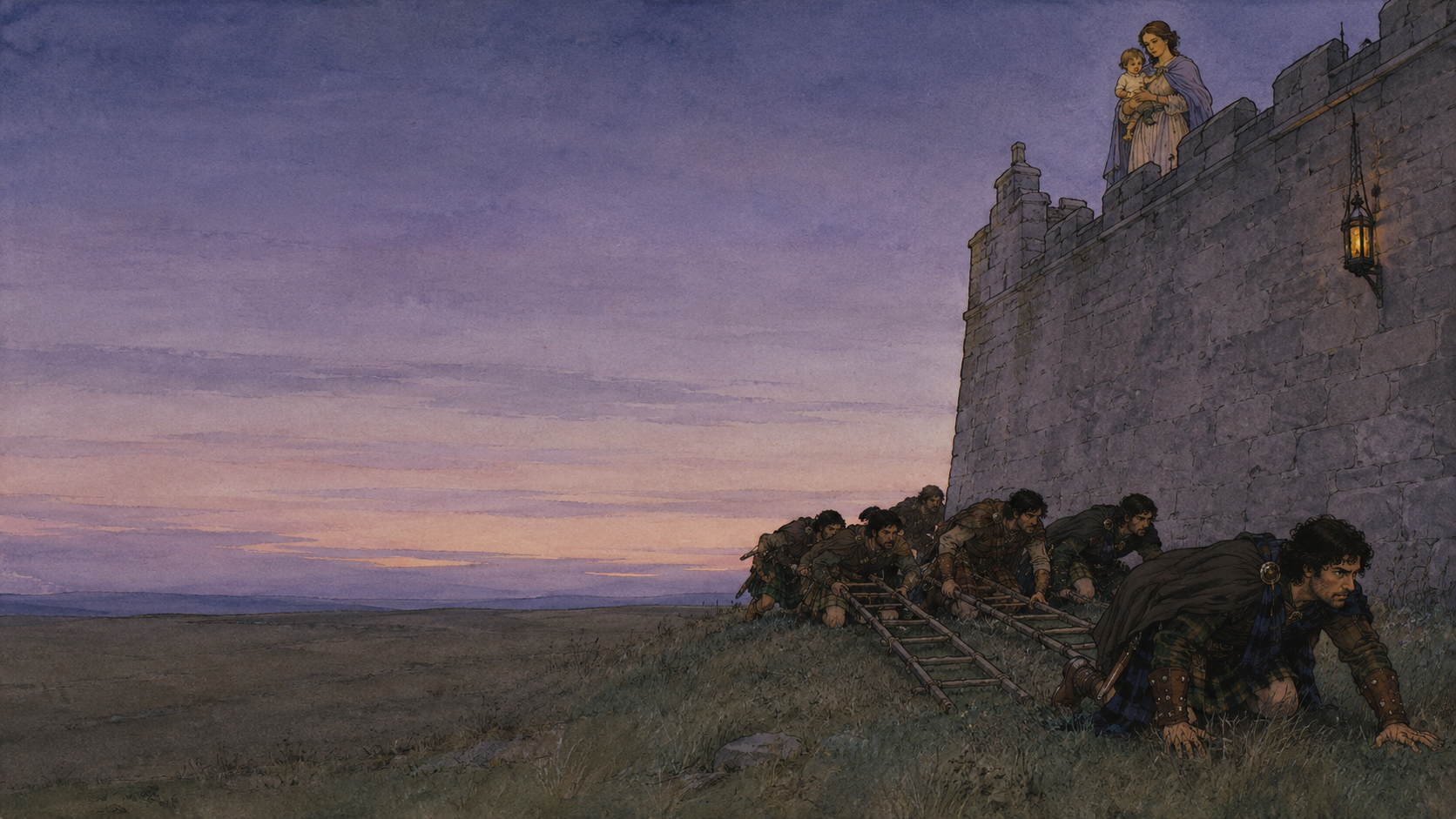
Fifty Famous Stories Retold Chapter 9, The Black Douglas, is the book's one tale of real suspense. Sir James Douglas, a dark-haired warrior so feared that English mothers hushed their children with his name, means to win back a castle held by the English. In the dusk, he and his men wrap themselves in dark cloaks and creep toward the walls on hands and knees. A watchman on the castle sees the dark shapes moving below but mistakes them for a farmer's stray cattle. On the wall an Englishwoman sings a song about the dreaded Black Douglas to quiet her child, never guessing he is near. It is a taut, shadowy story of a daring night attack.
Say what you remember!
Tell what you remember from the last chapter.
What happened in Fifty Famous Stories Retold Chapter 8, Bruce and the Spider?Have a look
In the last chapter, Bruce and the Spider, Robert Bruce, the king of Scotland, had been beaten six times by the English and lay hiding, weary and discouraged, in a lonely shelter. As he lay there he watched a little spider try again and again to swing its thread to a beam overhead. Six times it failed, just as he had failed. But on the seventh try the spider succeeded. Bruce took heart from the small brave creature, rose up, called his men together, and at last won his own battle. It was a stirring lesson in never giving up.
Read the previous lesson: Bruce and the Spider →Show what you know!
Use your printable Lesson Guide. Fill in the vocabulary you know, then click to check your work and learn some new words today.
What are the difficult or advanced vocabulary words in Fifty Famous Stories Retold Chapter 9, The Black Douglas?gruff, suffer, deeds, duskHave a look
- gruff: rough, deep, and unfriendly in sound
- suffer: to allow or permit something (an older meaning)
- deeds: things that are done; actions, often brave ones
- dusk: the dim light at the end of the day, just before dark
Locate it on the map!
Use your printable Lesson Guide. Use an atlas and fill in the blank map if you can find the geographic location, then click to check your work.
What important geographic location connects with Fifty Famous Stories Retold Chapter 9, The Black Douglas?
- Find Roxburgh Castle (Scottish Borders, Scotland).
See it on the mapHave a look
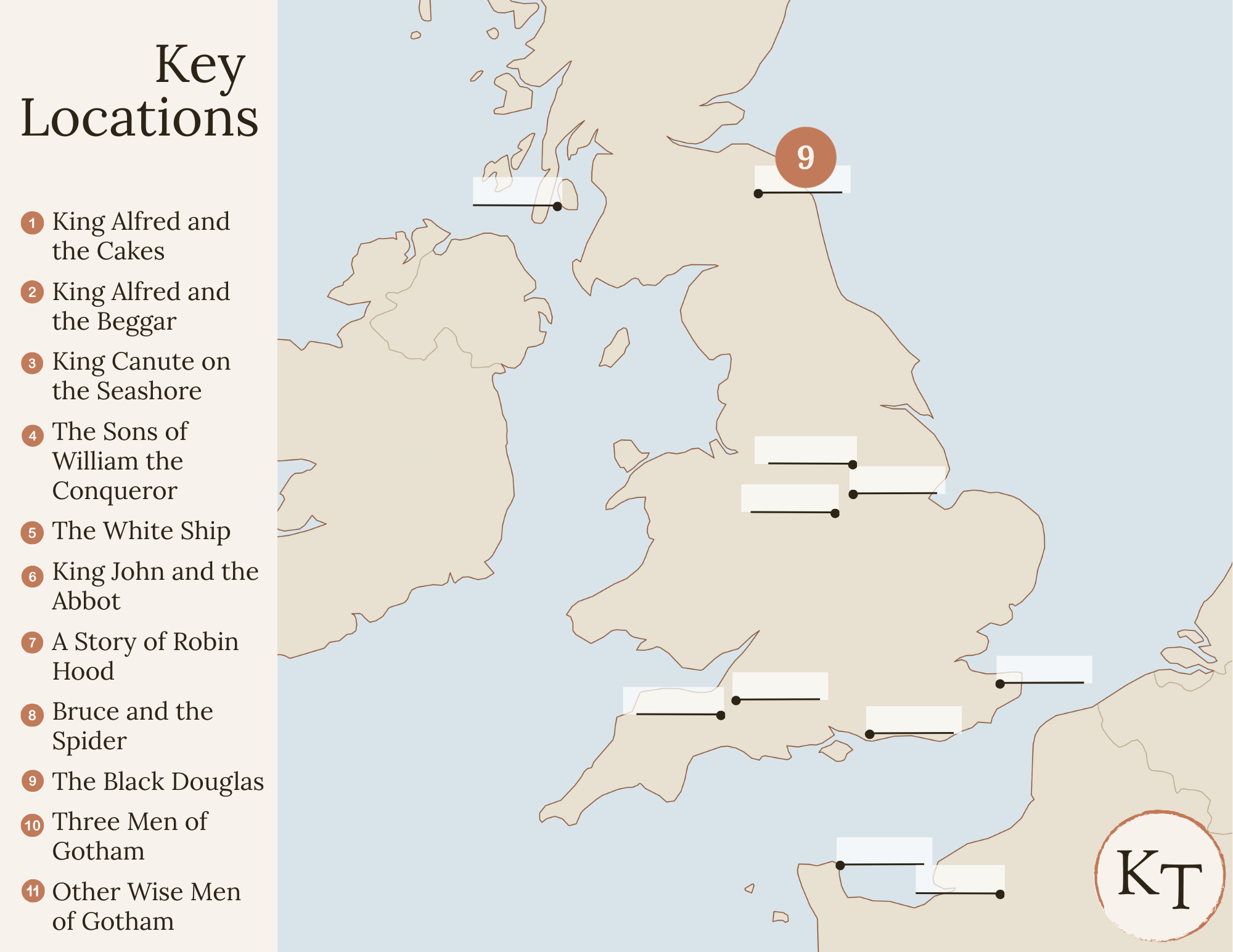
This matches the map in your Lesson Guide.
The Books come Alive!
Read or listen to Chapter 9 of Fifty Famous Stories Retold, the Kindred Thicket Enhanced Edition, read by Laura Caldwell.
Read by Laura Caldwell for LibriVox (public domain), professionally adjusted and trimmed by Kindred Thicket.
What do the Teacher’s Notes tell us about Chapter 9 of Fifty Famous Stories Retold?Parent review
This is a Kindred Thicket Enhanced Edition. Baldwin’s 1896 words are read exactly as he wrote them, and we add Teacher’s Notes with historical and literary context.
- About the whole bookFifty Famous Stories Retold gathers real history together with well-loved legends and traditions. These notes tell you, story by story, which is which.
- This chapterThe Black Douglas was Sir James Douglas, one of Bruce's chief commanders; his dark coloring gave the name.
- This chapterDouglas was so feared that mothers really did hush children with the Black Douglas shall not get ye.
- This chapterThis matches Douglas's real night capture of Roxburgh Castle in 1314, his men crawling in the dark and scaling the walls.
- This chapterThe scene of the woman singing on the wall is a traditional storytelling touch that cannot be verified.
Memory becomes Action!
Use the Response Resource* to remember and spell tricky names. Choose one way to narrate.
*Materials in the Lesson Guide.
What is the list of names, people, characters, and places that are important in Chapter 9 of Fifty Famous Stories Retold?The Black Douglas (Sir James Douglas), King Robert Bruce, The Soldier's Wife, The Watchman, ScotlandHave a look
- The Black Douglas (Sir James Douglas): Bruce's dark-haired, greatly feared warrior, who retook the castle by creeping up on it in the dusk.
- King Robert Bruce: The king of Scotland whom Douglas served as one of his strongest helpers.
- The Soldier's Wife: The Englishwoman on the wall who sang of the Black Douglas and was spared, with her child, when he appeared.
- The Watchman: The guard who mistook the crawling Scots for the farmer's stray cattle.
- Scotland: The land Douglas and Bruce fought to free from English control.
Chapter 9 Q & A
This is a Kindred Thicket Enhanced Edition. Baldwin’s stories mingle real history with beloved legend, and here is what to know about this one.
Is the story of the Black Douglas true?
Much of it is real history. The daring night attack matches Sir James Douglas's true capture of Roxburgh Castle in 1314, when his men crawled through the dark and scaled the walls. One storybook touch, the Englishwoman singing on the wall, is a traditional flourish that cannot be verified. So the tale mixes a real event with a memorable added scene.
Who was the Black Douglas?
The Black Douglas was Sir James Douglas, one of Robert Bruce's chief commanders in Scotland's war with England. His dark hair and coloring gave him the name. He was so feared by his enemies that English mothers really did hush their children with the warning that the Black Douglas would get them if they did not behave.
Did the night attack really happen?
Yes. The heart of the tale is real. Sir James Douglas truly did retake Roxburgh Castle in 1314 by a night surprise, his men creeping up in the dark and climbing the walls before the guards knew they were there. Baldwin follows this real event closely, which is why the story feels so full of genuine suspense.
Did the woman really sing on the wall?
We cannot know. The scene of the Englishwoman singing to her child on the castle wall is a traditional storytelling touch, the kind of detail added to bring a scene to life. It cannot be verified from history. It heightens the drama beautifully, but it belongs to the telling of the tale rather than to the record of the real attack.