The Listening Grove · Viking Tales
Chapter 5: Foes'-Fear
A Charlotte Mason history read-aloud lesson. Press play, with the lesson.
What is Viking Tales Chapter 5, Foes'-Fear, about?Parent review
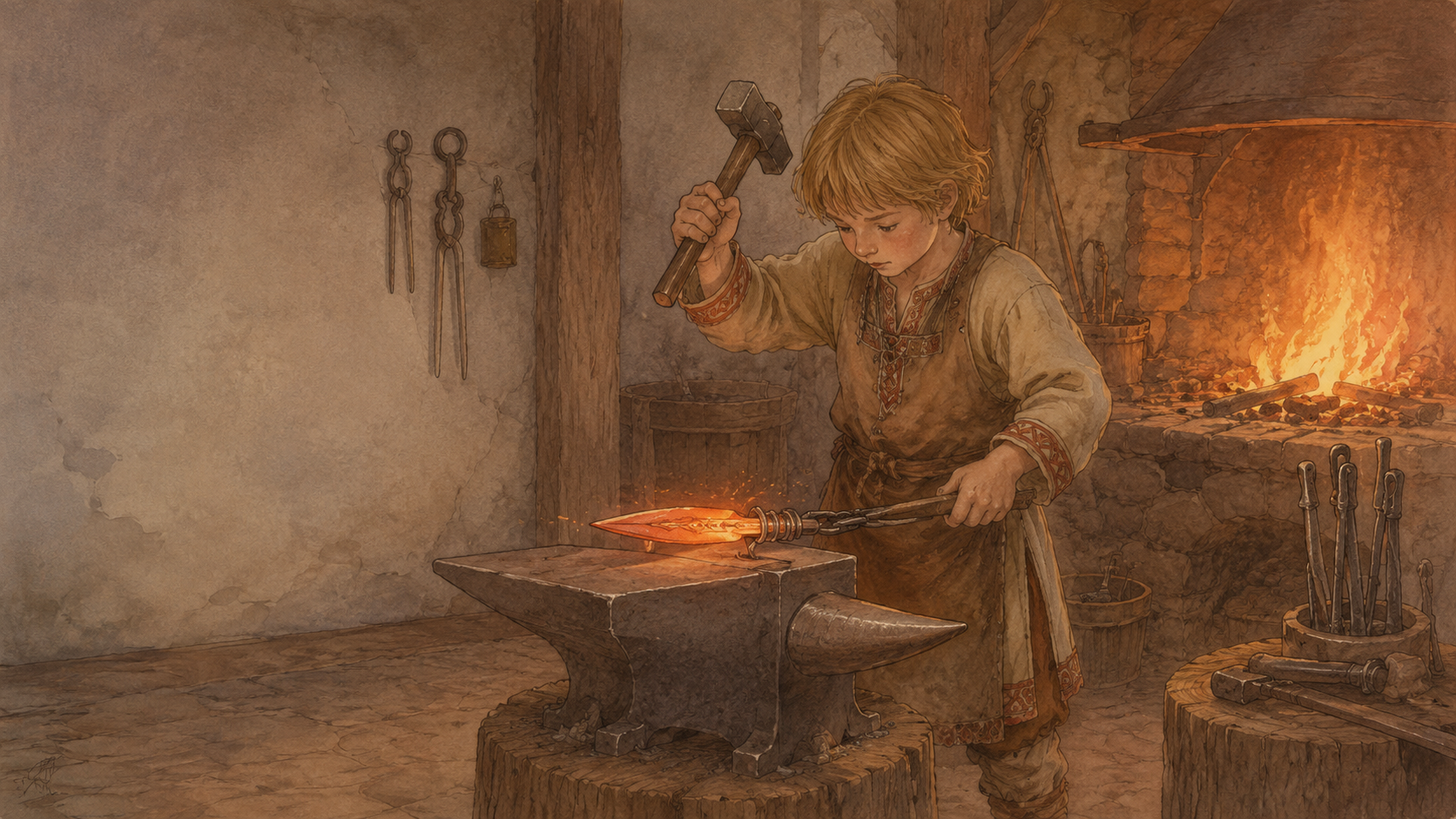
Viking Tales Chapter 5, Foes'-Fear, shows Harald growing from a listening boy into a young warrior. Filled with Olaf's stories, he longs to go a-viking and see the wide world, and he names the foreign goods vikings bring home from France, Greece, Rome, and Arabia. But Harald does more than dream. He trains hard: feeding the hunting dogs, swimming, riding, shooting the bow, playing the harp, and working at the smithy. There he forges a two-foot spear-head and beats runes into it, naming it Foes'-Fear. Going out on skees one deep-snow winter day to cut an ash pole for the handle, he is set upon by a wolf and kills it with the spear-point, taking his first wound. He finishes the spear with gold bands and shows the wound to Thorstein, who says he bears it like a true warrior.
Say what you remember!
Tell what you remember from the last chapter.
What happened in Viking Tales Chapter 4, Olaf's Fight with Havard?Have a look
In Chapter 4, Olaf's Fight with Havard, Olaf told Harald of a night his crew was trapped in a farmhouse by King Havard and two hundred fighters beating at the barred doors. As the men braced for a last stand, Thorkel fell through a cupboard panel and found a hidden passage. Most of the crew slipped away in the dark while ten held the doors, and Havard's men struck one another in the confusion. Olaf fought his way to the ship, having already disabled Havard's boats, and escaped by sea, though brave Hakon was killed by a spear.
Read the previous lesson: Olaf's Fight with Havard →Show what you know!
Use your printable Lesson Guide. Fill in the vocabulary you know, then click to check your work and learn some new words today.
What are the difficult or advanced vocabulary words in Viking Tales Chapter 5, Foes'-Fear?smithy, bellows, chasm, haftHave a look
- smithy: the workshop where a smith works
- bellows: a tool that blows air to make a fire hotter
- chasm: a deep crack or gap in the earth
- haft: the handle of a weapon or tool
Locate it on the map!
Use your printable Lesson Guide. Use an atlas and fill in the blank map if you can find the geographic location, then click to check your work.
What important geographic locations connect with Viking Tales Chapter 5, Foes'-Fear?
- Find the Arabian Peninsula: Vikings traded even with the hot, sandy land they called Arabia, today's Arabian Peninsula.
See these places on the mapHave a look
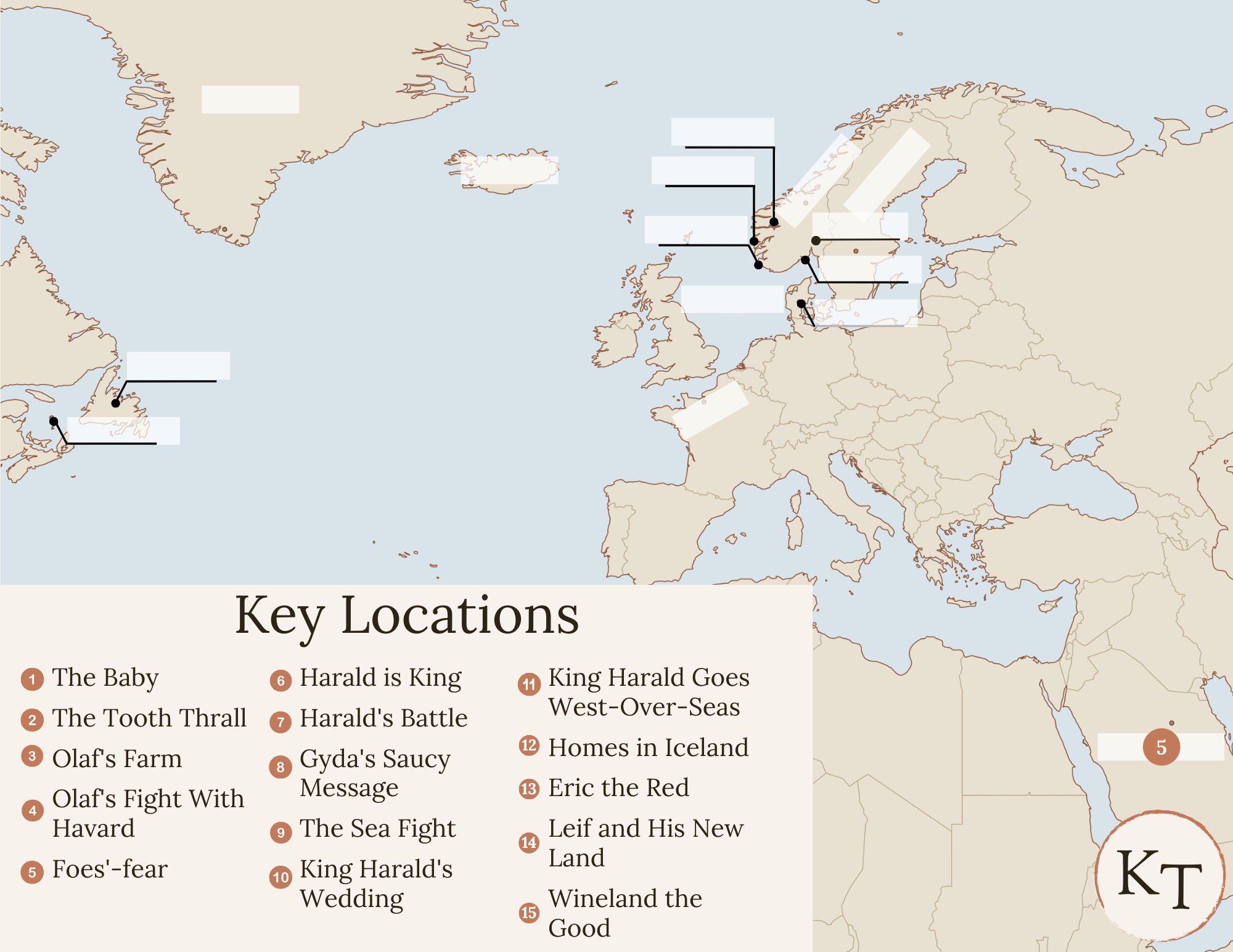
These match the map in your Lesson Guide.
The Books come Alive!
Read or listen to Chapter 5 of Viking Tales, the Kindred Thicket Enhanced Edition, read by Faerie Book Mama.
Read by Faerie Book Mama for LibriVox (public domain), professionally adjusted and trimmed by Kindred Thicket.
What historical context goes with Chapter 5 of Viking Tales?Parent review
This is a Kindred Thicket Enhanced Edition. Jennie Hall’s 1902 words are read exactly as she wrote them, and we add Teacher’s Notes with historical and cultural context.
- About the whole bookViking Tales is Jennie Hall’s 1902 retelling of old Norse stories drawn from the sagas, such as the Heimskringla and the Vinland sagas. These weave real history together with legend, so the tales are best enjoyed as saga tradition rather than exact history.
Memory becomes Action!
Use the Response Resource* to remember and spell tricky names. Choose one way to narrate.
*Materials in the Lesson Guide.
What is the list of names, people, characters, and places that are important in Chapter 5 of Viking Tales?Harald, Olaf, Ivar the Far-goer, Thorstein, Foes'-fear, Thor, Odin, ValhallaHave a look
- Harald: Halfdan's son, now a boy called Harald Halfdanson, training to be a warrior.
- Olaf: Harald's tooth thrall and storyteller.
- Ivar the Far-goer: A well-traveled warrior who teaches Harald harp and song; he has seen Arabia, France, Greece, and Rome.
- Thorstein: One of the king's men, who teaches Harald to swim.
- Foes'-fear: The two-edged spear Harald forges and names, marked with runes.
- Thor: The Norse thunder-god of Olaf's tales.
- Odin: The chief of the Norse gods; unknown, Ivar says, to the far people of Arabia.
- Valhalla: The Norse hall of heroes that Harald dreams of entering.
Chapter 5 Q & A
This is a Kindred Thicket Enhanced Edition. We keep Jennie Hall’s 1902 words as written and add historical context. Here are common questions about this chapter.
What happens in Chapter 5 of Viking Tales?
In Chapter 5, Foes'-Fear, Harald grows into a young warrior. He longs for viking life and trains in swimming, riding, archery, harp, and smithing. He forges a spear-head, cuts runes into it, and names it Foes'-Fear. Going out on skees to cut a handle, he is attacked by a wolf, kills it with the spear-point, and takes his first wound bravely.
What is Foes'-Fear in Viking Tales?
Foes'-Fear is the spear Harald forges himself in Chapter 5, a two-foot spear-head with runes beaten into it and finished with gold bands. Naming a weapon was a Norse custom, and Foes'-Fear becomes Harald's signature weapon in his later battles. Its making shows Harald's skill at the smithy as well as his readiness for war.
What are runes in Viking Tales?
Runes are the letters of the Norse alphabet, and in Chapter 5 Harald beats them into his spear-head to spell its name, Foes'-Fear. Runes also appear on Olaf's thrall-collar earlier in the book. Reading and writing were rare skills in the Norse world, so runes carried special meaning, a point the Teacher's Notes help parents explain.
What foreign lands are mentioned in Chapter 5 of Viking Tales?
Chapter 5 names France, Greece, Rome, and Arabia as far-off lands the vikings reached through raiding and trade. Harald lists the goods they brought home: striped cloth and sweet-smelling waters from Arabia, cloak-pins from Greece, golden cups from Rome, and a cape from France. These names show how widely the Norse traveled and traded across the known world.