The Listening Grove · Aesop's Fables
Fable 1: The Wolf and the Kid
A Charlotte Mason fable lesson. Press play, with the lesson.
What is Aesop's fable The Wolf and the Kid about?Parent review
Aesop's Fable 1, The Wolf and the Kid, is a short tale about letting yourself be turned aside from what matters. A little Kid, proud of his growing horns, ignores his mother's call and stays behind nibbling grass until the flock is gone and night is falling. A Wolf finds him, and the quick-thinking Kid begs for one tune to dance to before he is eaten. The Wolf, pleased with the idea of music before his meal, pipes a merry song, but the shepherd dogs hear it, know it at once for the Wolf's feasting-song, and race back to the rescue. The Wolf runs off with the dogs at his heels, scolding himself for turning piper when he should have stuck to his butcher's trade.
The Books come Alive!
Read or listen to The Wolf and the Kid, the Kindred Thicket Revised Edition.
Read by Kindred Thicket, from the Kindred Thicket Revised Edition.
Read along with the fableRead along
There was once a little Kid whose growing horns made him think he was a grown-up Billy Goat and able to take care of himself. So one evening when the flock started home from the pasture and his mother called, the Kid paid no heed and kept right on nibbling the tender grass. A little later when he lifted his head, the flock was gone.
He was all alone. The sun was sinking. Long shadows came creeping over the ground. A chilly little wind came creeping with them making scary noises in the grass. The Kid shivered as he thought of the terrible Wolf. Then he started wildly over the field, bleating for his mother. But not half-way, near a clump of trees, there was the Wolf!
The Kid knew there was little hope for him.
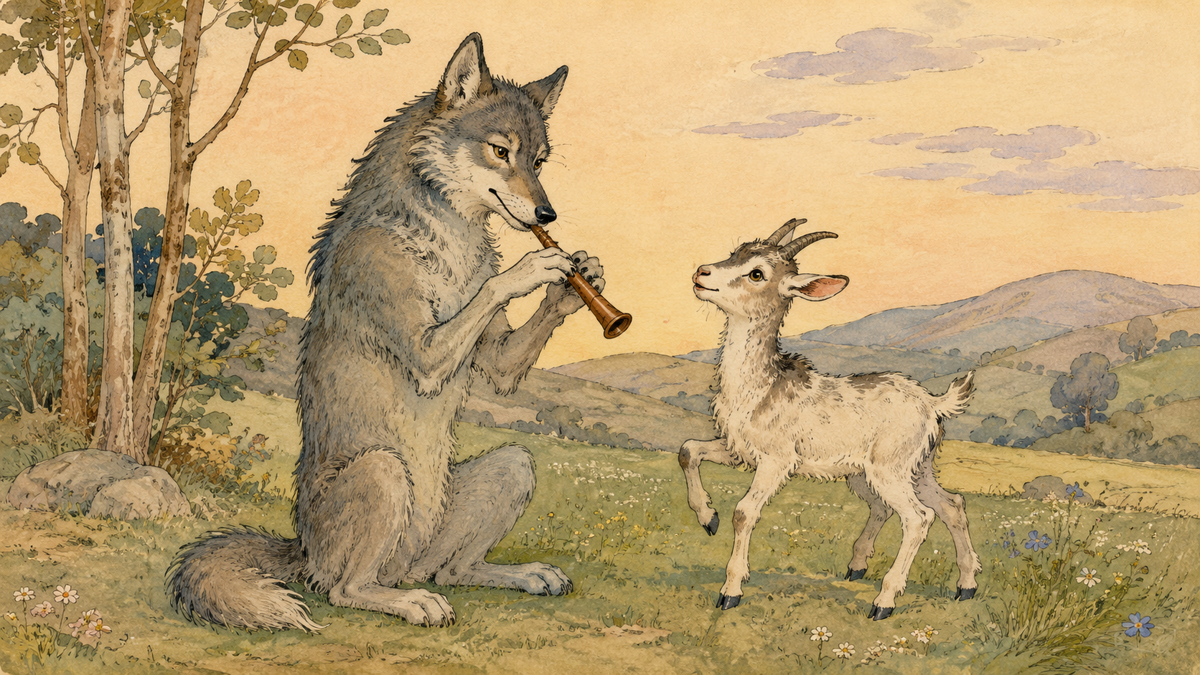
"Please, Mr. Wolf," he said trembling, "I know you are going to eat me. But first please pipe me a tune, for I want to dance and be merry as long as I can."
The Wolf liked the idea of a little music before eating, so he struck up a merry tune and the Kid leaped and frisked gaily.
Meanwhile, the flock was moving slowly homeward. In the still evening air the Wolf's piping carried far. The Shepherd Dogs pricked up their ears. They recognized the song the Wolf sings before a feast, and in a moment they were racing back to the pasture. The Wolf's song ended suddenly, and as he ran, with the Dogs at his heels, he called himself a fool for turning piper to please a Kid, when he should have stuck to his butcher's trade.
Memory becomes Action!
Use the character cards* to remember who is in the fable. Choose one way to narrate.
*Character cards are free with the email list; the Composition Prompt and Drawn Narration Sheet are in the Companion Guide.
What is the list of the names, people, characters, and places that are important in Aesop's fable The Wolf and the Kid?The Kid, The Mother Goat, The Wolf, The Shepherd Dogs, The pasture and fieldHave a look
- The Kid: A young goat with small budding horns, proud enough to think he can mind himself; he strays from the flock at dusk.
- The Mother Goat: The Kid's mother, who calls the flock home from the pasture when evening comes.
- The Wolf: A lean, sly wolf who finds the straying Kid and is coaxed into piping a tune before his meal.
- The Shepherd Dogs: The farm dogs who know the Wolf's feasting-song and come racing back to drive him off.
- The pasture and field: The place the fable happens: the open pasture the flock leaves and the field where the Kid is caught at nightfall.
What is the moral of Aesop's fable The Wolf and the Kid?Have a look
“Do not let anything turn you from your purpose.”
The Wolf had already caught his supper, but he let the Kid tempt him into piping a tune. That delay gave the shepherd dogs time to hear the song and drive him off, and he lost his meal.
The Wolf and the Kid Q & A
Common questions about this fable: the other titles it goes by, where it comes from, its lesson, and how to help your child narrate it.
Is "The Wolf and the Kid" the same as "The Kid and the Wolf"?
They sound alike, but they are two different fables, so it is worth knowing which you have. In this one, "The Wolf and the Kid," a young goat is caught by the wolf and buys himself time by asking the wolf to pipe a tune, and the music brings the shepherd dogs running. The other fable, "The Kid and the Wolf," is about a kid safe on a rooftop who jeers at a wolf below. You will also see this story called "The Wolf and the Young Goat." Look for the piping wolf and the dancing kid, and you have the right one.
Where does this fable come from, and where else will my child meet it?
It belongs to the old Greek collection gathered under Aesop's name, and it carries a proverb older than most: the wolf who "turned piper" and lost his dinner by stopping for a tune. It is one of a whole family of fables about the cunning wolf outwitted, so a child who knows it will recognize the pattern again and again in her reading, wherever a schemer is undone by his own distraction.
What is the lesson, and do I need to explain it?
The kid keeps his purpose in mind and the wolf loses his by getting distracted, so the fable quietly teaches, in the words of the old text, not to let anything turn you from your purpose. You do not need to announce that. Charlotte Mason found that children "readily appropriate the moral" of a fable on their own (Towards a Philosophy of Education, Vol. 6). Read it well and let the point arrive.
How do I help my child narrate this one?
Read it once, then ask her to tell it back. If she pauses, one prompt restarts her: "What did the kid ask the wolf to do, and who heard the music?" For a child who is not yet writing, let her draw the moment the dogs came racing back, and let the picture be her telling. If she likes something to hold, the character cards in the free bonus materials give her the wolf, the kid, and the dogs to move as she talks.