The Listening Grove · Aesop's Fables
Fable 2: The Tortoise and the Ducks
A Charlotte Mason fable lesson. Press play, with the lesson.
What is Aesop's fable The Tortoise and the Ducks about?Parent review
Aesop's Fable 2, The Tortoise and the Ducks, is a tale about vanity and knowing when to keep quiet. The Tortoise, who carries his house on his back and cannot travel far, grows sad watching the birds and animals roam freely. Two kind Ducks offer to carry him high into the sky on a stick held in his teeth, warning him to stay silent. All goes well until a passing Crow calls him the King of Tortoises. Too proud to let the flattery pass, the Tortoise opens his mouth to reply, loses his grip on the stick, and falls to the ground.
Say what you remember!
Tell what you remember from the last fable.
What happened in Aesop's fable The Wolf and the Kid?Have a look
In the last fable, The Wolf and the Kid, a little Kid stayed behind nibbling grass when his mother called the flock home, and found himself alone at nightfall with a hungry Wolf. He begged the Wolf to pipe him a tune so he could dance first. The Wolf agreed, but his piping carried far, and the shepherd dogs knew it at once for the Wolf's feasting-song and came racing back to drive him off.
Back to the previous lesson: The Wolf and the Kid →The Books come Alive!
Read or listen to The Tortoise and the Ducks, the Kindred Thicket Revised Edition.
Read by Kindred Thicket, from the Kindred Thicket Revised Edition.
Read along with the fableRead along
The Tortoise, you know, carries his house on his back. No matter how hard he tries, he cannot leave home. They say that Jupiter punished him so, because he was such a lazy stay-at-home that he would not go to Jupiter's wedding, even when especially invited.
After many years, Tortoise began to wish he had gone to that wedding. When he saw how gaily the birds flew about and how the Hare and the Chipmunk and all the other animals ran nimbly by, always eager to see everything there was to be seen, the Tortoise felt very sad and discontented. He wanted to see the world too, and there he was with a house on his back and little short legs that could hardly drag him along.
One day he met a pair of Ducks and told them all his trouble.
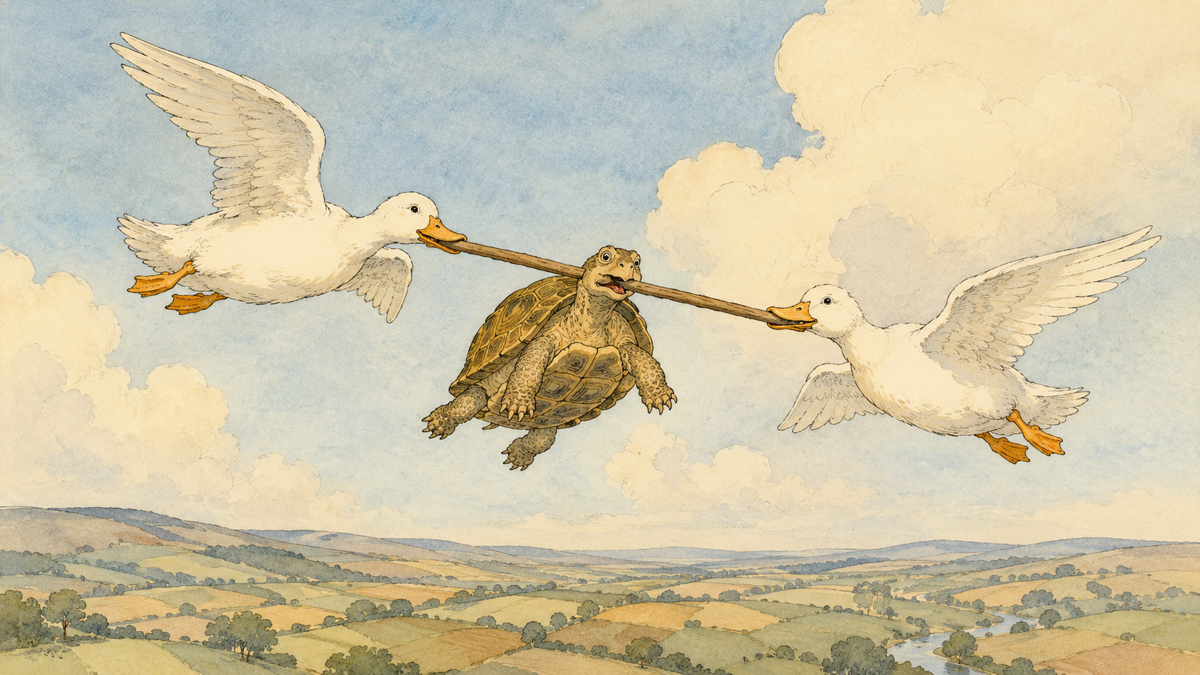
"We can help you to see the world," said the Ducks. "Take hold of this stick with your teeth and we will carry you far up in the air where you can see the whole countryside. But keep quiet or you will be sorry."
The Tortoise was very glad indeed. He seized the stick firmly with his teeth, the two Ducks took hold of it one at each end, and away they sailed up toward the clouds.
Just then a Crow flew by. He was very much astonished at the strange sight and cried:
"This must surely be the King of Tortoises!"
"Why certainly——" began the Tortoise.
But as he opened his mouth to say these foolish words he lost his hold on the stick, and down he fell to the ground, where he was dashed to pieces on a rock.
Memory becomes Action!
Use the character cards* to remember who is in the fable. Choose one way to narrate.
*Character cards are free with the email list; the Composition Prompt and Drawn Narration Sheet are in the Companion Guide.
What is the list of the names, people, characters, and places that are important in Aesop's fable The Tortoise and the Ducks?The Tortoise, The Ducks, The Crow, Jupiter, The sky and countrysideHave a look
- The Tortoise: Carries his house on his back and longs to see the world; his vanity is his undoing.
- The Ducks: A kind pair who offer to carry the Tortoise into the sky on a stick, warning him to keep quiet.
- The Crow: A glossy black crow who calls the Tortoise the King of Tortoises, tempting him to speak.
- Jupiter: The god who, the story says, gave the Tortoise his shell as a punishment for missing the wedding.
- The sky and countryside: The place the fable happens: high in the air above the whole countryside the Tortoise longed to see.
What is the moral of Aesop's fable The Tortoise and the Ducks?Have a look
“Foolish curiosity and vanity often lead to misfortune.”
The Tortoise had his wish and was seeing the whole world from the sky. But his vanity would not let the Crow's flattery pass, and the moment he opened his mouth to answer, he lost his grip and fell.
The Tortoise and the Ducks Q & A
Common questions about this fable: the other titles it goes by, where it comes from, its lesson, and how to help your child narrate it.
My book calls this "The Tortoise and the Birds" (or "The Flying Tortoise"). Same story?
Yes. This fable travels as "The Tortoise and the Ducks," "The Tortoise and the Birds," "The Flying Tortoise," and, in its older Eastern form, "The Talkative Tortoise." Look for the tortoise carried into the sky on a stick held by two birds, who opens his mouth to boast and falls. That is the one, whatever the heading.
Where does this fable come from, and where else will my child meet it?
This is one of the oldest fables in the world, and a lovely example of how far Aesop's stories traveled. The very same tale of a tortoise carried aloft who cannot keep quiet appears in the ancient Indian Panchatantra and the Buddhist Jataka tales, which is a reminder, as Charlotte Mason noted, that many of "the so-called Æsop's fables are infinitely older than the famous Greek story-teller" (Parents and Children, Vol. 2). When your child meets a talkative creature undone by its own boasting later on, she will be meeting this fable's long shadow.
What is the lesson, and do I need to explain it?
The tortoise gets his wish to see the world, then throws it away to answer a bit of flattery, so the fable teaches that foolish curiosity and vanity often lead to misfortune. Let your child feel the fall rather than lecturing on it. The story makes the point better than we can.
How do I help my child narrate this one?
After one reading, invite the telling-back. A stuck child starts again with a question: "How did the ducks carry the tortoise, and why did he fall?" A drawing of the tortoise sailing among the clouds works beautifully as narration for a pre-writer, and the free character cards give her the tortoise, the two ducks, and the crow to act out the ride.