The Listening Grove · Aesop's Fables
Fable 11: The Town Mouse and the Country Mouse
A Charlotte Mason fable lesson. Press play, with the lesson.
What is Aesop's fable The Town Mouse and the Country Mouse about?Parent review
Aesop's Fable 11, The Town Mouse and the Country Mouse, is a tale about the worth of peace and safety. A fine Town Mouse visits her country cousin and turns up her nose at the simple meal of wheat, roots, and acorns. She coaxes the Country Mouse back to the city, where a grand banquet waits, but their feast is broken again and again by a prowling Cat and the House Dog. Frightened out of every bite, the Country Mouse gathers her things and goes home, happy to trade rich food for a quiet, safe life.
Say what you remember!
Tell what you remember from the last fable.
What happened in Aesop's fable The Kid and the Wolf?Have a look
In the last fable, The Kid and the Wolf, a young Kid stood safe on a rooftop and jeered at a Wolf passing below. The Wolf only smiled and said he bore no grudge, for he knew it was the safe roof talking, not the Kid himself.
Back to the previous lesson: The Kid and the Wolf →The Books come Alive!
Read or listen to The Town Mouse and the Country Mouse, the Kindred Thicket Revised Edition.
Read by Kindred Thicket, from the Kindred Thicket Revised Edition.
Read along with the fableRead along
A Town Mouse once visited a relative who lived in the country. For lunch the Country Mouse served wheat stalks, roots, and acorns, with a dash of cold water for drink. The Town Mouse ate very sparingly, nibbling a little of this and a little of that, and by her manner making it very plain that she ate the simple food only to be polite.
After the meal the friends had a long talk, or rather the Town Mouse talked about her life in the city while the Country Mouse listened. They then went to bed in a cozy nest in the hedgerow and slept in quiet and comfort until morning. In her sleep the Country Mouse dreamed she was a Town Mouse with all the luxuries and delights of city life that her friend had described for her. So the next day when the Town Mouse asked the Country Mouse to go home with her to the city, she gladly said yes.
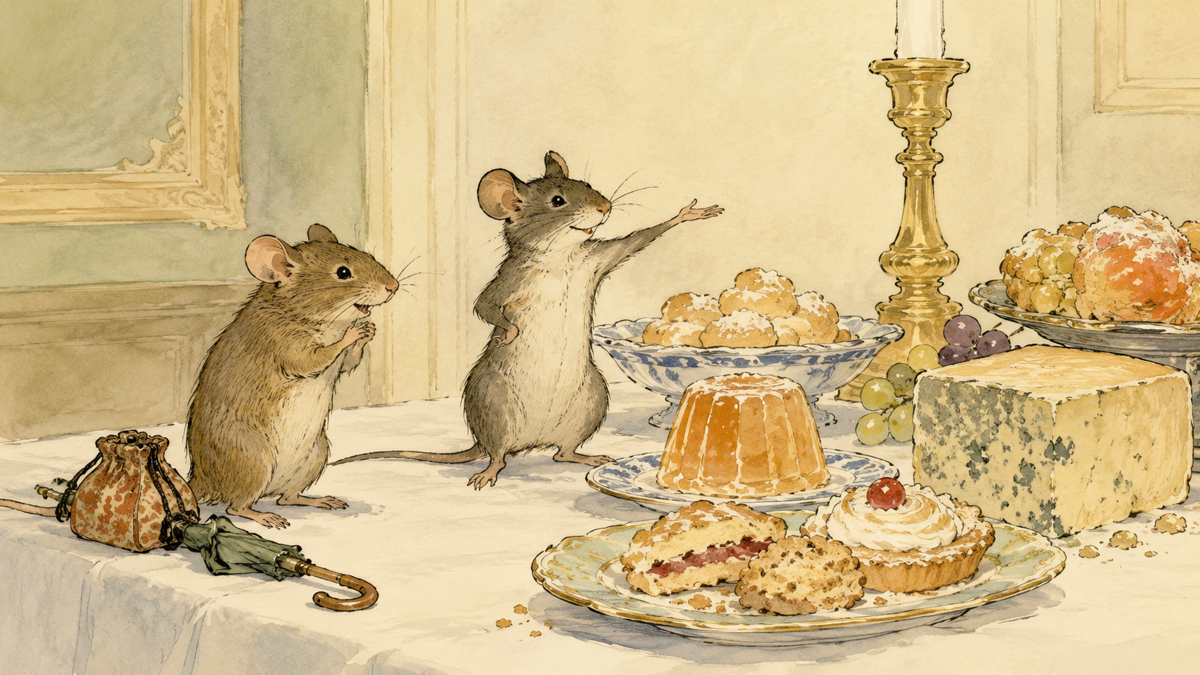
When they reached the mansion in which the Town Mouse lived, they found on the table in the dining room the leavings of a very fine banquet. There were sweetmeats and jellies, pastries, delicious cheeses, indeed, the most tempting foods that a Mouse can imagine. But just as the Country Mouse was about to nibble a dainty bit of pastry, she heard a Cat mew loudly and scratch at the door. In great fear the Mice scurried to a hiding place, where they lay quite still for a long time, hardly daring to breathe. When at last they ventured back to the feast, the door opened suddenly and in came the servants to clear the table, followed by the House Dog.
The Country Mouse stopped in the Town Mouse's den only long enough to pick up her carpet bag and umbrella.
"You may have luxuries and dainties that I have not," she said as she hurried away, "but I prefer my plain food and simple life in the country with the peace and security that go with it."
Memory becomes Action!
Use the character cards* to remember who is in the fable. Choose one way to narrate.
*Character cards are free with the email list; the Composition Prompt and Drawn Narration Sheet are in the Companion Guide.
What is the list of the names, people, characters, and places that are important in Aesop's fable The Town Mouse and the Country Mouse?The Town Mouse, The Country Mouse, The Cat, The House Dog, The country hedgerow and the town mansionHave a look
- The Town Mouse: A fine city mouse who scorns the country fare and coaxes her cousin to the town.
- The Country Mouse: The plain cousin who tastes the town's rich food but flees its dangers for her quiet home.
- The Cat: Prowls the town mansion, scattering the feasting mice in fear.
- The House Dog: Follows the servants in and drives the mice from the banquet a second time.
- The country hedgerow and the town mansion: The two places of the fable: the Country Mouse's cozy hedgerow and the grand town house with its dangerous feast.
What is the moral of Aesop's fable The Town Mouse and the Country Mouse?Have a look
“Poverty with security is better than plenty in the midst of fear and uncertainty.”
The Country Mouse tasted the rich food of the town, but every bite was spoiled by the fear of the Cat and the Dog. She chose instead her plain food and quiet home, where poverty came with peace and safety.
The Town Mouse and the Country Mouse Q & A
Common questions about this fable: the other titles it goes by, where it comes from, its lesson, and how to help your child narrate it.
My Aesop book calls this "The City Mouse and the Country Mouse." Is it the same story?
Yes, it is the same fable. This one travels under several names, most often "The Town Mouse and the Country Mouse" and "The City Mouse and the Country Mouse," and sometimes simply "The Two Mice." Whatever your book calls it, look for the country mouse who visits her cousin in the city, is frightened from the feast by a cat and a dog, and hurries home to her plain food and her peace. That is the one. The read-aloud on this page gives you the full text, so you can be sure you are reading the right story.
Where does this story come from, and where else will my child meet it?
The Town Mouse and the Country Mouse is one of the most traveled fables in the world. The Roman poet Horace retold it in his Satires more than two thousand years ago, La Fontaine set it in French verse, and Beatrix Potter grew it into her "Tale of Johnny Town-Mouse." When your child meets this story, she is joining a very long conversation that has run through Western literature for more than two thousand years.
What is the lesson of this fable? Do I need to explain the moral?
The country mouse trades her plain, quiet meals for a city banquet, then finds that fine food is no feast when you are too frightened to eat it. She goes home content, having learned that peace with little is worth more than plenty with fear. You do not need to spell this out. Charlotte Mason found that children "readily appropriate the moral" of a fable on their own (Towards a Philosophy of Education, Vol. 6), and a fable does its best work when a child reaches the point herself. Read it well and let it do its quiet work.
How do I help my young child narrate this fable?
Read it through once, without stopping to quiz, then invite your child to tell it back in her own words. Mason believed a single hearing was enough, noting that "few grown-ups could 'tell' one of Æsop's Fables with the terse directness which children reproduce" (Towards a Philosophy of Education, Vol. 6). If she stalls, one gentle prompt restarts her: "What did the country mouse serve for lunch? What happened at the banquet?" For a child who is not yet writing, drawn narration works beautifully here, letting her draw the moment the cat appeared, or the country mouse hurrying home, and let the picture be her telling. And if she needs something to hold while she tells, the character cards in our free bonus materials give her the two mice, the cat, and the dog to point to as the story unfolds.
Should I go over the vocabulary before we read this fable?
Usually not, and this is where fables differ from history or science. In those subjects a single unfamiliar word can carry the whole meaning of a passage, so it is worth a quick look beforehand. A fable works the other way. Its gift is exposure, and the way a child quietly infers what a word means from the story around it. So read this one straight through and let the context do the teaching. If a word truly blocks understanding, say what it means in a breath and read on, keeping the whole of the story in one piece.