The Listening Grove · Aesop's Fables
Fable 12: The Fox and the Grapes
A Charlotte Mason fable lesson. Press play, with the lesson.
What is Aesop's fable The Fox and the Grapes about?Parent review
Aesop's Fable 12, The Fox and the Grapes, is a short tale about wounded pride and the comfort of a poor excuse. A hungry Fox spies a beautiful bunch of ripe grapes hanging high on a vine and jumps for them again and again, but every leap falls short. At last, worn out and unwilling to admit he has failed, he walks away with his nose in the air, telling himself the grapes were sour and not worth having anyway. From this little fable comes the everyday phrase we still use for scorning what we cannot reach: “sour grapes.”
Say what you remember!
Tell what you remember from the last fable.
What happened in Aesop's fable The Town Mouse and the Country Mouse?Have a look
In the last fable, The Town Mouse and the Country Mouse, a fine Town Mouse turned up her nose at her cousin's plain country meal and coaxed her to the city. But their grand banquet was broken again and again by a prowling Cat and the House Dog, and the frightened Country Mouse hurried home, glad to trade rich food for a quiet, safe life.
Back to the previous lesson: The Town Mouse and the Country Mouse →The Books come Alive!
Read or listen to The Fox and the Grapes, the Kindred Thicket Revised Edition.
Read by Kindred Thicket, from the Kindred Thicket Revised Edition.
Read along with the fableRead along
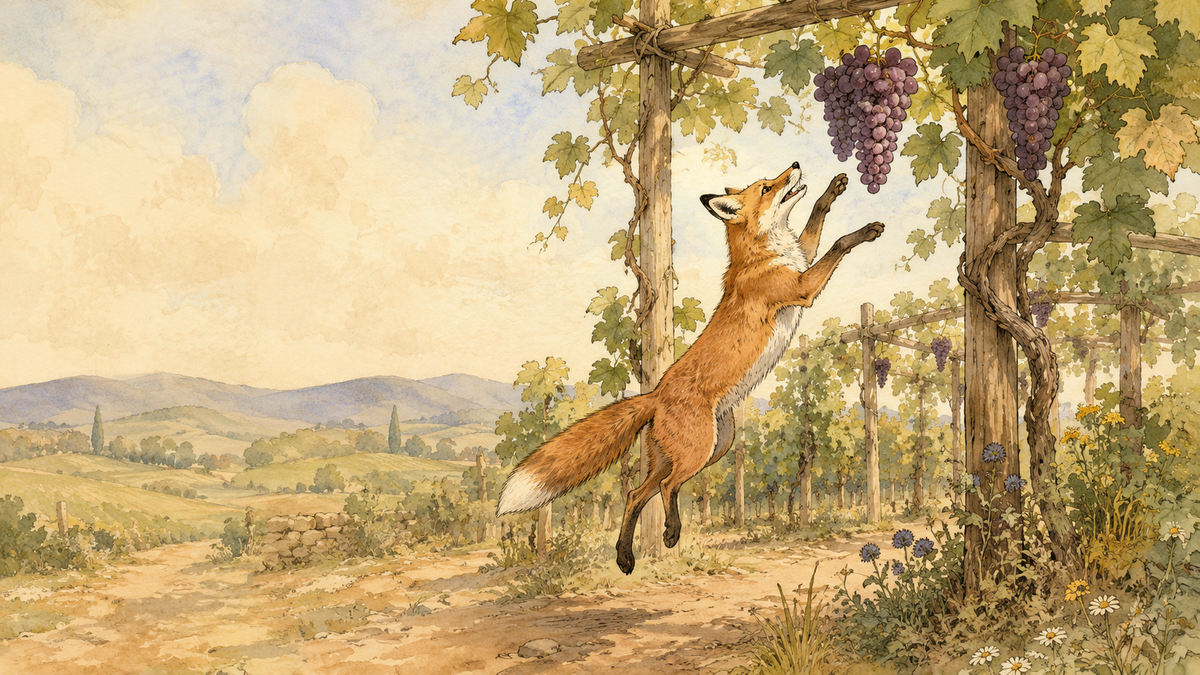
A Fox one day spied a beautiful bunch of ripe grapes hanging from a vine trained along the branches of a tree. The grapes seemed ready to burst with juice, and the Fox's mouth watered as he gazed longingly at them.
The bunch hung from a high branch, and the Fox had to jump for it. The first time he jumped he missed it by a long way. So he walked off a short distance and took a running leap at it, only to fall short once more. Again and again he tried, but in vain.
Now he sat down and looked at the grapes in disgust.
"What a fool I am," he said. "Here I am wearing myself out to get a bunch of sour grapes that are not worth gaping for."
And off he walked very, very scornfully.
Memory becomes Action!
Use the character cards* to remember who is in the fable. Choose one way to narrate.
*Character cards are free with the email list; the Composition Prompt and Drawn Narration Sheet are in the Companion Guide.
What is the list of the names, people, characters, and places that are important in Aesop's fable The Fox and the Grapes?The Fox, The bunch of grapes, The vine and treeHave a look
- The Fox: The hungry fox who leaps for the grapes again and again, then pretends he never wanted them.
- The bunch of grapes: The ripe, juicy grapes hanging just out of the Fox's reach, the prize he cannot win.
- The vine and tree: The setting of the fable: the vine trained along the branches where the grapes hang high overhead.
What is the moral of Aesop's fable The Fox and the Grapes?Have a look
“There are many who pretend to despise and belittle that which is beyond their reach.”
The Fox tried with all his might to reach the grapes, and when he could not, he told himself they were sour and walked away as though he had never wanted them. It is easy, when something is beyond us, to belittle it rather than admit we longed for it.
The Fox and the Grapes Q & A
Common questions about this fable: the other titles it goes by, where it comes from, its lesson, and how to help your child narrate it.
Is the phrase "sour grapes" really from this fable?
Yes. When we say someone is making "sour grapes," we mean they are pretending to scorn something only because they cannot have it, and the expression comes straight from this fable. The Fox cannot reach the grapes, so he decides they must be sour and not worth having. Your child is meeting the very story that gave English one of its most common sayings, which is a lovely thing to point out once she has heard the tale.
Where does this story come from, and where else will my child meet it?
The Fox and the Grapes is one of the most famous of all Aesop's fables. The Roman writer Phaedrus set it down in Latin, the French poet La Fontaine retold it in verse as "Le Renard et les Raisins," and it has given nearly every European language its own version of the phrase "sour grapes." When your child meets this fable, she is joining a conversation that has run through Western literature for more than two thousand years.
What is the lesson of this fable? Do I need to explain the moral?
The Fox wears himself out reaching for the grapes, then, unable to have them, decides they were sour all along. The moral is that we often belittle what is beyond our reach rather than admit we wanted it. You do not need to spell this out. Charlotte Mason found that children "readily appropriate the moral" of a fable on their own (Towards a Philosophy of Education, Vol. 6), and a fable does its best work when a child reaches the point herself. Read it well and let it do its quiet work.
How do I help my young child narrate this fable?
Read it through once, without stopping to quiz, then invite your child to tell it back in her own words. Mason believed a single hearing was enough, noting that "few grown-ups could 'tell' one of Æsop's Fables with the terse directness which children reproduce" (Towards a Philosophy of Education, Vol. 6). If she stalls, one gentle prompt restarts her: "What did the Fox want? What did he say when he could not reach it?" For a child who is not yet writing, drawn narration works beautifully here, letting her draw the Fox leaping for the grapes, or walking away with his nose in the air. And if she needs something to hold while she tells, the character cards in our free bonus materials give her the Fox and the grapes to point to as the story unfolds.
Should I go over the vocabulary before we read this fable?
Usually not, and this is where fables differ from history or science. In those subjects a single unfamiliar word can carry the whole meaning of a passage, so it is worth a quick look beforehand. A fable works the other way. Its gift is exposure, and the way a child quietly infers what a word means from the story around it. So read this one straight through and let the context do the teaching. If a word truly blocks understanding, say what it means in a breath and read on, keeping the whole of the story in one piece.