The Listening Grove · Aesop's Fables
Fable 18: The Shepherd Boy and the Wolf
A Charlotte Mason fable lesson. Press play, with the lesson.
What is Aesop's fable The Shepherd Boy and the Wolf about?Parent review
Aesop's Fable 18, The Shepherd Boy and the Wolf, is the famous story of the boy who cried wolf. Bored while watching his master's sheep, the boy amuses himself by shouting "Wolf! Wolf!" and laughing as the villagers come running for nothing, twice over. But when a real wolf attacks the flock and the boy cries out in earnest, no one believes him, and the wolf carries off many of his sheep.
Say what you remember!
Tell what you remember from the last fable.
What happened in Aesop's fable The Lion and the Mouse?Have a look
In the last fable, The Lion and the Mouse, a tiny Mouse woke a sleeping Lion and was spared when she promised to repay him one day. He laughed at the thought, but later, when the Lion was caught in a hunter's net, the little Mouse gnawed through the ropes and set him free.
Back to the previous lesson: The Lion and the Mouse →The Books come Alive!
Read or listen to The Shepherd Boy and the Wolf, the Kindred Thicket Revised Edition.
Read by Kindred Thicket, from the Kindred Thicket Revised Edition.
Read along with the fableRead along
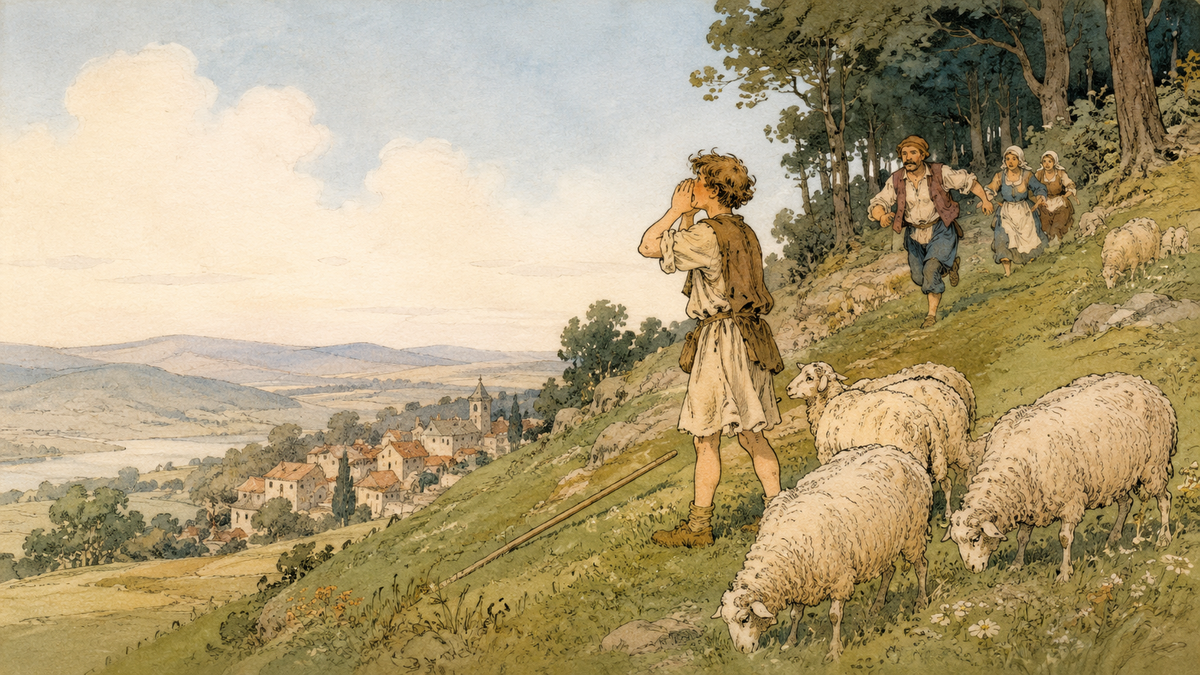
A Shepherd Boy tended his master's Sheep near a dark forest not far from the village. Soon he found life in the pasture very dull. All he could do to amuse himself was to talk to his dog or play on his shepherd's pipe.
One day as he sat watching the Sheep and the quiet forest, and thinking what he would do should he see a Wolf, he thought of a plan to amuse himself.
His Master had told him to call for help should a Wolf attack the flock, and the Villagers would drive it away. So now, though he had not seen anything that even looked like a Wolf, he ran toward the village shouting at the top of his voice, "Wolf! Wolf!"
As he expected, the Villagers who heard the cry dropped their work and ran in great excitement to the pasture. But when they got there they found the Boy doubled up with laughter at the trick he had played on them.
A few days later the Shepherd Boy again shouted, "Wolf! Wolf!" Again the Villagers ran to help him, only to be laughed at again.
Then one evening as the sun was setting behind the forest and the shadows were creeping out over the pasture, a Wolf really did spring from the underbrush and fall upon the Sheep.
In terror the Boy ran toward the village shouting "Wolf! Wolf!" But though the Villagers heard the cry, they did not run to help him as they had before. "He cannot fool us again," they said.
The Wolf killed a great many of the Boy's sheep and then slipped away into the forest.
Memory becomes Action!
Use the character cards* to remember who is in the fable. Choose one way to narrate.
*Character cards are free with the email list; the Composition Prompt and Drawn Narration Sheet are in the Companion Guide.
What is the list of the names, people, characters, and places that are important in Aesop's fable The Shepherd Boy and the Wolf?The Shepherd Boy, The Villagers, The WolfHave a look
- The Shepherd Boy: The bored boy who cries "Wolf!" for a joke, until no one believes him when the wolf is real.
- The Villagers: The neighbors who twice run to help, then stay away when the boy has fooled them once too often.
- The Wolf: The real wolf that at last comes and, with no one to drive it off, scatters the flock.
What is the moral of Aesop's fable The Shepherd Boy and the Wolf?Have a look
“Liars are not believed even when they speak the truth.”
The boy fooled the villagers twice for his own amusement, so when the wolf truly came they would not believe his cry. A liar is not believed even when, at last, he tells the truth.
The Shepherd Boy and the Wolf Q & A
Common questions about this fable: the other titles it goes by, where it comes from, its lesson, and how to help your child narrate it.
Is this where the phrase "cry wolf" comes from?
Yes. When we say someone is "crying wolf," we mean they are raising a false alarm, and the expression comes straight from this fable. The shepherd boy raises the alarm twice for fun, so no one comes when the wolf is real. Your child is meeting the very story behind one of our most common sayings.
Where does this story come from, and where else will my child meet it?
The Shepherd Boy and the Wolf, often called "The Boy Who Cried Wolf," is one of the most famous fables attributed to Aesop and has been retold in nearly every language, giving each its version of the phrase "to cry wolf." When your child meets this fable, she is meeting a lesson about truth-telling that has been taught for well over two thousand years.
What is the lesson of this fable? Do I need to explain the moral?
The boy raises a false alarm twice for his own amusement, so when the wolf is real no one comes. You do not need to spell this out. Charlotte Mason found that children "readily appropriate the moral" of a fable on their own (Towards a Philosophy of Education, Vol. 6), and a fable does its best work when a child reaches the point herself. Read it well and let it do its quiet work.
How do I help my young child narrate this fable?
Read it through once, without stopping to quiz, then invite your child to tell it back in her own words. Mason believed a single hearing was enough, noting that "few grown-ups could 'tell' one of Æsop's Fables with the terse directness which children reproduce" (Towards a Philosophy of Education, Vol. 6). If she stalls, one gentle prompt restarts her: "What did the boy shout when there was no wolf? What happened when the wolf was real?" For a child who is not yet writing, drawn narration works beautifully here, letting her draw the villagers running up the hill, or the boy calling out with no one coming. And if she needs something to hold while she tells, the character cards in our free bonus materials give her the shepherd boy, the villagers, and the wolf to point to as the story unfolds.
Should I go over the vocabulary before we read this fable?
Usually not, and this is where fables differ from history or science. In those subjects a single unfamiliar word can carry the whole meaning of a passage, so it is worth a quick look beforehand. A fable works the other way. Its gift is exposure, and the way a child quietly infers what a word means from the story around it. So read this one straight through and let the context do the teaching. If a word truly blocks understanding, say what it means in a breath and read on, keeping the whole of the story in one piece.