The Listening Grove · Aesop's Fables
Fable 17: The Lion and the Mouse
A Charlotte Mason fable lesson. Press play, with the lesson.
What is Aesop's fable The Lion and the Mouse about?Parent review
Aesop's Fable 17, The Lion and the Mouse, is a beloved story about how even the smallest kindness can be repaid. A tiny Mouse wakes a sleeping Lion by running across his nose, and the angry Lion nearly kills her, but lets her go when she promises to repay him one day. He laughs at the idea. Later the Lion is trapped in a hunter's net, and it is the little Mouse who gnaws through the ropes and sets him free.
Say what you remember!
Tell what you remember from the last fable.
What happened in Aesop's fable The Oxen and the Wheels?Have a look
In the last fable, The Oxen and the Wheels, two oxen pulled a heavy wagon through deep mud without a word of complaint, while the wagon wheels, doing far less work, creaked and groaned at every turn. The tired oxen finally asked the wheels what they had to complain about at all.
Back to the previous lesson: The Oxen and the Wheels →The Books come Alive!
Read or listen to The Lion and the Mouse, the Kindred Thicket Revised Edition.
Read by Kindred Thicket, from the Kindred Thicket Revised Edition.
Read along with the fableRead along
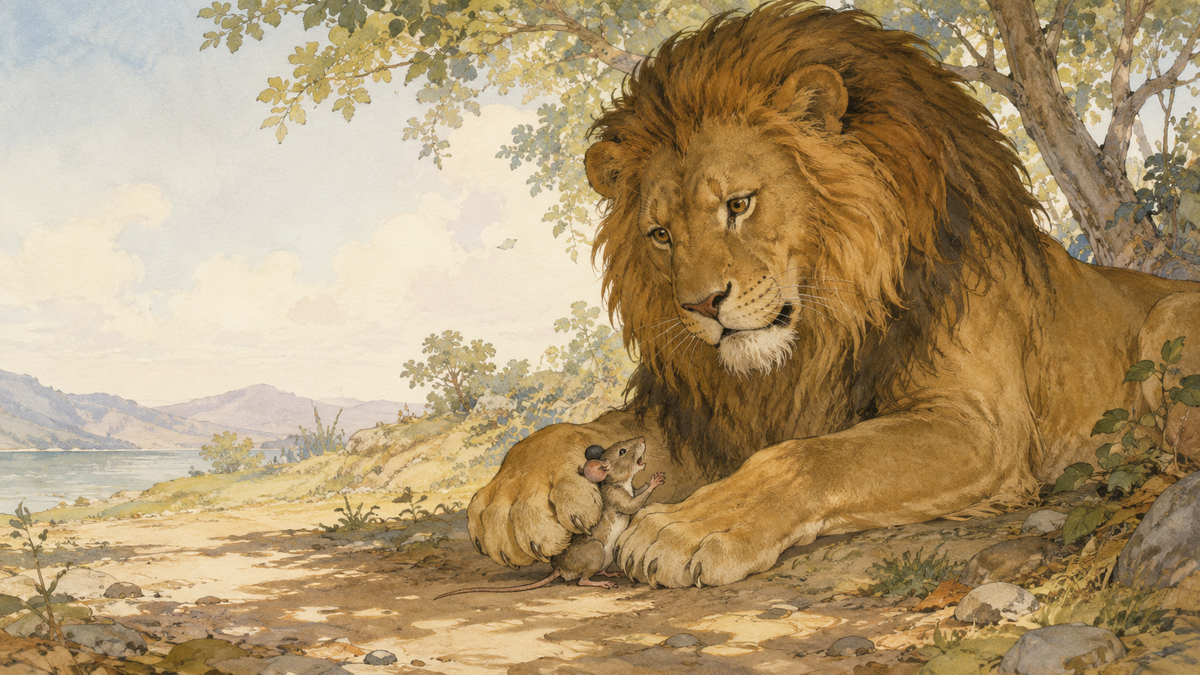
A Lion lay asleep in the forest, his great head resting on his paws. A timid little Mouse came upon him unexpectedly, and in her fright and haste to get away, ran across the Lion's nose. Roused from his nap, the Lion laid his huge paw angrily on the tiny creature to kill her.
"Spare me!" begged the poor Mouse. "Please let me go and some day I will surely repay you."
The Lion was much amused to think that a Mouse could ever help him. But he was generous and finally let the Mouse go.
Some days later, while stalking his prey in the forest, the Lion was caught in the toils of a hunter's net. Unable to free himself, he filled the forest with his angry roaring. The Mouse knew the voice and quickly found the Lion struggling in the net. Running to one of the great ropes that bound him, she gnawed it until it parted, and soon the Lion was free.
"You laughed when I said I would repay you," said the Mouse. "Now you see that even a Mouse can help a Lion."
Memory becomes Action!
Use the character cards* to remember who is in the fable. Choose one way to narrate.
*Character cards are free with the email list; the Composition Prompt and Drawn Narration Sheet are in the Companion Guide.
What is the list of the names, people, characters, and places that are important in Aesop's fable The Lion and the Mouse?The Lion, The Mouse, The hunter's netHave a look
- The Lion: The mighty lion who spares the little mouse, then is saved by her when he is caught in a net.
- The Mouse: The timid little mouse who promises to repay the lion, and gnaws him free when he is trapped.
- The hunter's net: The trap that binds the great lion, until the tiny mouse chews through its ropes.
What is the moral of Aesop's fable The Lion and the Mouse?Have a look
“A kindness is never wasted.”
The Lion thought a mouse far too small to ever help him, yet it was the mouse who freed him from the hunter's net. No act of kindness, however small, is ever wasted.
The Lion and the Mouse Q & A
Common questions about this fable: the other titles it goes by, where it comes from, its lesson, and how to help your child narrate it.
Is this the one where the little mouse saves the lion?
Yes, this is that beloved fable. The mouse the lion spares turns out to be the very one who gnaws through the hunter's net and sets him free. It is one of the most famous of all Aesop's stories, and the read-aloud on this page gives you the full text so you can follow it word for word.
Where does this story come from, and where else will my child meet it?
The Lion and the Mouse is among the best-known fables in the world, found in the ancient Greek collections and retold by La Fontaine and countless picture-book makers since. By tradition Aesop himself was a slave, and this story of the small repaying the great has always been dear to ordinary people. When your child meets it, she joins a very long line of listeners.
What is the lesson of this fable? Do I need to explain the moral?
The great Lion laughs that a Mouse could ever help him, and then the Mouse frees him from the hunter's net. You do not need to spell this out. Charlotte Mason found that children "readily appropriate the moral" of a fable on their own (Towards a Philosophy of Education, Vol. 6), and a fable does its best work when a child reaches the point herself. Read it well and let it do its quiet work.
How do I help my young child narrate this fable?
Read it through once, without stopping to quiz, then invite your child to tell it back in her own words. Mason believed a single hearing was enough, noting that "few grown-ups could 'tell' one of Æsop's Fables with the terse directness which children reproduce" (Towards a Philosophy of Education, Vol. 6). If she stalls, one gentle prompt restarts her: "Why did the lion let the mouse go? How did the mouse help him later?" For a child who is not yet writing, drawn narration works beautifully here, letting her draw the mouse running across the lion's nose, or gnawing through the ropes of the net. And if she needs something to hold while she tells, the character cards in our free bonus materials give her the lion and the mouse to point to as the story unfolds.
Should I go over the vocabulary before we read this fable?
Usually not, and this is where fables differ from history or science. In those subjects a single unfamiliar word can carry the whole meaning of a passage, so it is worth a quick look beforehand. A fable works the other way. Its gift is exposure, and the way a child quietly infers what a word means from the story around it. So read this one straight through and let the context do the teaching. If a word truly blocks understanding, say what it means in a breath and read on, keeping the whole of the story in one piece.