The Listening Grove · Aesop's Fables
Fable 4: The Frogs and the Ox
A Charlotte Mason fable lesson. Press play, with the lesson.
What is Aesop's fable The Frogs and the Ox about?Parent review
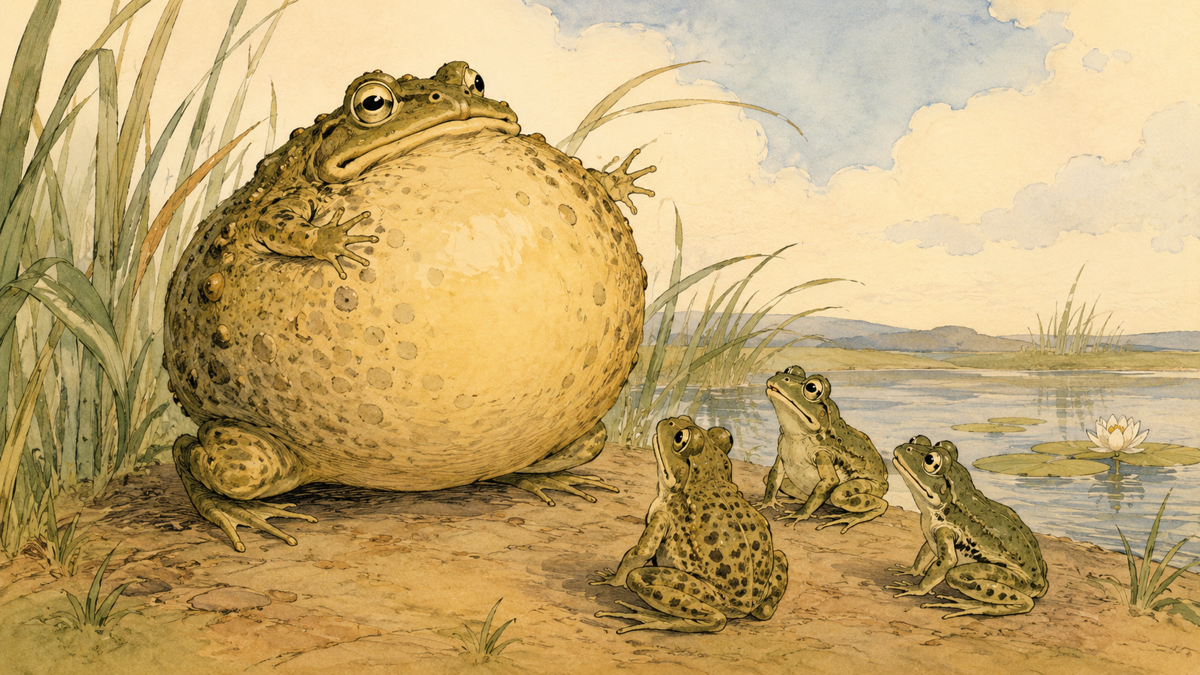
Aesop's Fable 4, The Frogs and the Ox, is a tale about trying to be something you are not. When a great Ox tramples one of her little ones by the pool, the old Mother Frog asks what crushed him. Told it was a huge monster, she puffs herself up, again and again, asking each time if she is as big as the beast. The little frogs keep saying the Ox was far bigger, and the old Frog puffs herself out more and more until, at last, she bursts.
Say what you remember!
Tell what you remember from the last fable.
What happened in Aesop's fable The Young Crab and His Mother?Have a look
In the last fable, The Young Crab and His Mother, a Mother Crab scolded her son for walking sideways and told him to walk straight forward. When the little Crab asked her to show him how, the old Crab found she could only walk sideways too, and tripped on her nose.
Back to the previous lesson: The Young Crab and His Mother →The Books come Alive!
Read or listen to The Frogs and the Ox, the Kindred Thicket Revised Edition.
Read by Kindred Thicket, from the Kindred Thicket Revised Edition.
Read along with the fableRead along
An Ox came down to a reedy pool to drink. As he splashed heavily into the water, he crushed a young Frog into the mud. The old Frog soon missed the little one and asked his brothers and sisters what had become of him.
"A great big monster," said one of them, "stepped on little brother with one of his huge feet!"
"Big, was he!" said the old Frog, puffing herself up. "Was he as big as this?"
"Oh, much bigger!" they cried.
The Frog puffed up still more.
"He could not have been bigger than this," she said. But the little Frogs all declared that the monster was much, much bigger and the old Frog kept puffing herself out more and more until, all at once, she burst.
Memory becomes Action!
Use the character cards* to remember who is in the fable. Choose one way to narrate.
*Character cards are free with the email list; the Composition Prompt and Drawn Narration Sheet are in the Companion Guide.
What is the list of the names, people, characters, and places that are important in Aesop's fable The Frogs and the Ox?The old Frog, The little Frogs, The Ox, The reedy poolHave a look
- The old Frog: The mother frog who puffs herself up to match the Ox's size, and bursts in the trying.
- The little Frogs: Her children, who saw the Ox and keep telling her the monster was far bigger.
- The Ox: A great ox who comes to drink and crushes one of the little frogs without noticing.
- The reedy pool: The place the fable happens: the pool where the Ox comes to drink and the frogs live.
What is the moral of Aesop's fable The Frogs and the Ox?Have a look
“Do not attempt the impossible.”
The old Frog could not bear to be smaller than the Ox, so she puffed herself up again and again to match his size. It was more than any frog could do, and she burst in the trying.
The Frogs and the Ox Q & A
Common questions about this fable: the other titles it goes by, where it comes from, its lesson, and how to help your child narrate it.
My book calls this "The Frog Who Wished to Be as Big as the Ox." Same fable?
Yes. It appears as "The Frogs and the Ox," "The Frog and the Ox," and "The Frog Who Wished to Be as Big as the Ox." Look for the old frog who puffs herself up, bigger and bigger, trying to match the size of an ox, until she bursts. That is this one.
Where does this fable come from, and where else will my child meet it?
This is one of the most retold fables in the West. The Roman poets Phaedrus and Horace both told it, and La Fontaine made it one of his most famous verses, "The Frog That Wished to Be as Big as the Ox." From it we get the enduring image of a person "puffed up" with self-importance until they burst, a picture your child will meet again and again in books and everyday speech.
What is the lesson, and do I need to explain it?
The frog destroys herself trying to be something she is not, so the fable teaches, in the words of the text, not to attempt the impossible. Children take the point at once from the bursting frog. There is nothing to add.
How do I help my child narrate this one?
Read it, then let her tell it, using the repetition to her advantage: "How big did the frog try to be? What did the little frogs keep saying?" The puffing-up repeats, which gives a young narrator an easy shape to follow. A drawing of the frog growing rounder and rounder makes a delightful narration, and the free character cards give her the frog and the great ox to compare.