The Listening Grove · Aesop's Fables
Fable 8: The Boy and the Filberts
A Charlotte Mason fable lesson. Press play, with the lesson.
What is Aesop's fable The Boy and the Filberts about?Parent review
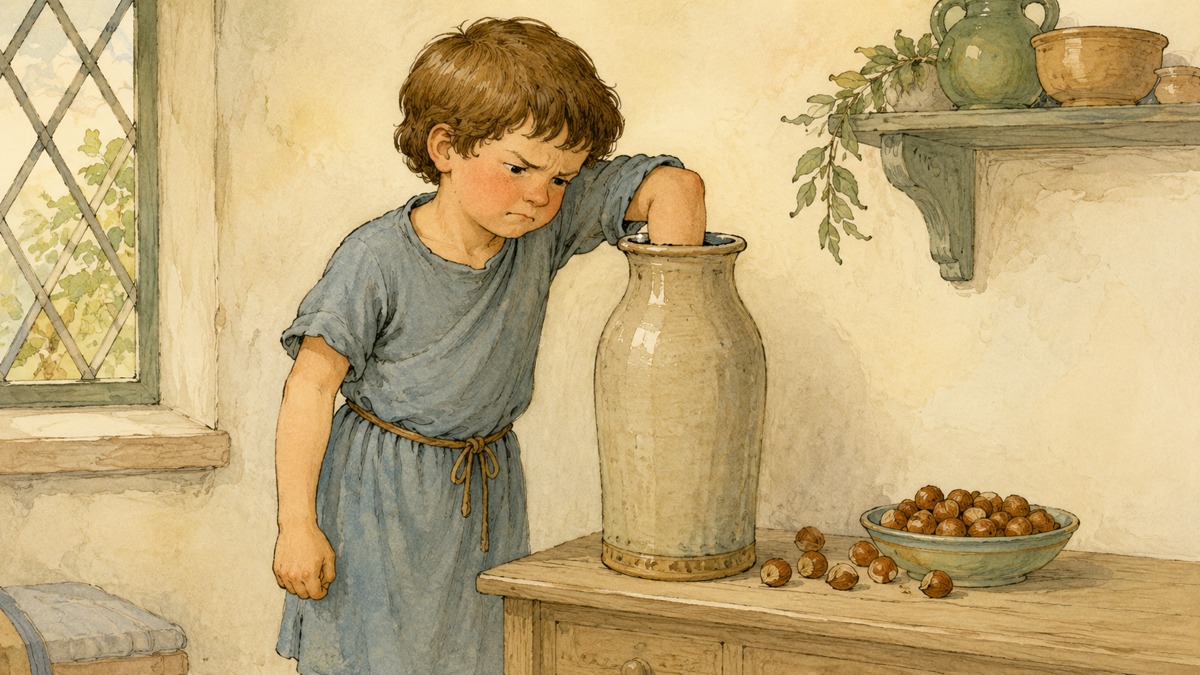
Aesop's Fable 8, The Boy and the Filberts, is a short tale about grasping for too much. A Boy is allowed to take some filberts from a pitcher, but he grabs such a great fistful that he cannot pull his hand back out. Unwilling to give up a single nut, and unable to free them all at once, he begins to cry. His mother gently tells him to be satisfied with half, and then his hand will slip out easily.
Say what you remember!
Tell what you remember from the last fable.
What happened in Aesop's fable The Eagle and the Jackdaw?Have a look
In the last fable, The Eagle and the Jackdaw, an Eagle carried off a lamb, and a watching Jackdaw thought he could do the same. He swooped onto a great Ram, but his claws tangled in the wool, and the Shepherd caught him, clipped his wings, and gave him to the children.
Back to the previous lesson: The Eagle and the Jackdaw →The Books come Alive!
Read or listen to The Boy and the Filberts, the Kindred Thicket Revised Edition.
Read by Kindred Thicket, from the Kindred Thicket Revised Edition.
Read along with the fableRead along
A Boy was given permission to put his hand into a pitcher to get some filberts. But he took such a great fistful that he could not draw his hand out again. There he stood, unwilling to give up a single filbert and yet unable to get them all out at once. Vexed and disappointed he began to cry.
"My boy," said his mother, "be satisfied with half the nuts you have taken and you will easily get your hand out. Then perhaps you may have some more filberts some other time."
Memory becomes Action!
Use the character cards* to remember who is in the fable. Choose one way to narrate.
*Character cards are free with the email list; the Composition Prompt and Drawn Narration Sheet are in the Companion Guide.
What is the list of the names, people, characters, and places that are important in Aesop's fable The Boy and the Filberts?The Boy, The Mother, The pitcher of filbertsHave a look
- The Boy: Grabs too great a fistful of filberts and cannot pull his hand from the jar.
- The Mother: Gently tells him to take only half, and then his hand will come out easily.
- The pitcher of filberts: The place the fable happens: at home, at the jar of filberts the Boy reaches into.
What is the moral of Aesop's fable The Boy and the Filberts?Have a look
“Do not attempt too much at once.”
The Boy grabbed a whole fistful of filberts and then could not get his hand out of the jar. Had he been content with half, he would have managed easily; trying for too much at once left him stuck with nothing.
The Boy and the Filberts Q & A
Common questions about this fable: the other titles it goes by, where it comes from, its lesson, and how to help your child narrate it.
What other names does this fable go by, and what is a filbert?
You will see it as "The Boy and the Filberts" and "The Boy and the Nuts." A filbert is simply a hazelnut, so if your book says "nuts," it is the same story: a boy grabs such a huge fistful from a jar that his hand will not come out. You do not need to pre-teach that word; the story makes it plain, and your child will pick it up from the picture and the sense of the tale.
Where does this fable come from, and where else will my child meet it?
It is a classic Greek fable and a favorite for its plain good sense about grasping for too much at once. The image of the boy who loses everything by refusing to let go of a little is one of those small, sturdy lessons that turns up in sermons, stories, and everyday advice for the rest of a person's life.
What is the lesson, and do I need to explain it?
The boy could have his nuts if he took fewer, but insists on the whole fistful and gets none, so the fable teaches, in the old words, not to attempt too much at once. His mother says it kindly within the story, so you do not have to say it again after.
How do I help my child narrate this one?
This one is short and vivid. Read it, then ask: "How many nuts did the boy grab, and why couldn't he get his hand out?" A drawing of the fist stuck in the jar is narration enough for a little one, and the free character cards give her the boy and his mother to speak the story's few lines.