The Listening Grove · Aesop's Fables
Fable 9: Hercules and the Wagoner
A Charlotte Mason fable lesson. Press play, with the lesson.
What is Aesop's fable Hercules and the Wagoner about?Parent review
Aesop's Fable 9, Hercules and the Wagoner, is a tale about helping yourself. A Farmer's wagon sinks to the hub in the mud of a country road, and the horses can pull it no further. Instead of lifting a finger, the Farmer stands by, cursing his luck and calling on the mighty Hercules for help. Hercules appears, but only to tell him to put his own shoulder to the wheel and urge on his horses, for help comes to those who help themselves.
Say what you remember!
Tell what you remember from the last fable.
What happened in Aesop's fable The Boy and the Filberts?Have a look
In the last fable, The Boy and the Filberts, a Boy reached into a jar and grabbed such a large fistful of nuts that he could not pull his hand free. His mother told him to be content with half, and then his hand would come out easily.
Back to the previous lesson: The Boy and the Filberts →The Books come Alive!
Read or listen to Hercules and the Wagoner, the Kindred Thicket Revised Edition.
Read by Kindred Thicket, from the Kindred Thicket Revised Edition.
Read along with the fableRead along
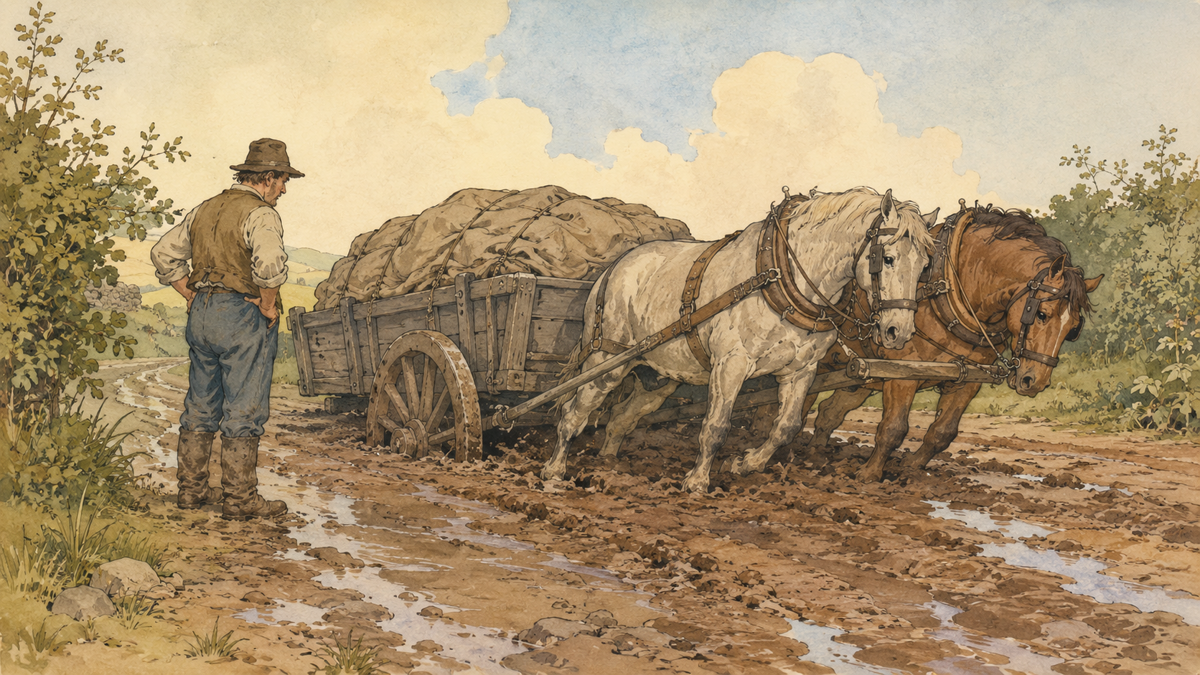
A Farmer was driving his wagon along a miry country road after a heavy rain. The horses could hardly drag the load through the deep mud, and at last came to a standstill when one of the wheels sank to the hub in a rut.
The farmer climbed down from his seat and stood beside the wagon looking at it but without making the least effort to get it out of the rut. All he did was to curse his bad luck and call loudly on Hercules to come to his aid. Then, it is said, Hercules really did appear, saying:
"Put your shoulder to the wheel, man, and urge on your horses. Do you think you can move the wagon by simply looking at it and whining about it? Hercules will not help unless you make some effort to help yourself."
And when the farmer put his shoulder to the wheel and urged on the horses, the wagon moved very readily, and soon the Farmer was riding along in great content and with a good lesson learned.
Memory becomes Action!
Use the character cards* to remember who is in the fable. Choose one way to narrate.
*Character cards are free with the email list; the Composition Prompt and Drawn Narration Sheet are in the Companion Guide.
What is the list of the names, people, characters, and places that are important in Aesop's fable Hercules and the Wagoner?The Farmer, Hercules, The horses, The muddy country roadHave a look
- The Farmer: The wagoner whose wheel sinks in the mud; he only curses his luck and calls for help.
- Hercules: The mighty hero, who appears only to tell the Farmer to help himself first.
- The horses: The team that can move the wagon readily once the Farmer puts his own shoulder to the wheel.
- The muddy country road: The place the fable happens: the miry road where the wagon wheel sinks after heavy rain.
What is the moral of Aesop's fable Hercules and the Wagoner?Have a look
“Self help is the best help.”
The Farmer whose wagon stuck in the mud only stood and called on Hercules for help. Hercules told him to put his own shoulder to the wheel first, for help comes to those who begin by helping themselves.
Hercules and the Wagoner Q & A
Common questions about this fable: the other titles it goes by, where it comes from, its lesson, and how to help your child narrate it.
My book spells it "Waggoner" or calls it "Hercules and the Carter." Same fable?
Yes. It appears as "Hercules and the Wagoner," "Hercules and the Waggoner," and "Hercules and the Carter." Look for the farmer whose wagon sinks in the mud, who calls on Hercules for help and is told to put his own shoulder to the wheel first.
Where does this fable come from, and where else will my child meet it?
This little fable has left a deep mark on English. From it we get the everyday phrase "put your shoulder to the wheel," and the proverb often traced to it, "the gods help those who help themselves," which later generations turned into "God helps those who help themselves." Your child will hear both long before she remembers where they began.
What is the lesson, and do I need to explain it?
The farmer wants rescue without effort, and Hercules will not lift the wagon for a man who will not lift it himself, so the fable teaches, in the old words, that self help is the best help. Hercules says it aloud inside the story, which means you can simply read and let it stand.
How do I help my child narrate this one?
Read it, then ask her to tell it back. If she stalls: "What did the farmer want Hercules to do, and what did Hercules tell him instead?" A drawing of the farmer pushing while the wagon comes free makes a strong narration, and the free character cards give her the farmer, the horses, and Hercules to move through the scene.