The Listening Grove · Birds of the Air
Chapter 1: Birds We Know
A Charlotte Mason nature-study lesson. Press play, with the lesson.
What is Birds of the Air Chapter 1, Birds We Know, about?Parent review
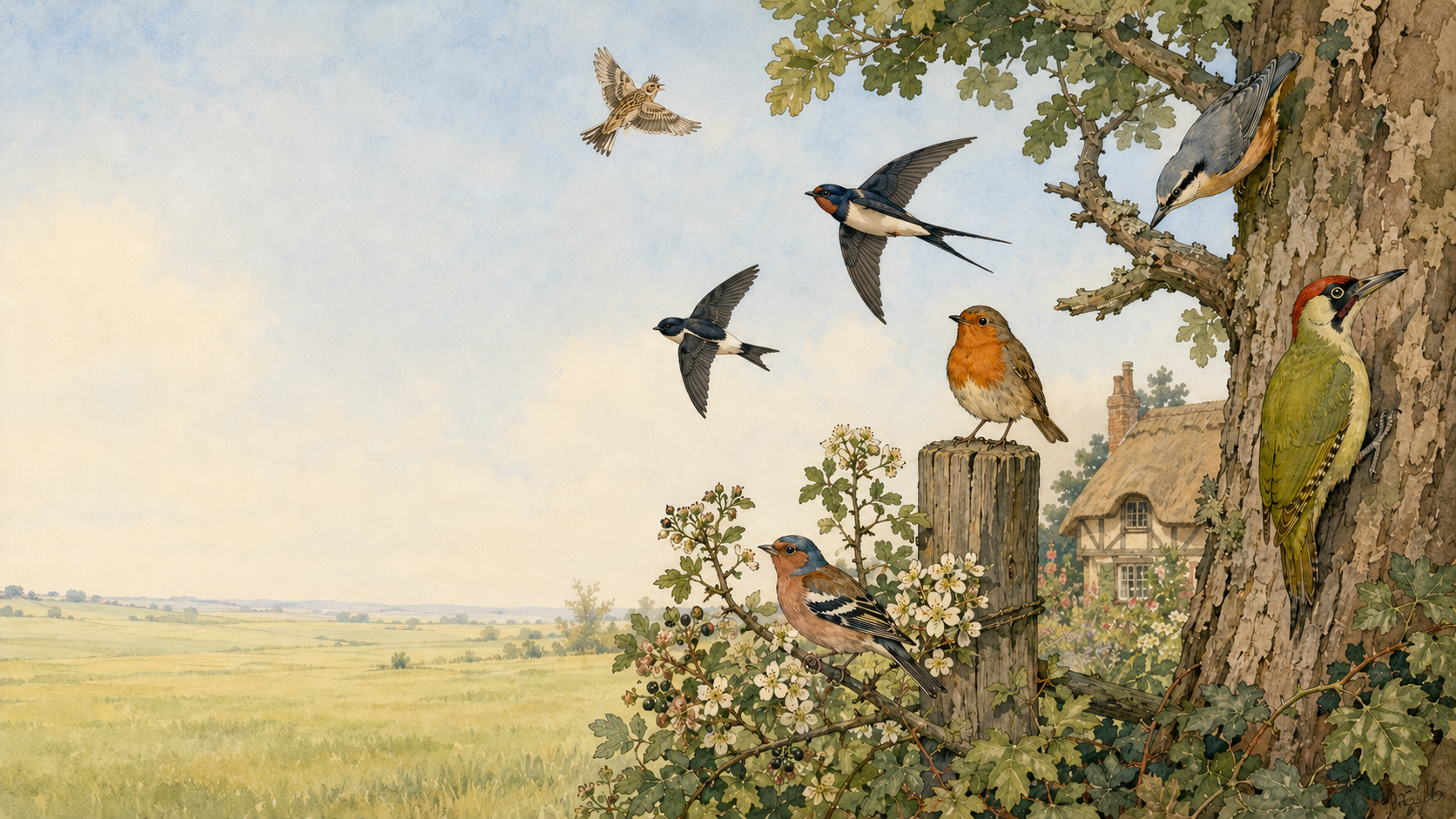
Birds of the Air Chapter 1, Birds We Know, opens Arabella Buckley’s gentle nature study by inviting your child to notice the birds she already knows by sight. Buckley walks through the familiar garden and countryside birds of Britain, the Robin with his red breast, the Chaffinch, the Lark, the Green Woodpecker, the Nuthatch, and the cooing Wood-pigeon, and shows how to tell one from another by shape, colour, call, and the way each one moves. She turns to the swifts, swallows, and martins that leave in autumn and the fieldfares that arrive from the north, and ends with a quiet invitation to watch nests and young birds without ever disturbing them. It is a warm first lesson in looking closely.
Show what you know!
Use your printable Lesson Guide. Fill in the vocabulary you know, then click to check your work and learn some new words today.
What are the difficult or advanced vocabulary words in Birds of the Air Chapter 1, Birds We Know?soar, recognize, dingy, grudgeHave a look
- soar: To fly high in the air, gliding along without flapping the wings.
- recognize: To know who or what something is because you have seen it before.
- dingy: Dull and dirty-looking; not bright or fresh in colour.
- grudge: To give something unwillingly, or to resent having to share it.
The Books come Alive!
Read or listen to Chapter 1 of Birds of the Air, the Kindred Thicket Enhanced Edition, read by Laura Caldwell.
Teacher’s Notes
This is a Kindred Thicket Enhanced Edition. As you listen, keep these corrections and updates to Birds of the Air in mind.
- “three to four hundred different British birds”The official British List today stands at about 636 species, up from around 395 in Buckley’s day.
- “the mother robin’s breast is not quite so red”Male and female robins are actually identical; only the young are plain brown, with no red at all.
- “yellow tips to some of his feathers”The chaffinch’s clearest marks are the two white bars on his dark wings, not yellow tips.
- “white speckled throat”It is the skylark’s breast that is streaked and speckled, not its throat.
Read by Laura Caldwell for LibriVox (public domain), cleaned and trimmed by Kindred Thicket.
Memory becomes Action!
Use the Response Resource* to remember and spell tricky names. Choose one way to narrate.
*Materials in the Lesson Guide.
What is the list of names, people, characters, birds, and places that are important in Chapter 1 of Birds of the Air?Robin, Chaffinch, Lark, Green Woodpecker, Nuthatch, Wood-pigeon, Magpie, Hawk, Owl, Swift, Swallow, House Martin, Fieldfare, ThrushHave a look
- Robin: Known by his red breast, plump little body, and brown wings. Males and females look alike; only the young have no red at all.
- Chaffinch: Has a browner breast than the robin, white bands on his dark wings, and a loud "pink, pink" call near his nest.
- Lark: A slender brown bird with a streaked, speckled breast, known for soaring high as he sings his sweet song.
- Green Woodpecker: Easily known by his bright colours, curious feet, and stiff tail, which he uses to jerk himself up a tree.
- Nuthatch: No bigger than a sparrow, with a short tail, blue-grey wings, and a dingy red breast. He climbs trees by jumps.
- Wood-pigeon: A familiar bird known by its soft, cooing call.
- Magpie: Known by its noisy chattering.
- Hawk: Recognized by its soaring flight and sharp, hooked beak.
- Owl: Known by its soft, downy feathers.
- Swift: Flies away to the south in August, before the swallows and martins.
- Swallow: Has a blue-black collar across his breast and a deeply forked tail, longer than the martin’s.
- House Martin: Much like the swallow, but with a shorter fork to its tail. They come and go together.
- Fieldfare: Comes from the north in autumn and feeds in flocks on worms and on holly berries.
- Thrush: Taps a snail-shell against a stone to reach the snail. A good gardener who clears away pests.
Chapter 1 Q & A
This is a Kindred Thicket Enhanced Edition. We read every chapter against modern science, and here is what we found in this chapter.
Is Birds of the Air Chapter 1, Birds We Know, scientifically accurate?
Birds of the Air Chapter 1, Birds We Know, is mostly accurate. We checked every natural-history claim against modern ornithology (BTO, RSPB, and the BOU British List), and most hold up. There is one clear correction, about the female robin’s colour, and a few details have moved on since Buckley wrote in 1895. This is a Kindred Thicket Enhanced Edition, so you’ll find those corrections in the Teacher’s Notes.
Do male and female robins look the same?
Yes. Male and female European robins are identical in plumage, both with the same orange-red face and breast. Buckley writes that the mother robin’s breast is "not quite so red," a common Victorian assumption, but it is not correct for the robin. Only the young birds are plain brown, with no red at all, which develops during their first moult.
How many kinds of British birds are there?
About 636 species are on the official British List today (British Ornithologists’ Union, 2025). Buckley’s "between three and four hundred" was close to the count of her own day, around 395 species in 1889. The number has nearly doubled since, as rare visitors have been recorded and bird classification has changed. Buckley made no error; the count has simply grown.
How can you tell a chaffinch from a robin?
The male chaffinch has a browner breast than the robin and two bright white bars on his dark wings, and his loud "pink, pink" call gives him away near the nest. Buckley’s marks are accurate, though modern guides lead with the white wing bars rather than her "yellow tips," which are subtle.
Does the green woodpecker really climb with its tail?
Yes. The green woodpecker has two toes pointing forward and two back, and stiffened tail feathers it props against the trunk to jerk itself upward, exactly as Buckley describes. One thing she does not mention: the green woodpecker feeds mainly on ants on the ground, unlike most woodpeckers.
How do you tell a swallow from a house martin?
A swallow has a blue-black collar across his breast and a deeply forked tail with long streamers, longer than the house martin’s shorter, shallow fork. Both of Buckley’s marks are accurate. A modern extra: the house martin also shows a bright white rump.
When do swifts, swallows, and martins leave Britain?
Swifts leave first, mostly through August; swallows and house martins follow, chiefly September into October, with a few lingering later. Buckley’s "swifts in August, swallows and martins in October" is broadly accurate. As they go, fieldfares arrive from Scandinavia to spend the winter feeding in the fields.