The Listening Grove · Birds of the Air
Chapter 2: The Song of Birds
A Charlotte Mason nature-study lesson. Press play, with the lesson.
What is Birds of the Air Chapter 2, The Song of Birds, about?Parent review
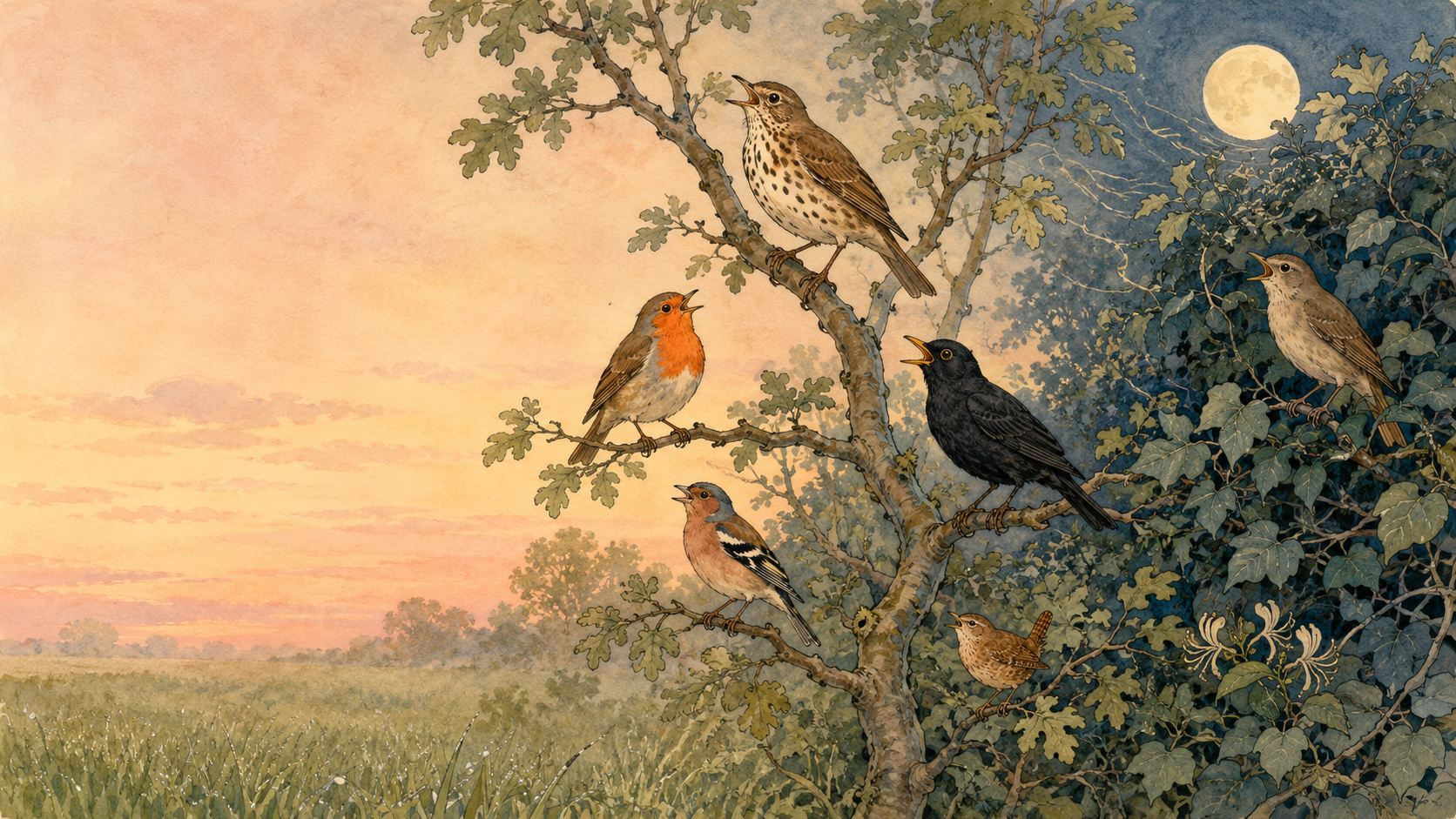
Birds of the Air Chapter 2, The Song of Birds, listens to why and how birds sing. Arabella Buckley leads your child through the spring dawn chorus, when Robins, Thrushes, Blackbirds, Chaffinches, and Wrens all burst into song at sunrise, and shows how to pick out one voice from another once the birds quiet down. She plays with the words people use to imitate bird song, the Yellowhammer’s "a little bit of bread and no cheese," the Chiff-chaff calling its own name, and the cooing Wood-pigeon, and lingers on the Nightingale, who sings nearly all night in the warm southern summer. She ends with the tender picture of the father bird singing to the mother on her nest and teaching his young their song. It is a lesson in listening closely.
Say what you remember!
Tell what you remember from the last chapter.
What happened in Birds of the Air Chapter 1, Birds We Know?Have a look
In the last chapter, Birds We Know, Arabella Buckley invited us to notice the birds we already know by sight, the Robin, the Chaffinch, the Lark, the Green Woodpecker, the Nuthatch, and the cooing Wood-pigeon, and showed how to tell them apart by shape, colour, and call. We met the swifts, swallows, and martins that leave in autumn and the fieldfares that come from the north, and were reminded to watch nests and young birds gently, without ever disturbing them.
Read the previous lesson: Birds We Know →Show what you know!
Use your printable Lesson Guide. Fill in the vocabulary you know, then click to check your work and learn some new words today.
What are the difficult or advanced vocabulary words in Birds of the Air Chapter 2, The Song of Birds?trill, concert, imitate, quiverHave a look
- trill: To sing or sound a quick, quivering musical note.
- concert: Many voices or instruments making music together.
- imitate: To copy the sound or actions of someone or something.
- quiver: To shake or tremble with a slight, fast movement.
The Books come Alive!
Read or listen to Chapter 2 of Birds of the Air, the Kindred Thicket Enhanced Edition, read by Laura Caldwell.
Teacher’s Notes
This is a Kindred Thicket Enhanced Edition. As you listen, keep this correction and update to Birds of the Air in mind.
- “In Yorkshire or Devonshire you will not hear him”True in Buckley’s day, but the nightingale’s range has contracted even further south since. They no longer breed in Devon and are effectively absent from Yorkshire, and today they are concentrated in Kent, Sussex, and Essex.
Read by Laura Caldwell for LibriVox (public domain), cleaned and trimmed by Kindred Thicket.
Memory becomes Action!
Use the Response Resource* to remember and spell tricky names. Choose one way to narrate.
*Materials in the Lesson Guide.
What is the list of names, people, characters, birds, and places that are important in Chapter 2 of Birds of the Air?Robin, Thrush, Blackbird, Chaffinch, Wren, Yellowhammer, Chiff-chaff, Cuckoo, Wood-pigeon, Nightingale, Lark, RookHave a look
- Robin: The cock-robin sings from a branch to his mate; you may find his nest by his song.
- Thrush: Sings loudest and clearest of all, first to begin and last to leave off.
- Blackbird: Joins the morning chorus; the young learn the father’s tune note by note.
- Chaffinch: Whistles merrily in the morning burst of song.
- Wren: A tiny bird that joins the evening concert.
- Yellowhammer: Bright yellow head; seems to sing "a little bit of bread, and no cheese."
- Chiff-chaff: Calls its own name quite distinctly, "chiff-chaff, chiff-chaff."
- Cuckoo: Any child can imitate its simple two-note call.
- Wood-pigeon: Coos "coo-oo-oo," puffing out his throat and bowing to his mate.
- Nightingale: Sings nearly all night in warm summer in the south and east; a sweet, flute-like song.
- Lark: The very first of all the birds to begin singing in the morning.
- Rook: Caws "caw-caw" as it flies home from the fields in the evening.
Chapter 2 Q & A
This is a Kindred Thicket Enhanced Edition. We read every chapter against modern science, and here is what we found in this chapter.
Is Birds of the Air Chapter 2, The Song of Birds, scientifically accurate?
Birds of the Air Chapter 2, The Song of Birds, is almost entirely accurate. We checked every claim about bird song against modern ornithology (BTO, RSPB), and the dawn chorus, the individual songs, and the young birds learning their father’s tune all hold up. The one update is the Nightingale’s range, which has contracted further south since Buckley wrote in 1895. This is a Kindred Thicket Enhanced Edition, so you’ll find that correction in the Teacher’s Notes.
Which birds sing in the dawn chorus?
The spring dawn chorus is led by Robins, Thrushes, Blackbirds, Chaffinches, and Wrens, with many other small birds joining as the sun rises, exactly as Buckley describes. The Song Thrush is often the loudest and clearest voice in it, first to begin and last to leave off.
Where can you hear a nightingale in Britain today?
Nightingales sing mainly in the south and east of England, and today they are concentrated in Kent, Sussex, and Essex. Buckley wrote in 1895 that you would not hear them in Yorkshire or Devonshire; since then the range has contracted even further, so they no longer breed in Devon and are effectively absent from Yorkshire. They sing nearly all night in May and June.
Does the yellowhammer really sing "a little bit of bread and no cheese"?
Yes. "A little bit of bread and no cheese" is the long-established British mnemonic for the Yellowhammer’s song, and Buckley’s version is accurate. The bird’s bright yellow head makes it easy to spot as it sings from a hedge.
Why is the chiffchaff called the chiffchaff?
The Chiffchaff is named after its song: it repeats a clear "chiff-chaff, chiff-chaff," one of the most recognisable sounds of early spring. Buckley’s description is accurate.
How do young birds learn to sing?
Young songbirds such as blackbirds and thrushes learn their song from the father, starting with a single note, then two or three, often out of tune, and trying again and again until the full song forms. This matches modern research on song learning in passerines, which have a sensitive period for learning their species’ song.