The Listening Grove · Birds of the Air
Chapter 15: Bird Enemies
A Charlotte Mason nature-study lesson. Press play, with the lesson.
What is Birds of the Air Chapter 15, Bird Enemies, about?Parent review
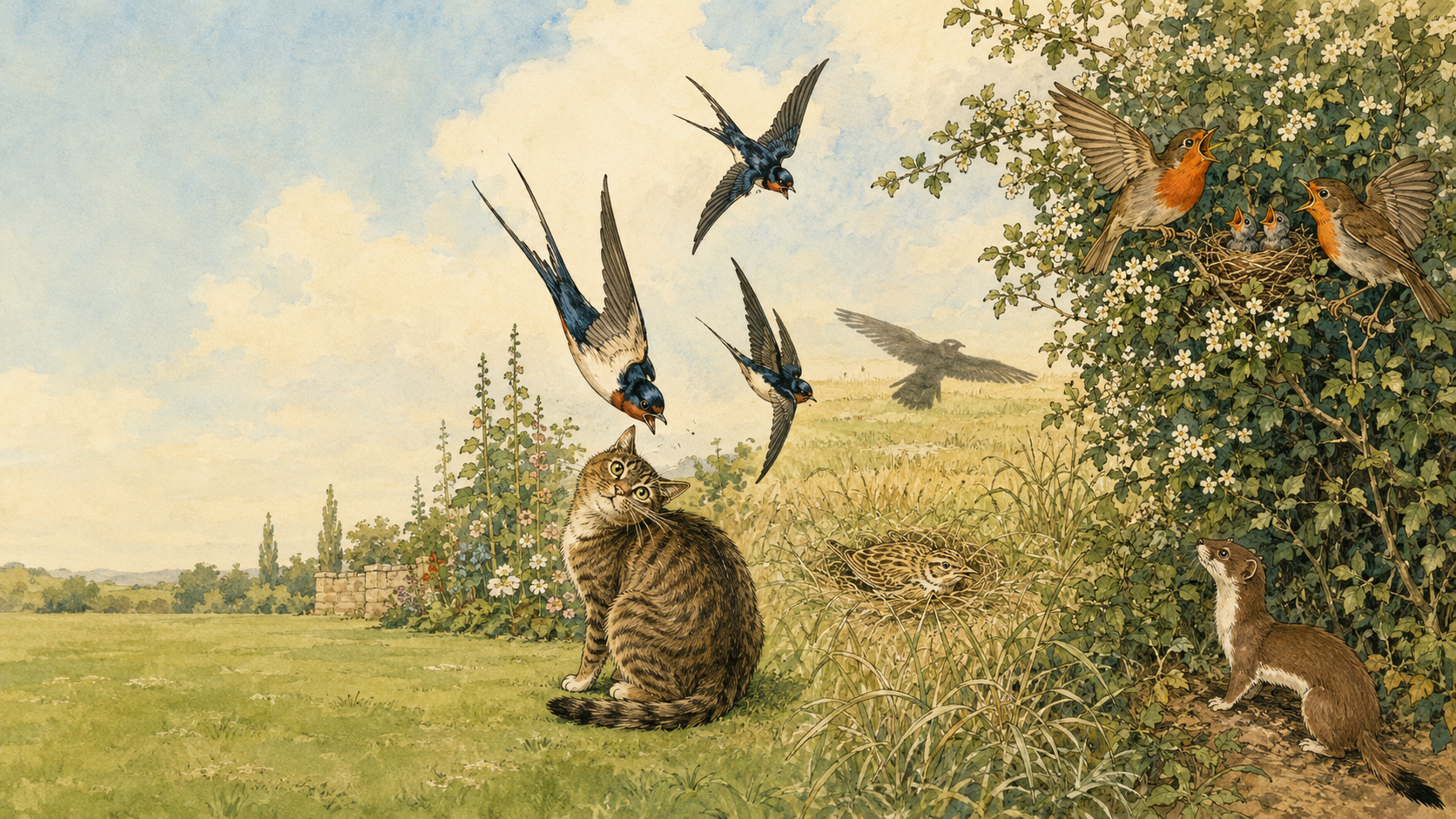
Birds of the Air Chapter 15, Bird Enemies, is the final chapter, and it turns from how birds live to the dangers they face and how we can protect them. Arabella Buckley names the birds’ natural enemies: the cat that the swallows swoop down and peck, the owl prowling the hedge, the weasels, stoats, and snakes that hunt eggs and young, the fox that the partridge and pheasant dread at night, and the hawk that is a daytime terror to larks and pigeons. She reminds your child that animals must kill their food, but people need not rob nests, take eggs for show, or catch birds for cages and feathers. She explains that because so many birds had grown rare, laws were made to protect them, forbidding shooting, snaring, or egg-taking between the 15th of March and the 1st of August, with the lark and certain safe places like the Norfolk Broads and Slapton Ley specially guarded. She closes with a gentle charge: watch the birds, learn their nests, leave them undisturbed, and feed them in winter to make them your friends. It is a lesson in kindness, in noticing, and in caring for the small lives around us.
Say what you remember!
Tell what you remember from the last chapter.
What happened in Birds of the Air Chapter 14, Web-Footed Birds?Have a look
In the last chapter, Web-Footed Birds, Arabella Buckley looked at the birds that live mostly on the water. We met the gulls that float on the sea and fly up the Thames to London, the big black Cormorant that dives head-first for fish, and the shy little Grebe, or dabchick, that vanishes at the least alarm. Then she studied the farmyard Duck up close: her webbed feet that fold like a fan and open like a paddle, her light down-filled body, and the oil she spreads to keep her feathers dry. She ended with the handsome wild drake and his shining green head, noting how geese, swans, and wild ducks share the same webbed feet and strainer-like beaks.
Read the previous lesson: Web-Footed Birds →Show what you know!
Use your printable Lesson Guide. Fill in the vocabulary you know, then click to check your work and learn some new words today.
What are the difficult or advanced vocabulary words in Birds of the Air Chapter 15, Bird Enemies?prowl, snare, ornament, dreadHave a look
- prowl: To move about quietly and secretly, hunting for prey.
- snare: To catch an animal in a trap or loop.
- ornament: Something used only for decoration.
- dread: To feel great fear about something that may happen.
The Books come Alive!
Read or listen to Chapter 15 of Birds of the Air, the Kindred Thicket Enhanced Edition, read by Laura Caldwell.
Teacher’s Notes
This is a Kindred Thicket Enhanced Edition. We checked every claim in this chapter against modern ornithology.
Everything in this chapter still holds up today, so there are no corrections to keep in mind. The predators Buckley names, the way swallows mob a cat, and the lark crouching flat on her nest are all accurate, and the bird-protection law she describes, with its 15th of March to 1st of August close time, reflects the real Wild Birds Protection Acts of the 1880s. We checked each claim against the BTO and RSPB. Just enjoy the reading.
Read by Laura Caldwell for LibriVox (public domain), cleaned and trimmed by Kindred Thicket.
Memory becomes Action!
Use the Response Resource* to remember and spell tricky names. Choose one way to narrate.
*Materials in the Lesson Guide.
What is the list of names, people, characters, birds, and places that are important in Chapter 15 of Birds of the Air?Swallow, Owl, Hawk, Lark, Partridge, Pheasant, Grouse, PigeonHave a look
- Swallow: Swoops down to peck the cat’s back, then rises again before she can turn round.
- Owl: Prowls along the hedge at night, hunting sitting mothers and young birds.
- Hawk: A daytime terror to all birds; the lark and song-birds flee or hide when it is near.
- Lark: Crouches on the nest hoping the grass will hide her; now protected by law.
- Partridge: Dreads the fox at night and runs to cover from the hawk by day.
- Pheasant: Fears the fox at night, like the fowls and ducks in the farmyard.
- Grouse: One of the ground birds that dreads the fox at night.
- Pigeon: Hides away in the wood when a hawk is near.
Chapter 15 Q & A
This is a Kindred Thicket Enhanced Edition. We read every chapter against modern science, and here is what we found in this chapter.
Is Birds of the Air Chapter 15, Bird Enemies, scientifically accurate?
Birds of the Air Chapter 15, Bird Enemies, is accurate throughout. The natural history is light but sound: we checked Buckley’s account of swallows mobbing a cat, the owl and stoat as nest predators, snakes eating eggs, and the lark crouching flat on her nest against modern ornithology (BTO BirdFacts and the RSPB), and they all hold up. The bird-protection law she describes, with its close time from the 15th of March to the 1st of August, reflects the real Wild Birds Protection Acts of the 1880s. This is a Kindred Thicket Enhanced Edition, and this chapter needed no corrections.
Why do swallows swoop at a cat?
Swallows swoop at a cat because they are mobbing it, a bold anti-predator behaviour in which birds harass a threat near their nest or roost. Using their speed and manoeuvrability, swallows peck at a cat’s back and rise again before she can turn round, exactly as Buckley describes, and they will do the same to hawks and other dangers. This is well documented today, and her account is accurate.
What are the natural enemies of birds in this chapter?
The natural enemies of birds in this chapter are the cat, the owl that prowls the hedge at night, weasels and stoats, egg-eating snakes, the fox that ground birds dread after dark, and the hawk that is a daytime terror. Buckley explains that these animals must kill to eat, so they are the birds’ natural enemies, and modern ornithology confirms owls, stoats, foxes, and snakes as real predators of birds, eggs, and young.
Why were laws made to protect wild birds?
Laws were made to protect wild birds because so many birds and eggs had been taken, for cages, for feathers on ornaments, and for show, that birds common thirty years earlier had grown rare. Buckley is describing the Wild Birds Protection Acts of the 1880s, which created a close time from the 15th of March to the 1st of August when people could not shoot, snare, or take the eggs of wild birds except on their own land. This gave birds time to raise their young.
What is the "close time" for birds?
The "close time" is the season, from the 15th of March to the 1st of August, when people were forbidden to shoot or snare wild birds or take their eggs, so the birds had time to bring up their young. Certain birds, including the lark, were protected even in one’s own garden during this period, and a few places, such as some of the Norfolk Broads and Slapton Ley in Devon, were guarded at all times. These dates match the real Victorian bird-protection acts.
How can children help protect birds?
Children can help protect birds by following one very safe rule Buckley gives: do not take any eggs, and do not kill any birds. Beyond that, she encourages them to watch where birds nest and keep them undisturbed, listen to their songs, notice the good work they do eating slugs, snails, and grubs, and feed them in winter to make them friends. It is a gentle lesson in kindness and careful observation to close the book.