The Listening Grove · Birds of the Air
Chapter 14: Web-Footed Birds
A Charlotte Mason nature-study lesson. Press play, with the lesson.
What is Birds of the Air Chapter 14, Web-Footed Birds, about?Parent review
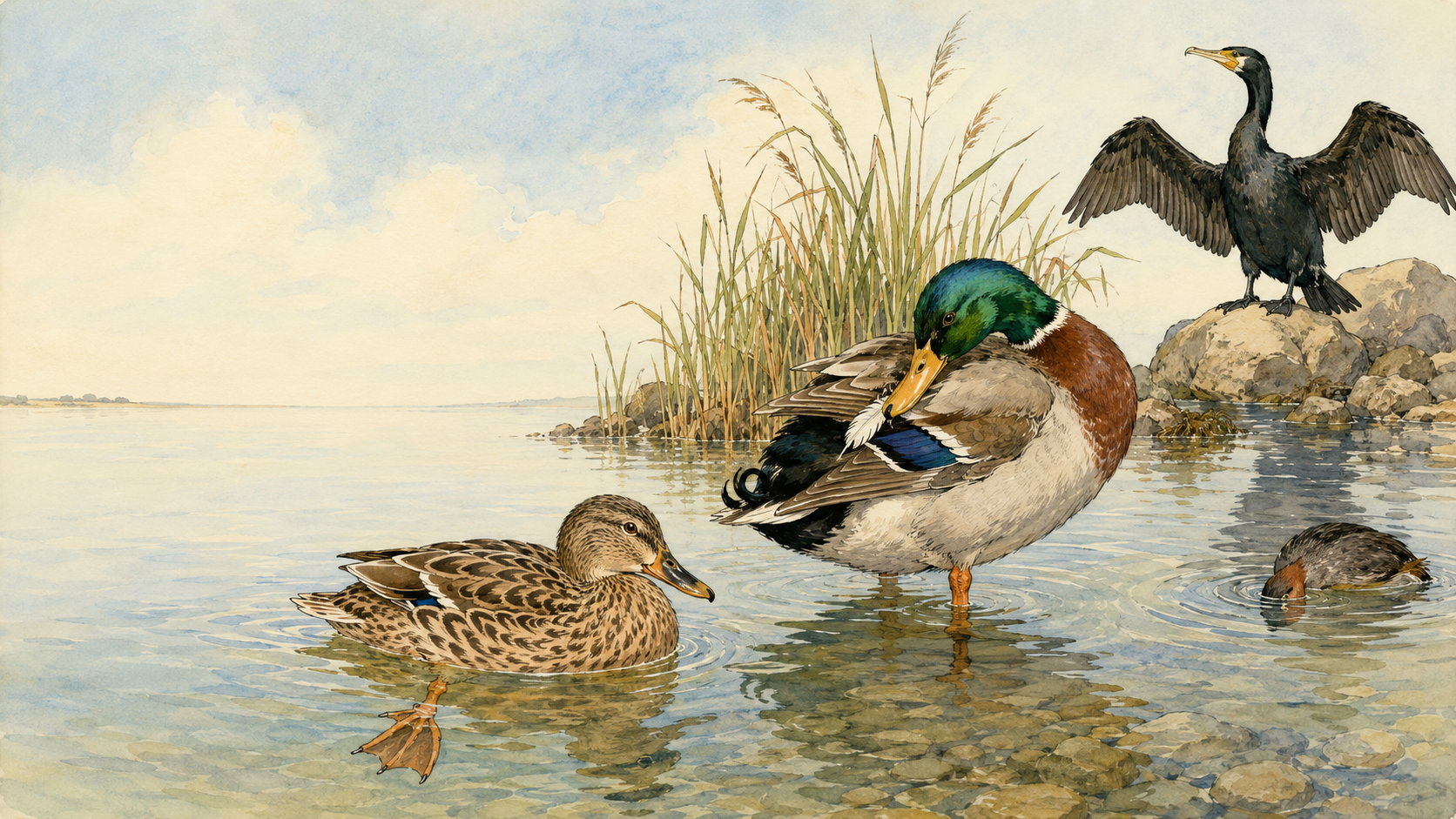
Birds of the Air Chapter 14, Web-Footed Birds, looks closely at the birds that live and feed on the water. Arabella Buckley begins with the gulls that circle over the sea and up the river Thames, the big black Cormorants that dive head-first for fish, and the shy little Dabchick that vanishes among the reeds at the least alarm. She then turns to the tame Duck of the farmyard, and shows your child exactly how the skin between her toes folds like a fan when she lifts her foot and spreads into a paddle when she rows through the water. She explains why the duck floats so lightly, how she oils her feathers water-proof from a little pocket near her tail, and how her broad bill works like a strainer to sift food from the mud. She ends with the handsome green-headed Drake, who trades his glossy colours for a plain brown coat in June and does not grow gay again until October. It is a lesson in watching how a bird’s whole body is fitted for a life on the water.
Say what you remember!
Tell what you remember from the last chapter.
What happened in Birds of the Air Chapter 13, Rooks and Their Companions?Have a look
In the last chapter, Rooks and Their Companions, Arabella Buckley showed us how the noisy black Rook does far more good than harm, eating the wire-worms, grubs, and cockchafers that would otherwise ruin a farmer’s crops. We learned to tell a Rook from a Crow by the bald grey patch above the older rook’s beak, and by the fact that crows keep to pairs while rooks live together in a busy rookery. She watched the sentinel rooks that keep guard and cry caw-caw when danger comes, waking the lazy ones so the whole flock can fly away together. She ended with the friends the rooks allow to feed beside them, the sprightly Jackdaw and the bright, glossy Starling.
Read the previous lesson: Rooks and Their Companions →Show what you know!
Use your printable Lesson Guide. Fill in the vocabulary you know, then click to check your work and learn some new words today.
What are the difficult or advanced vocabulary words in Birds of the Air Chapter 14, Web-Footed Birds?web-footed, waddle, strainer, glossyHave a look
- web-footed: Having skin joining the toes, which helps a bird swim.
- waddle: To walk with short steps, rocking from side to side.
- strainer: A tool with small holes that lets water through but holds solids back.
- glossy: Smooth and shiny.
The Books come Alive!
Read or listen to Chapter 14 of Birds of the Air, the Kindred Thicket Enhanced Edition, read by Laura Caldwell.
Teacher’s Notes
This is a Kindred Thicket Enhanced Edition. We checked every claim in this chapter against modern ornithology.
Buckley’s account of the duck’s webbed feet, waterproof feathers, and strainer-like bill all holds up today, and the drake’s June-to-October change of coat is described exactly right, so there are no corrections to keep in mind. We checked each claim against the BTO. Just enjoy the reading.
Read by Laura Caldwell for LibriVox (public domain), cleaned and trimmed by Kindred Thicket.
Memory becomes Action!
Use the Response Resource* to remember and spell tricky names. Choose one way to narrate.
*Materials in the Lesson Guide.
What is the list of names, people, characters, birds, and places that are important in Chapter 14 of Birds of the Air?Gull, Cormorant, Grebe (Dabchick), Duck, Drake, Goose, SwanHave a look
- Gull: Floats on the sea and flies far up rivers, circling to catch food thrown to it.
- Cormorant: A big black bird that flies heavily with its neck stretched out, then dives head-first for fish.
- Grebe (Dabchick): A small brown diving bird that paddles among the reeds and vanishes at the least alarm.
- Duck: Web-footed; her folding foot-skin works like a paddle to row her through the water, and her strainer bill sifts food from the mud.
- Drake: The handsome male duck, with a dark green head, white collar, and chestnut breast, who trades his colours for a plain coat from June to October.
- Goose: Has feet and a beak much like the farmyard duck.
- Swan: Has feet and a beak much like the duck, built for a life on the water.
Chapter 14 Q & A
This is a Kindred Thicket Enhanced Edition. We read every chapter against modern science, and here is what we found in this chapter.
Is Birds of the Air Chapter 14, Web-Footed Birds, scientifically accurate?
Birds of the Air Chapter 14, Web-Footed Birds, is accurate almost throughout. We checked it against modern ornithology (BTO BirdFacts), and Buckley’s detailed account of the duck, its webbed feet, its buoyancy, its oiled waterproof feathers, and its strainer-like bill, all holds up, as does the timing of the drake Mallard’s eclipse-plumage moult from June to October. Two very minor points: she calls the little Dabchick’s short wings a result of its "chiefly floating," when in fact short wings in grebes are an adaptation for diving underwater; and her Cormorant description, while correct, is a brief sketch. This is a Kindred Thicket Enhanced Edition, and none of these small points needed a correction on the recording.
How do a duck’s webbed feet help it swim?
A duck’s webbed feet have a skin between the front toes that folds up like a fan when she lifts her foot forward, then spreads wide into a paddle when she pushes it back against the water, so she rows herself along. Because her legs grow far back on her body, she can also twist and tip head-down to feed while paddling. Buckley’s description of this folding-and-spreading action is exactly how avian swimming works, and it is accurate.
Why do a duck’s feathers not get wet?
A duck’s feathers stay dry because she smears them with oil from a little pocket, the preen gland, near her tail, pressing her beak against it and drawing each feather through the beak. This is the uropygial gland that modern ornithology describes, and the oil makes her outer feathers water-proof. Buckley’s account of how a duck oils and preens herself is accurate.
Why does a drake mallard lose his bright colours in summer?
A drake Mallard loses his glossy green head and chestnut breast in June, when he moults into a plain brown and grey "eclipse" coat that looks like the mother duck, and he does not grow gay again until October. This dull plumage helps hide him during the weeks he cannot fly while his wing feathers are replaced. Buckley’s June-to-October timing matches modern records exactly, and it is accurate.
What is a dabchick?
A Dabchick is an old country name for the Little Grebe, a small brown diving bird with a thin neck that paddles among the reeds of lakes and rivers and dives at the least alarm, coming up far away out of sight. Buckley’s portrait of its shy, vanishing habits is accurate; her one loose point is saying its short wings come from "chiefly floating," when short wings in grebes are really an adaptation for diving.
How does a duck use its bill like a strainer?
A duck’s bill is broad and flat with a soft, nerve-filled skin that lets her feel food in the mud, and its edges are lined with thin horny strips that fit together into a sieve when she closes her beak. She sifts the mud through this strainer, forcing out the water with her thick tongue while keeping snails and weeds in her mouth. Buckley’s description matches the comb-like lamellae of a real duck bill, and it is accurate.