The Listening Grove · Fifty Famous Stories Retold
Chapter 22: The Bell of Atri
A Charlotte Mason read-aloud lesson. Press play, with the lesson.
What is Fifty Famous Stories Retold Chapter 22, The Bell of Atri, about?Parent review
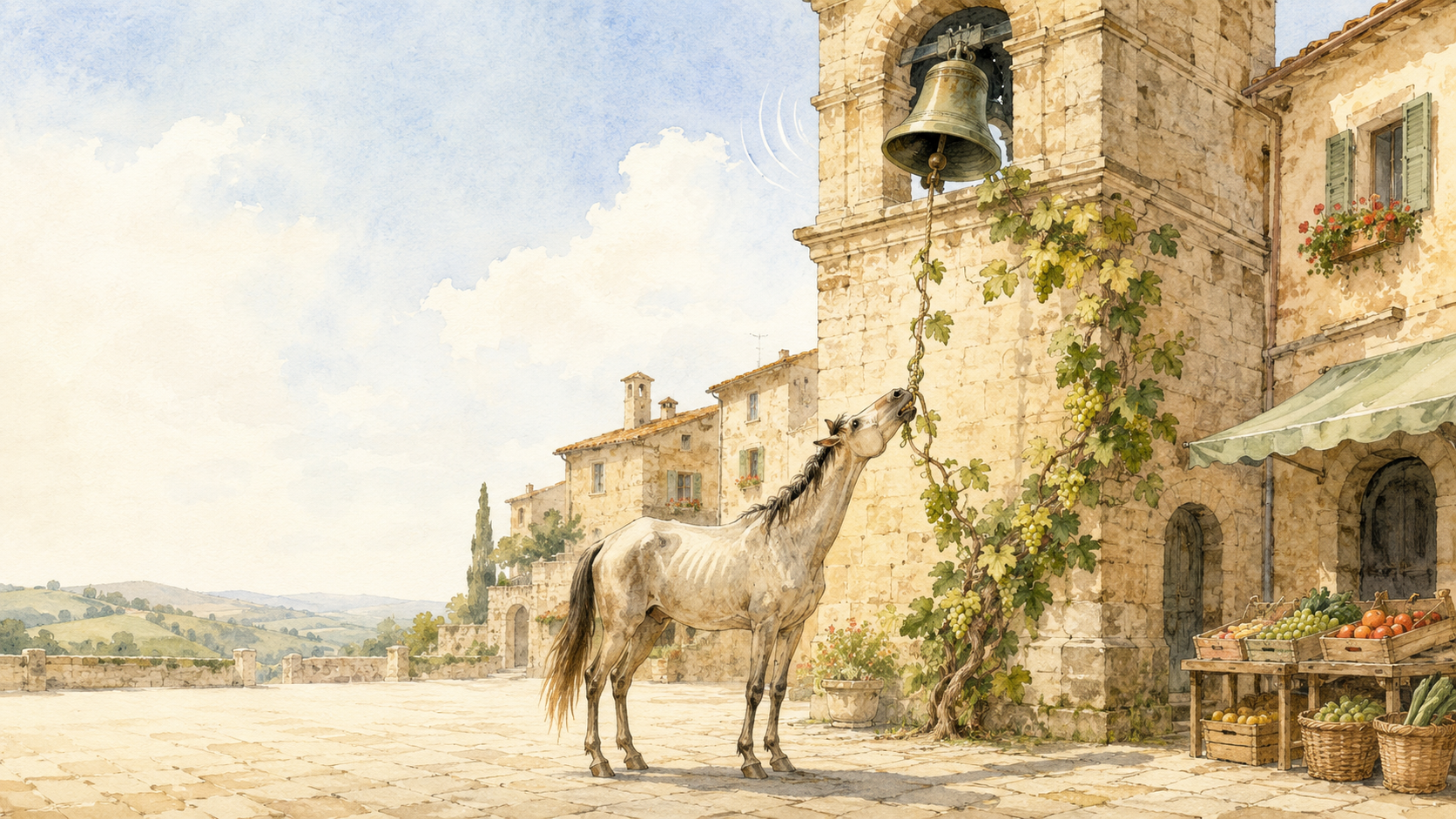
Fifty Famous Stories Retold Chapter 22, The Bell of Atri, is a story about justice and mercy to animals. In the Italian town of Atri, a king hung up a great bell of justice, so that anyone who had been wronged might ring it and be heard. Years passed, and the old bell-rope wore away until a leafy grape-vine was tied on in its place. In the town lived a miserly old man who had a faithful horse, but he grew so greedy that he turned the poor beast out to starve. One day the hungry horse wandered into the square, reached up to nibble the vine, and set the bell ringing. The judges came, understood the horse’s silent plea, and ordered the miser to spend half his gold on caring for the animal.
Say what you remember!
Tell what you remember from the last chapter.
What happened in Fifty Famous Stories Retold Chapter 21, Arnold Winkelried?Have a look
In the last chapter, Arnold Winkelried, an armored army marched into Switzerland, their ranks so bristling with spears that the Swiss could not break through. As the battle hung in the balance, a brave man named Arnold Winkelried stepped forward. Crying farewell to his companions, he gathered a whole bundle of the enemy’s spears into his own body. His countrymen poured through the gap he had opened, and the Swiss won the day. Winkelried gave his life to save his homeland, and his name has never been forgotten.
Read the previous lesson: Arnold Winkelried →Show what you know!
Use your printable Lesson Guide. Fill in the vocabulary you know, then click to check your work and learn some new words today.
What are the difficult or advanced vocabulary words in Fifty Famous Stories Retold Chapter 22, The Bell of Atri?justice, miser, steed, tendrilsHave a look
- justice: fair treatment under the law
- miser: a stingy person who hates to spend money
- steed: a spirited horse used for riding
- tendrils: slender coiling parts that help a plant climb
Locate it on the map!
Use your printable Lesson Guide. Use an atlas and fill in the blank map if you can find the geographic location, then click to check your work.
What important geographic location connects with Fifty Famous Stories Retold Chapter 22, The Bell of Atri?
- Find Italy.
See it on the mapHave a look
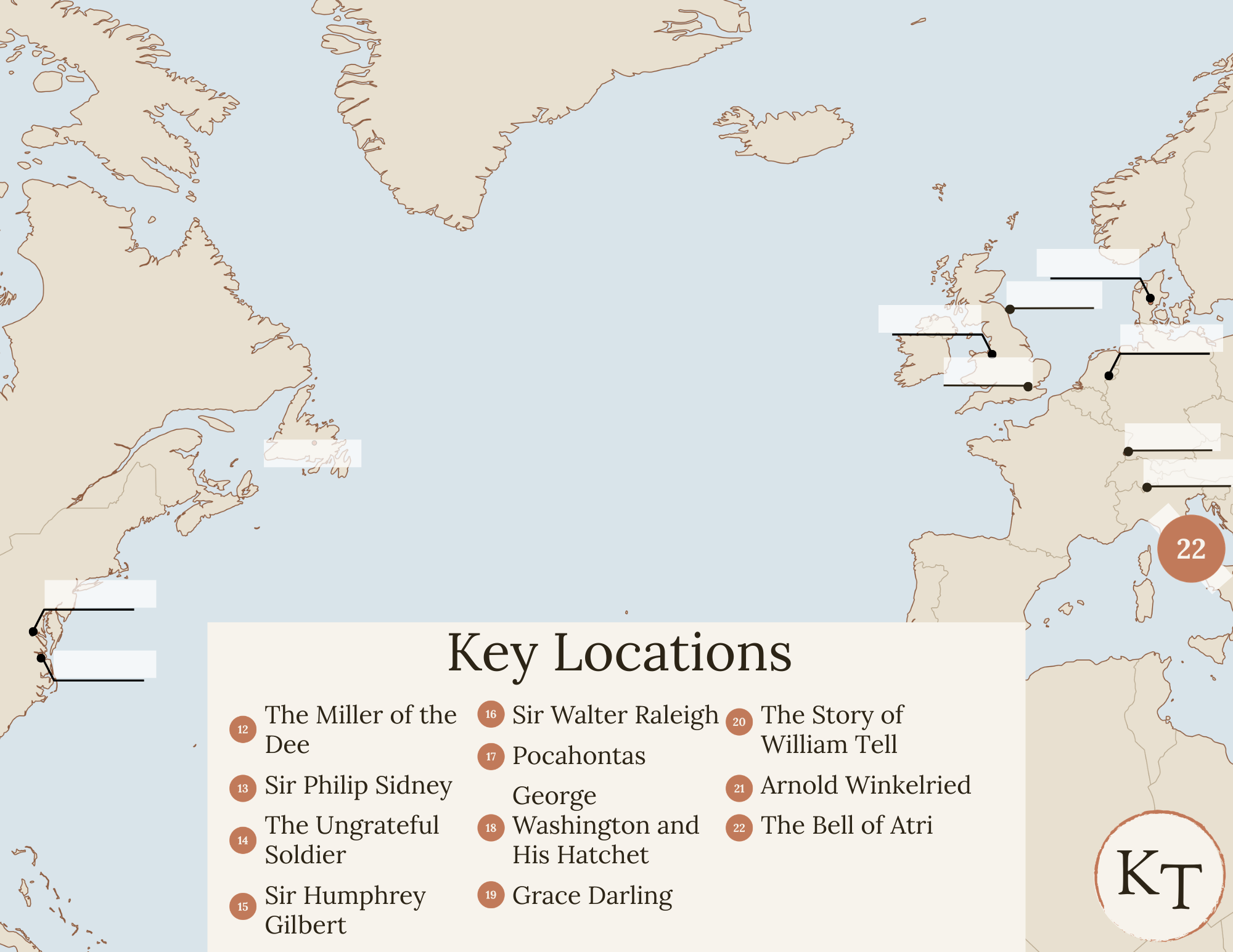
This matches the map in your Lesson Guide.
The Books come Alive!
Read or listen to Chapter 22 of Fifty Famous Stories Retold, the Kindred Thicket Enhanced Edition, read by Laura Caldwell.
Read by Laura Caldwell for LibriVox (public domain), professionally adjusted and trimmed by Kindred Thicket.
What do the Teacher’s Notes tell us about Chapter 22 of Fifty Famous Stories Retold?Parent review
This is a Kindred Thicket Enhanced Edition. Baldwin’s 1896 words are read exactly as he wrote them, and we add Teacher’s Notes with historical and literary context.
- About the whole bookFifty Famous Stories Retold gathers real history together with well-loved legends and traditions. These notes tell you, story by story, which is which.
- This chapterAtri is a real, ancient town in Italy, but the bell of justice and the starving horse are a legend, best known from Longfellow’s poem ’The Bell of Atri.’ Enjoy it as a story about mercy and fairness.
- This chapterAtri was never a kingdom; it became a duchy of the Acquaviva family in 1393, so ’King of Atri’ is the language of story, not history.
Memory becomes Action!
Use the Response Resource* to remember and spell tricky names. Choose one way to narrate.
*Materials in the Lesson Guide.
What is the list of names, people, characters, and places that are important in Chapter 22 of Fifty Famous Stories Retold?Atri, The King of Atri, The bell of justice, The miser, The horse, The judgesHave a look
- Atri: A real, very old hilltop town in Italy’s Abruzzo region.
- The King of Atri: The ruler who gives the town its bell of justice.
- The bell of justice: The town bell any wronged person may ring to summon the judges.
- The miser: A once-brave knight, now old and greedy, who neglects his faithful horse.
- The horse: The miser’s loyal old warhorse.
- The judges: The town officials who hear cases and give justice.
Chapter 22 Q & A
This is a Kindred Thicket Enhanced Edition. Baldwin’s stories mingle real history with beloved legend, and here is what to know about this one.
Is the story of The Bell of Atri true?
Atri is a real, ancient town in Italy, but the bell of justice and the starving horse are a legend, best known from Longfellow’s poem ’The Bell of Atri.’ There is no history behind the ringing horse and the miser’s judgment. It is best enjoyed as a story about mercy and fairness.
Was there really a King of Atri?
There was never really a King of Atri, for Atri was never a kingdom. In the year 1393 it became a duchy of the Acquaviva family, so ’King of Atri’ is the language of story rather than of history. The tale simply uses a king to stand for justice and authority.
How did the horse ring the bell of justice?
The horse rang the bell of justice by accident, reaching up to nibble the leafy grape-vine that had been tied on in place of the worn-out rope. As it tugged at the vine for food, the great bell overhead began to ring. The judges took this as the starving animal’s plea for justice.
What is the lesson of The Bell of Atri?
The lesson of The Bell of Atri is that justice and mercy are owed even to the animals in our care. The greedy miser was made to answer for starving his faithful horse, just as if a person had rung the bell against him. The story invites children to be kind and fair to every living creature.