The Listening Grove · Fifty Famous Stories Retold
Chapter 23: How Napoleon Crossed the Alps
A Charlotte Mason read-aloud lesson. Press play, with the lesson.
What is Fifty Famous Stories Retold Chapter 23, How Napoleon Crossed the Alps, about?Parent review
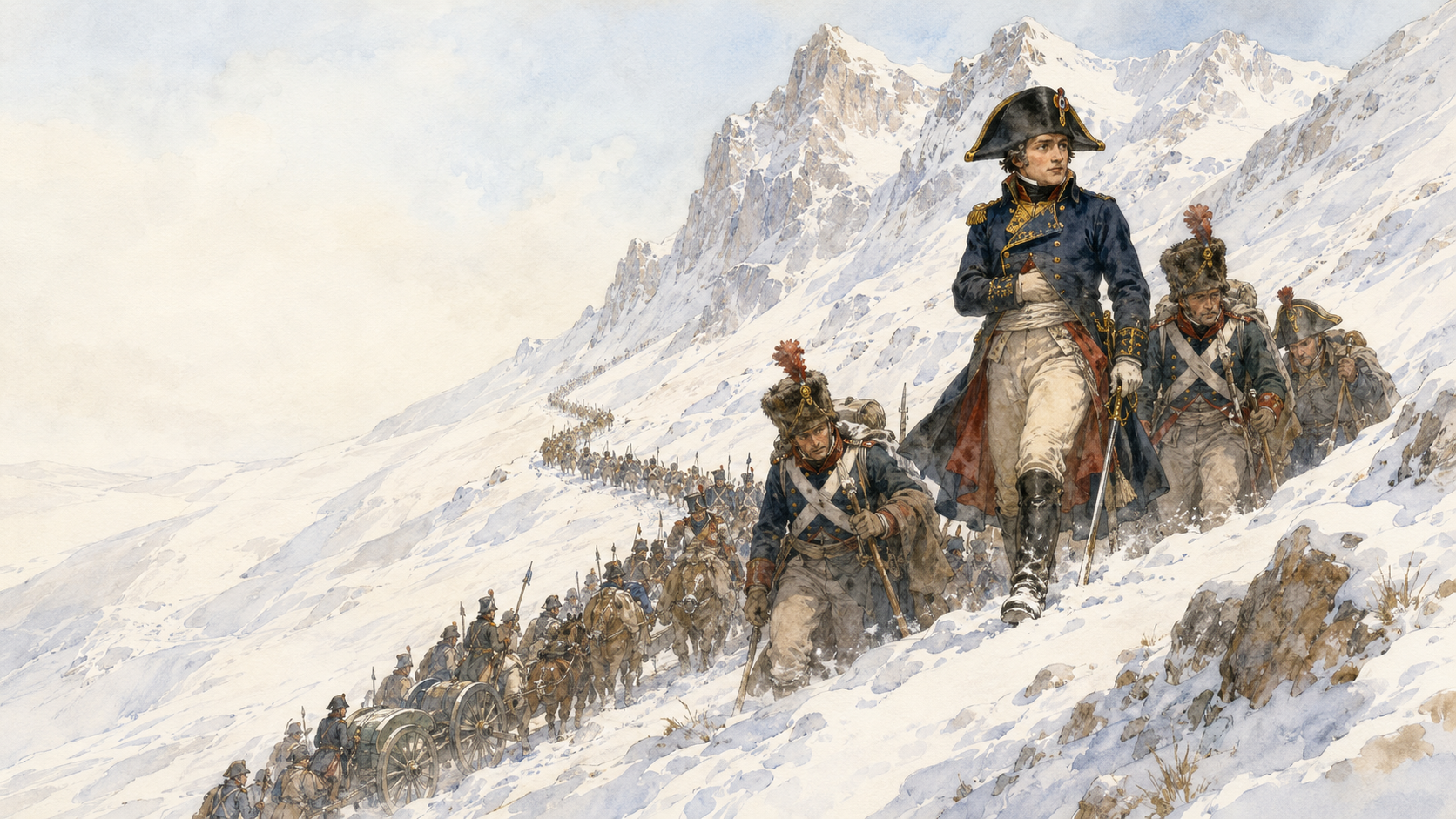
Fifty Famous Stories Retold Chapter 23, How Napoleon Crossed the Alps, tells of a bold march over snow-covered mountains. About a hundred years ago the French general Napoleon Bonaparte was at war with the lands around France and wished to reach Italy, which lay on the far side of the Alps. There was no road across, and his scouts warned that the crossing might be impossible. Napoleon would not be turned back. He led his army, with its horses and heavy cannon, up through the steep and icy passes where no army had gone before. In four days the long column came safely down onto the plains of Italy. It is a story of resolve and never saying a thing cannot be done.
Say what you remember!
Tell what you remember from the last chapter.
What happened in Fifty Famous Stories Retold Chapter 22, The Bell of Atri?Have a look
In the last chapter, The Bell of Atri, a king in an Italian town hung up a great bell of justice that anyone who had been wronged might ring, so that a judge would come to hear the case. After many years the bell-rope wore away and a grape-vine was tied on in its place. One day a poor old horse, starved and turned out by his miserly owner, wandered into the market place and nibbled the leaves of the vine, and so the bell rang. The judges came and heard the horse's silent case, then ordered the miser to spend half his money on the animal's food and care.
Read the previous lesson: The Bell of Atri →Show what you know!
Use your printable Lesson Guide. Fill in the vocabulary you know, then click to check your work and learn some new words today.
What are the difficult or advanced vocabulary words in Fifty Famous Stories Retold Chapter 23, How Napoleon Crossed the Alps?general, pass, cannon, trumpetHave a look
- general: the leader of an army
- pass: a low road through a mountain range
- cannon: a large, heavy gun on wheels
- trumpet: a brass horn that plays loud, clear notes
Locate it on the map!
Use your printable Lesson Guide. Use an atlas and fill in the blank map if you can find the geographic location, then click to check your work.
What important geographic location connects with Fifty Famous Stories Retold Chapter 23, How Napoleon Crossed the Alps?
- Find The Great St. Bernard Pass (Valais, Switzerland): the high mountain pass where Napoleon's army crossed the Alps
See it on the mapHave a look
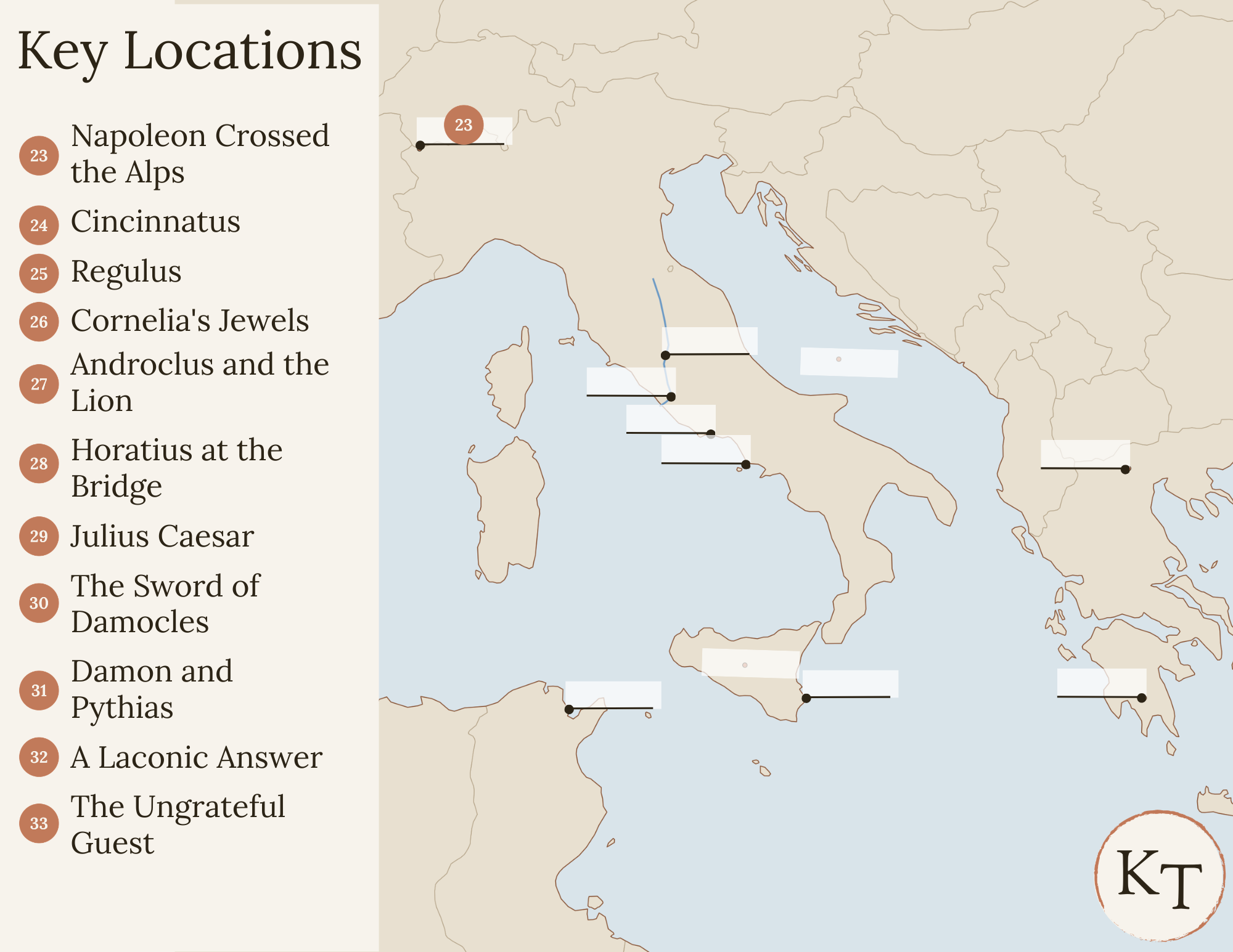
This matches the map in your Lesson Guide.
The Books come Alive!
Read or listen to Chapter 23 of Fifty Famous Stories Retold, the Kindred Thicket Enhanced Edition, read by Laura Caldwell.
Read by Laura Caldwell for LibriVox (public domain), professionally adjusted and trimmed by Kindred Thicket.
What do the Teacher’s Notes tell us about Chapter 23 of Fifty Famous Stories Retold?Parent review
This is a Kindred Thicket Enhanced Edition. Baldwin’s 1896 words are read exactly as he wrote them, and we add Teacher’s Notes with historical and literary context.
- About the whole bookFifty Famous Stories Retold gathers real history together with well-loved legends and traditions. These notes tell you, story by story, which is which.
Memory becomes Action!
Use the Response Resource* to remember and spell tricky names. Choose one way to narrate.
*Materials in the Lesson Guide.
What is the list of names, people, characters, and places that are important in Chapter 23 of Fifty Famous Stories Retold?Napoleon Bonaparte, The French army, France, Italy, The AlpsHave a look
- Napoleon Bonaparte: A real French general who led his army over the Alps into Italy in 1800.
- The French army: The soldiers Napoleon takes over the mountains, with their horses and cannon.
- France: Napoleon's country, at war with nearly all the lands around it.
- Italy: The land on the far side of the mountains that Napoleon means to reach.
- The Alps: The real snow-topped mountains between France and Italy; the army crossed at the Great St Bernard Pass.
Chapter 23 Q & A
This is a Kindred Thicket Enhanced Edition. Baldwin’s stories mingle real history with beloved legend, and here is what to know about this one.
Is How Napoleon Crossed the Alps a true story or a legend?
This one is real history. Napoleon Bonaparte truly led a French army over the Alps into Italy in the year 1800, crossing at the Great St. Bernard Pass. Among the eleven stories in this section, it is the one firmly documented modern event. The daring march really happened, though the numbers and details are told simply here for children.
Where did Napoleon cross the mountains?
History records that Napoleon's army crossed at the Great St. Bernard Pass, high in the Alps between Switzerland and Italy. The Baldwin story says only that there was no road and that the soldiers climbed where no army had gone before. On our Key Places map this crossing is the location marked for the chapter.
Did Napoleon really say the march was impossible?
A famous saying claims Napoleon declared that the word 'impossible' was not French. It is a memorable line that fits his bold spirit, but it cannot be treated as a documented quotation of his exact words. It is best enjoyed as a saying that captures his determination rather than as history recorded from his own lips.
How long did the crossing take?
In the story the army comes down onto the plains of Italy just four days after starting up the mountains. Baldwin tells the tale in round, simple numbers for young listeners. The real crossing of 1800 was a remarkable feat of planning and endurance, moving thousands of soldiers, horses, and heavy cannon over icy passes where there was no proper road.