The Listening Grove · Fifty Famous Stories Retold
Chapter 24: The Story of Cincinnatus
A Charlotte Mason read-aloud lesson. Press play, with the lesson.
What is Fifty Famous Stories Retold Chapter 24, The Story of Cincinnatus, about?Parent review
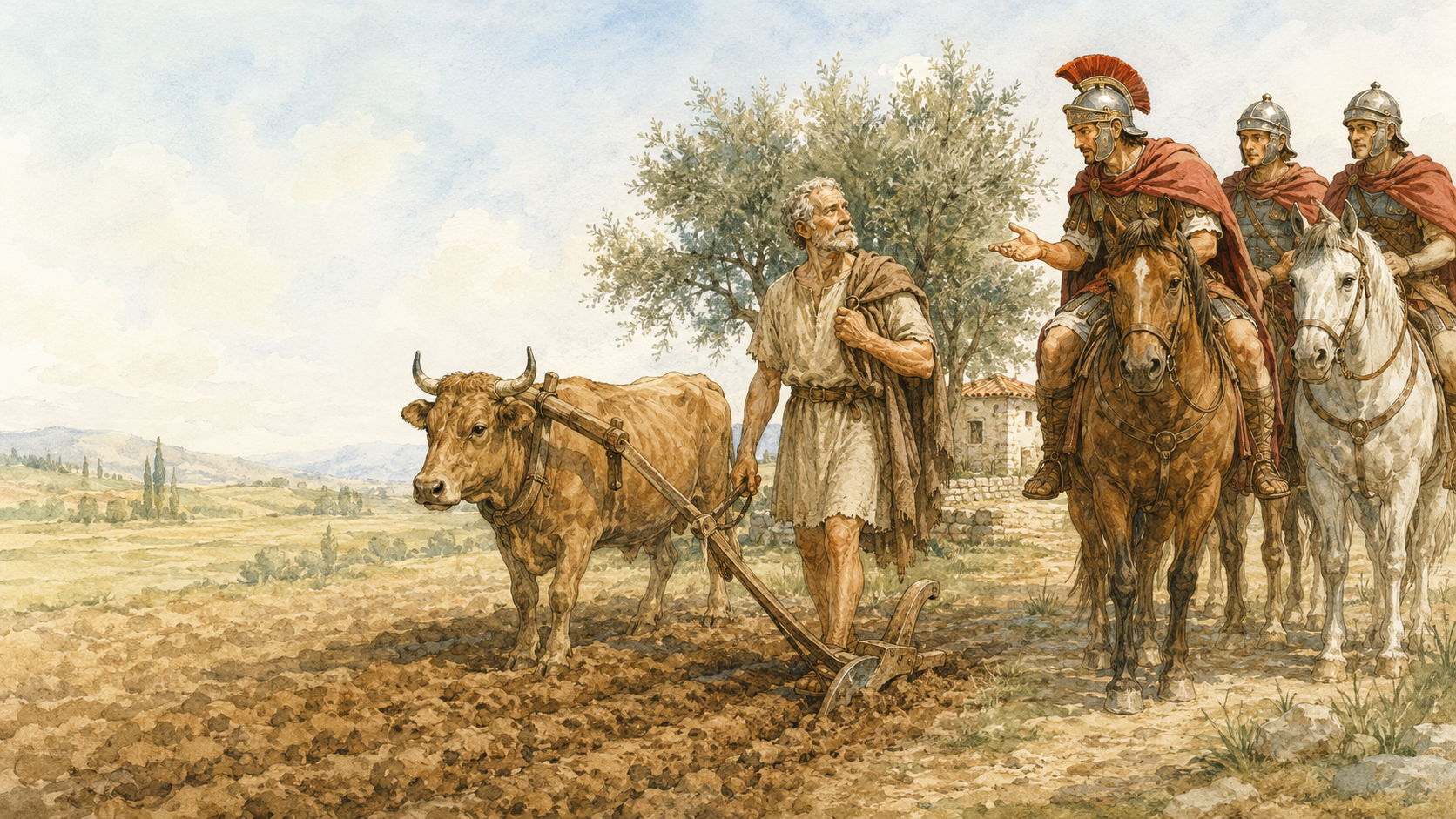
Fifty Famous Stories Retold Chapter 24, The Story of Cincinnatus, is about a farmer who saved Rome and then went home. Long ago Cincinnatus had held the highest office in the land, but now he lived quietly, plowing his own small farm. When a fierce mountain tribe trapped the Roman army in a narrow pass, the lawmakers of Rome hurried to his field and made him ruler with complete power. He left his plow, armed the guards and boys who were left, and defeated the enemy. Having freed the army and saved the city, he gave back his power and returned to his plow after only sixteen days. It is a lesson in duty and humble service.
Say what you remember!
Tell what you remember from the last chapter.
What happened in Fifty Famous Stories Retold Chapter 23, How Napoleon Crossed the Alps?Have a look
In the last chapter, How Napoleon Crossed the Alps, the French general Napoleon Bonaparte set out to lead his army into Italy, which lay beyond the snowy Alps. There was no road across the mountains, and his scouts warned that the crossing might be impossible. Napoleon refused to turn back. He led his soldiers, with their horses and heavy cannon, up through the steep and icy passes where no army had marched before. After four hard days the long column came safely down onto the plains of Italy. It was a striking example of firm resolve, and of not giving up when a task looks too hard to be done.
Read the previous lesson: How Napoleon Crossed the Alps →Show what you know!
Use your printable Lesson Guide. Fill in the vocabulary you know, then click to check your work and learn some new words today.
What are the difficult or advanced vocabulary words in Fifty Famous Stories Retold Chapter 24, The Story of Cincinnatus?plunder, till, entrap, bannerHave a look
- plunder: to rob and take goods by force
- till: to plow and work the soil for crops
- entrap: to catch someone in a trap
- banner: a flag carried as a sign
Locate it on the map!
Use your printable Lesson Guide. Use an atlas and fill in the blank map if you can find the geographic location, then click to check your work.
What important geographic location connects with Fifty Famous Stories Retold Chapter 24, The Story of Cincinnatus?
- Find The Alban Hills (Lazio, Italy).
See it on the mapHave a look
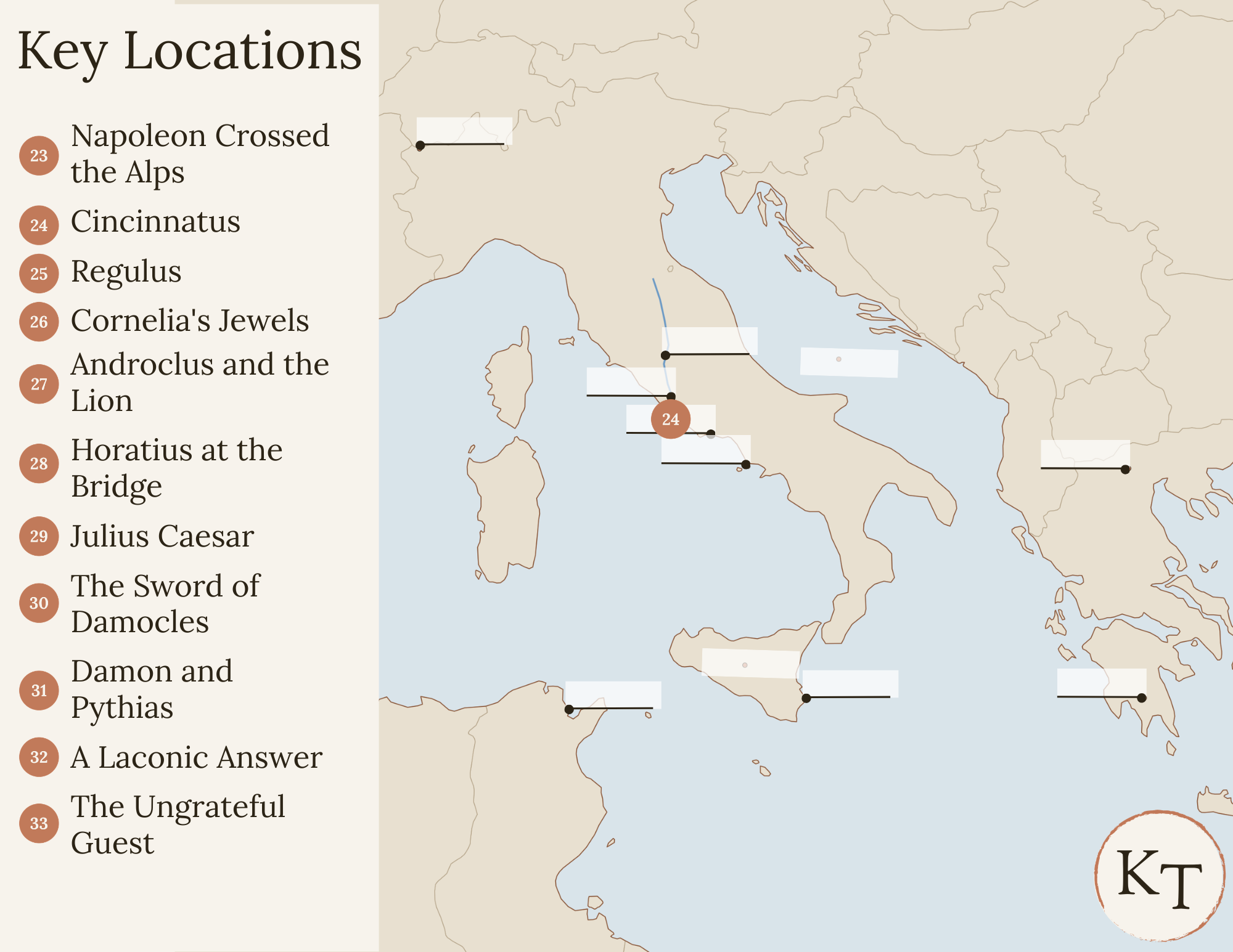
This matches the map in your Lesson Guide.
The Books come Alive!
Read or listen to Chapter 24 of Fifty Famous Stories Retold, the Kindred Thicket Enhanced Edition, read by Laura Caldwell.
Read by Laura Caldwell for LibriVox (public domain), professionally adjusted and trimmed by Kindred Thicket.
What do the Teacher’s Notes tell us about Chapter 24 of Fifty Famous Stories Retold?Parent review
This is a Kindred Thicket Enhanced Edition. Baldwin’s 1896 words are read exactly as he wrote them, and we add Teacher’s Notes with historical and literary context.
- About the whole bookFifty Famous Stories Retold gathers real history together with well-loved legends and traditions. These notes tell you, story by story, which is which.
- This chapterCincinnatus was a real Roman leader, called from his farm to rescue Rome in 458 BC. Much of his story, like the famous plow and the sixteen days of rule, grew richer as a treasured tradition over the centuries.
Memory becomes Action!
Use the Response Resource* to remember and spell tricky names. Choose one way to narrate.
*Materials in the Lesson Guide.
What is the list of names, people, characters, and places that are important in Chapter 24 of Fifty Famous Stories Retold?Cincinnatus, Rome, The white-haired Fathers, The men of the mountains, The Roman army, The guards and the boysHave a look
- Cincinnatus: A real Roman farmer who had once held the highest office in the land, called from his plow to lead Rome.
- Rome: The city in danger, small in those days, where every man was a soldier.
- The white-haired Fathers: The lawmakers of Rome, that is, the Roman Senate.
- The men of the mountains: The fierce tribe at war with Rome, known to history as the Aequi.
- The Roman army: Rome's finest fighting force, caught in a narrow mountain pass.
- The guards and the boys: The few defenders left in the city, whom Cincinnatus arms and leads out himself.
Chapter 24 Q & A
This is a Kindred Thicket Enhanced Edition. Baldwin’s stories mingle real history with beloved legend, and here is what to know about this one.
Is the story of Cincinnatus true history or a legend?
Cincinnatus was a real Roman leader, called from his farm to rescue Rome in 458 BC. Much of his story, like the famous plow and the sixteen days of rule, grew richer as a treasured tradition over the centuries. So the man is history, while the well-loved details are best shared as honored tradition rather than exact record.
Who were the enemies that trapped the Roman army?
The story calls them the fierce men of the mountains. History knows this tribe as the Aequi, a people who often fought against early Rome. Baldwin leaves them unnamed and simply describes a fierce tribe from the hills who boasted they would destroy the city. The Roman army had been caught in a narrow mountain pass when Cincinnatus was called to help.
Did Cincinnatus really give up his power?
Giving up power after only sixteen days is the heart of this treasured tradition. Roman writers remembered Cincinnatus as a man who took command to save the city, then laid it down at once and went back to his plow. Whether every detail is exact or not, he was long held up as a model of duty and humble service.
What can children learn from Cincinnatus?
The story is offered as a lesson in duty, humility, and giving up power when the work is done. Cincinnatus does not seek to rule or to grow rich; he serves when his city needs him and then returns quietly to his farm. It is a gentle picture of putting the common good ahead of one's own honor or comfort.