The Listening Grove · Fifty Famous Stories Retold
Chapter 32: A Laconic Answer
A Charlotte Mason read-aloud lesson. Press play, with the lesson.
What is Fifty Famous Stories Retold Chapter 32, A Laconic Answer, about?Parent review
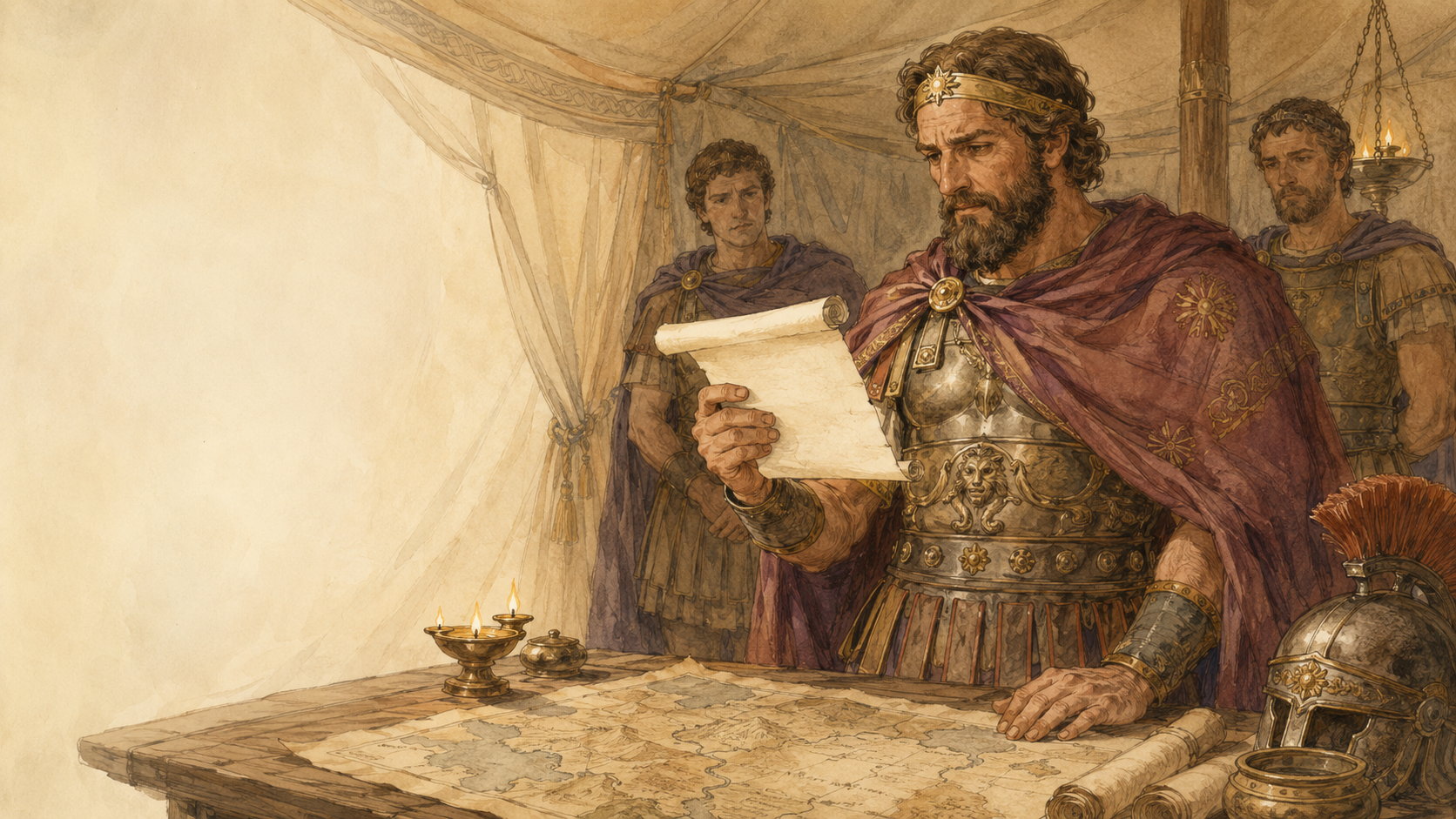
Fifty Famous Stories Retold Chapter 32, A Laconic Answer, is a brief tale about few words and steady courage. Long ago Greece was not one country but many separate states. The Spartans, who lived in the land of Laconia, were known for speaking very few words, which is why a short, plain answer is still called laconic. When Philip, the warlike king of Macedon, had conquered most of Greece, he sent Sparta a letter warning that if he entered Laconia he would level their city to the ground. The Spartans sent back a single word in reply: 'If.' It is a story about brevity, boldness, and where a familiar word comes from.
Say what you remember!
Tell what you remember from the last chapter.
What happened in Fifty Famous Stories Retold Chapter 31, Damon and Pythias?Have a look
In the last chapter, Damon and Pythias, a young man named Pythias was condemned to die by the tyrant Dionysius. He asked leave to go home to say farewell to his family, and his faithful friend Damon took his place in prison, ready to die himself if Pythias did not return. Storms and a shipwreck delayed Pythias, and the day of death drew near, yet Damon kept faith in his friend. At the very last moment Pythias arrived. The tyrant, amazed that two friends could be so loyal and true, set them both free. It was a treasured story of loyal friendship.
Read the previous lesson: Damon and Pythias →Show what you know!
Use your printable Lesson Guide. Fill in the vocabulary you know, then click to check your work and learn some new words today.
What are the difficult or advanced vocabulary words in Fifty Famous Stories Retold Chapter 32, A Laconic Answer?united, brief, warlike, levelHave a look
- united: joined together and acting as one
- brief: short and to the point
- warlike: fond of war and ready to fight
- level: to knock flat to the ground
Locate it on the map!
Use your printable Lesson Guide. Use an atlas and fill in the blank map if you can find the geographic location, then click to check your work.
What important geographic location connects with Fifty Famous Stories Retold Chapter 32, A Laconic Answer?
- Find Sparta (Laconia, Greece): the Spartan city that sent the one-word reply
See it on the mapHave a look
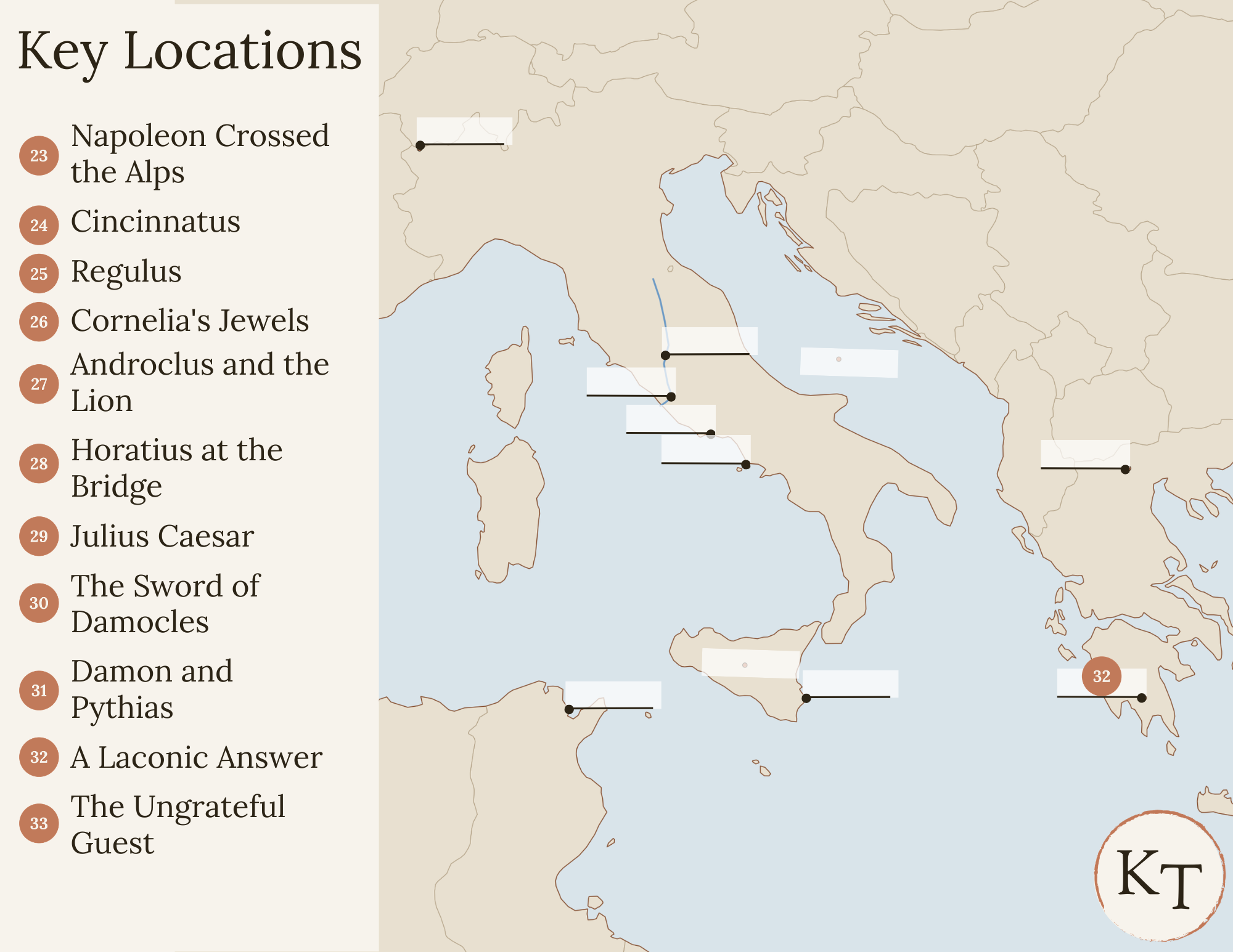
This matches the map in your Lesson Guide.
The Books come Alive!
Read or listen to Chapter 32 of Fifty Famous Stories Retold, the Kindred Thicket Enhanced Edition, read by Laura Caldwell.
Read by Laura Caldwell for LibriVox (public domain), professionally adjusted and trimmed by Kindred Thicket.
What do the Teacher’s Notes tell us about Chapter 32 of Fifty Famous Stories Retold?Parent review
This is a Kindred Thicket Enhanced Edition. Baldwin’s 1896 words are read exactly as he wrote them, and we add Teacher’s Notes with historical and literary context.
- About the whole bookFifty Famous Stories Retold gathers real history together with well-loved legends and traditions. These notes tell you, story by story, which is which.
- This chapterPhilip of Macedon truly conquered Greece, and the Spartans were famous for using few words, which gives us the word 'laconic.' Their one-word answer, 'If,' is a celebrated old tradition recorded by the writer Plutarch.
Memory becomes Action!
Use the Response Resource* to remember and spell tricky names. Choose one way to narrate.
*Materials in the Lesson Guide.
What is the list of names, people, characters, and places that are important in Chapter 32 of Fifty Famous Stories Retold?Greece, The Spartans, Laconia, Macedon, PhilipHave a look
- Greece: A real famous land beyond Rome, not united like the Romans, but several states each with its own rulers.
- The Spartans: The people of southern Greece, noted for simple habits and bravery, and sometimes called Lacons.
- Laconia: The real Spartan land, which gives us the word laconic.
- Macedon: A real kingdom in the northern part of Greece.
- Philip: Philip II of Macedon, the warlike king who made himself master of nearly all Greece.
Chapter 32 Q & A
This is a Kindred Thicket Enhanced Edition. Baldwin’s stories mingle real history with beloved legend, and here is what to know about this one.
Is A Laconic Answer true history or a legend?
Philip of Macedon truly conquered Greece, and the Spartans were famous for using few words, which gives us the word 'laconic.' Their one-word answer, 'If,' is a celebrated old tradition recorded by the writer Plutarch. So the history is real, while the famous single-word reply is a treasured tradition passed down about the Spartans.
Where does the word 'laconic' come from?
It comes from Laconia, the region of southern Greece where the Spartans lived. The Spartans were known for speaking very briefly and plainly, so a short, pointed answer came to be called laconic. The chapter shows this habit at its sharpest, when the Spartans answer Philip's long threat with just a single word: 'If.'
Who was Philip of Macedon?
Philip was the warlike king of Macedon, a real kingdom in the northern part of Greece. History records that he conquered nearly all of Greece. In this story he sends Sparta a threatening letter, and the Spartans answer him with one bold word. Philip was also the father of Alexander the Great, though the chapter does not mention that.
Did the Spartans really answer with one word?
The famous reply, the single word 'If,' is a celebrated old tradition recorded by the Greek writer Plutarch in his sayings of the Spartans. Whether it happened exactly so or not, it perfectly captures the Spartan love of few, fearless words. It is best enjoyed as a treasured tradition about their brave and simple speech.