The Listening Grove · Fifty Famous Stories Retold
Chapter 35: Diogenes the Wise Man
A Charlotte Mason read-aloud lesson. Press play, with the lesson.
What is Fifty Famous Stories Retold Chapter 35, Diogenes the Wise Man, about?Parent review
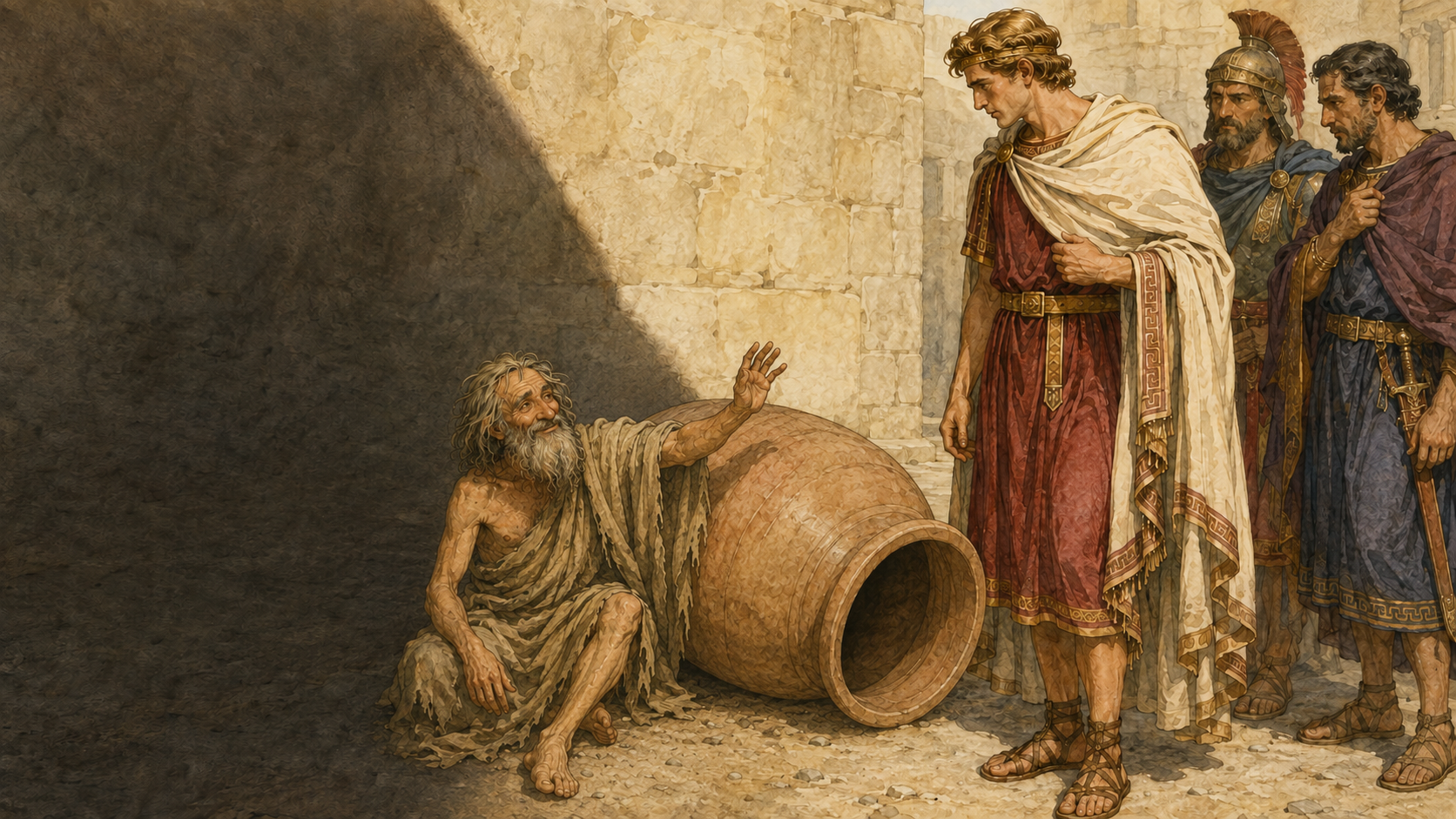
Fifty Famous Stories Retold Chapter 35, Diogenes the Wise Man, is a story about a philosopher who cared nothing for wealth or fame and lived by his own strict idea of what a person truly needs. Diogenes made his home in Corinth, sleeping in a rolled-about tub instead of a house, and once wandered the streets by daylight carrying a lighted lantern, explaining that he was searching for an honest man. When Alexander the Great visited Corinth, every leading citizen turned out to meet him, except Diogenes, who alone had not come to see the famous king. Curious about the one man who did not care for his praise, Alexander went to find him instead, and offered to grant him anything he wished. Diogenes asked only that the king step out of his sunlight. Alexander was so struck by the answer that he told his officers if he were not Alexander, he would wish to be Diogenes.
Say what you remember!
Tell what you remember from the last chapter.
What happened in Fifty Famous Stories Retold Chapter 34, Alexander and Bucephalus?Have a look
In the last chapter, Alexander and Bucephalus, we learned that young Alexander tamed a wild horse no one else could ride by noticing it was afraid of its own shadow and turning it to face the sun. His father, King Philip, was so amazed that he told Alexander he would need a larger kingdom than Macedon to match him. From then on, Alexander and his horse Bucephalus were inseparable, and Bucephalus carried him through many countries and battles as Alexander grew into the famous conqueror known as Alexander the Great.
Read the previous lesson: Alexander and Bucephalus →Show what you know!
Use your printable Lesson Guide. Fill in the vocabulary you know, then click to check your work and learn some new words today.
What are the difficult or advanced vocabulary words in Fifty Famous Stories Retold Chapter 35, Diogenes the Wise Man?foremost, admire, praise, greetedHave a look
- foremost: first in rank or importance
- admire: to regard with respect and approval
- praise: to say good things about someone
- greeted: spoke kindly to someone on meeting
Locate it on the map!
Use your printable Lesson Guide. Use an atlas and fill in the blank map if you can find the geographic location, then click to check your work.
What important geographic location connects with Fifty Famous Stories Retold Chapter 35, Diogenes the Wise Man?
- Find Corinth (Greece): Corinth is the Greek city where the wise philosopher Diogenes made his home, living simply in an old tub and content with almost nothing. It was here that Alexander the Great, curious about the one man in the city who had not come to praise him, sought Diogenes out.
See it on the mapHave a look

This matches the map in your Lesson Guide.
The Books come Alive!
Read or listen to Chapter 35 of Fifty Famous Stories Retold, the Kindred Thicket Enhanced Edition, read by Laura Caldwell.
Read by Laura Caldwell for LibriVox (public domain), professionally adjusted and trimmed by Kindred Thicket.
What do the Teacher’s Notes tell us about Chapter 35 of Fifty Famous Stories Retold?Parent review
This is a Kindred Thicket Enhanced Edition. Baldwin’s 1896 words are read exactly as he wrote them, and we add Teacher’s Notes with historical and literary context.
- About the whole bookFifty Famous Stories Retold gathers real history together with well-loved legends and traditions. These notes tell you, story by story, which is which.
- "At Corinth, in Greece"Diogenes came from Sinope, in what is now Turkey, and left it after a scandal over defaced coins. He lived in Athens first, where the famous tub stood, and reached Corinth later, after pirates captured and sold him.
- "a tub or barrel"The tub or barrel was really a pithos, a big clay storage jar used for grain or wine. Diogenes slept in one and once rolled it up and down the street to look busy while everyone else prepared for war.
- "a lighted lantern"The old book says lamp, not lantern: a small clay dish of oil with a burning wick, held in one hand. It gives no hour either, only daylight. Noon is not in the record.
- "I am looking for an honest man."The oldest telling has no "honest" in it. Diogenes says only "I am looking for a man," meaning a real human being. He is not hunting for someone truthful; he is saying that almost nobody he meets deserves to be called a person.
- "the only man for whose opinions Alexander cared""The only man" overstates it. Alexander admired Diogenes, but he had been taught by Aristotle, and Plutarch describes many statesmen and philosophers crowding around him on that same visit.
- the king finding him by his tubEverything in this chapter comes from stories written down four to six hundred years after Diogenes died. They are the oldest we have, and much loved, but no one can prove them. Neither one puts the tub in this scene.
Memory becomes Action!
Use the Response Resource* to remember and spell tricky names. Choose one way to narrate.
*Materials in the Lesson Guide.
What is the list of names, people, characters, and places that are important in Chapter 35 of Fifty Famous Stories Retold?Diogenes, Alexander the Great, Corinth, GreeceHave a look
- Diogenes: A wise man of Corinth.
- Alexander the Great: The king of Macedon.
- Corinth: A city in Greece, where Diogenes lived.
- Greece: The country Corinth is in.
Chapter 35 Q & A
This is a Kindred Thicket Enhanced Edition. Baldwin’s stories mingle real history with beloved legend, and here is what to know about this one.
Did Diogenes really live in Corinth?
He was born in Sinope, in what is now Turkey, and only reached Corinth later in life, after living for a time in Athens, where his famous tub first stood, and after being captured and sold by pirates.
Was it really a lantern, and did he really carry it at noon looking for "an honest man"?
The oldest sources say lamp, not lantern, and they do not mention noon at all. They also do not include the word "honest": the oldest version has Diogenes saying only "I am looking for a man," meaning a person who lives up to what a human being should be.
Was Diogenes really the only man Alexander cared about?
That is an overstatement. Alexander admired Diogenes, but he had been taught by the philosopher Aristotle, and ancient writers describe many statesmen and philosophers gathered around Alexander on that same visit.
Can we be sure any of this really happened the way it is told?
Not entirely. Every detail in this chapter comes from accounts written four to six hundred years after Diogenes died. They are the oldest records we have and much loved, but neither one even places him in a tub during the meeting with Alexander, so it is best enjoyed as treasured legend built around a real philosopher.