The Listening Grove · Fifty Famous Stories Retold
Chapter 36: The Brave Three Hundred
A Charlotte Mason read-aloud lesson. Press play, with the lesson.
What is Fifty Famous Stories Retold Chapter 36, The Brave Three Hundred, about?Parent review
Fifty Famous Stories Retold Chapter 36, The Brave Three Hundred, is a story about courage and dying free rather than living as a slave. A mighty Persian army marched toward Greece, and its king demanded water and earth from every city as tokens of surrender, but the Greeks refused. The only way into Greece on that side was a narrow pass between the mountains and the sea, guarded by Leonidas, king of the Spartans, and just three hundred soldiers. Though the Persian host was too vast to count, the Spartans held the pass, even joking they would fight in the shade of the enemy's arrows. All day they fought, and one by one they fell, until every Spartan lay dead, but twenty thousand Persians had fallen before them. Their sacrifice is remembered as a story of courage against overwhelming odds, still told after thousands of years.
Say what you remember!
Tell what you remember from the last chapter.
What happened in Fifty Famous Stories Retold Chapter 35, Diogenes the Wise Man?Have a look
In the last chapter, Diogenes the Wise Man, we learned that the philosopher Diogenes lived simply in Corinth, sleeping in a tub and once wandering the streets by daylight with a lighted lantern, saying he was looking for an honest man. When Alexander the Great came to Corinth, Diogenes was the only man who did not turn out to praise him, so Alexander sought him out instead and offered to grant him anything he wished. Diogenes asked only that the king step out of his sunlight, an answer that impressed Alexander so much he said he would rather be Diogenes than anyone else, if he could not be Alexander.
Read the previous lesson: Diogenes the Wise Man →Show what you know!
Use your printable Lesson Guide. Fill in the vocabulary you know, then click to check your work and learn some new words today.
What are the difficult or advanced vocabulary words in Fifty Famous Stories Retold Chapter 36, The Brave Three Hundred?token, haste, bidding, stirHave a look
- token: an outward sign that shows what is meant
- haste: great speed in moving or acting
- bidding: telling someone what they must do
- stir: a state of excitement and busy activity
Locate it on the map!
Use your printable Lesson Guide. Use an atlas and fill in the blank map if you can find the geographic location, then click to check your work.
What important geographic location connects with Fifty Famous Stories Retold Chapter 36, The Brave Three Hundred?
- Find Thermopylae (Greece): Baldwin never names this place himself, describing it only as "a narrow pass between the mountains and the sea" where Leonidas and his three hundred Spartans made their stand. History gives that pass its name: Thermopylae, in Greece.
See it on the mapHave a look
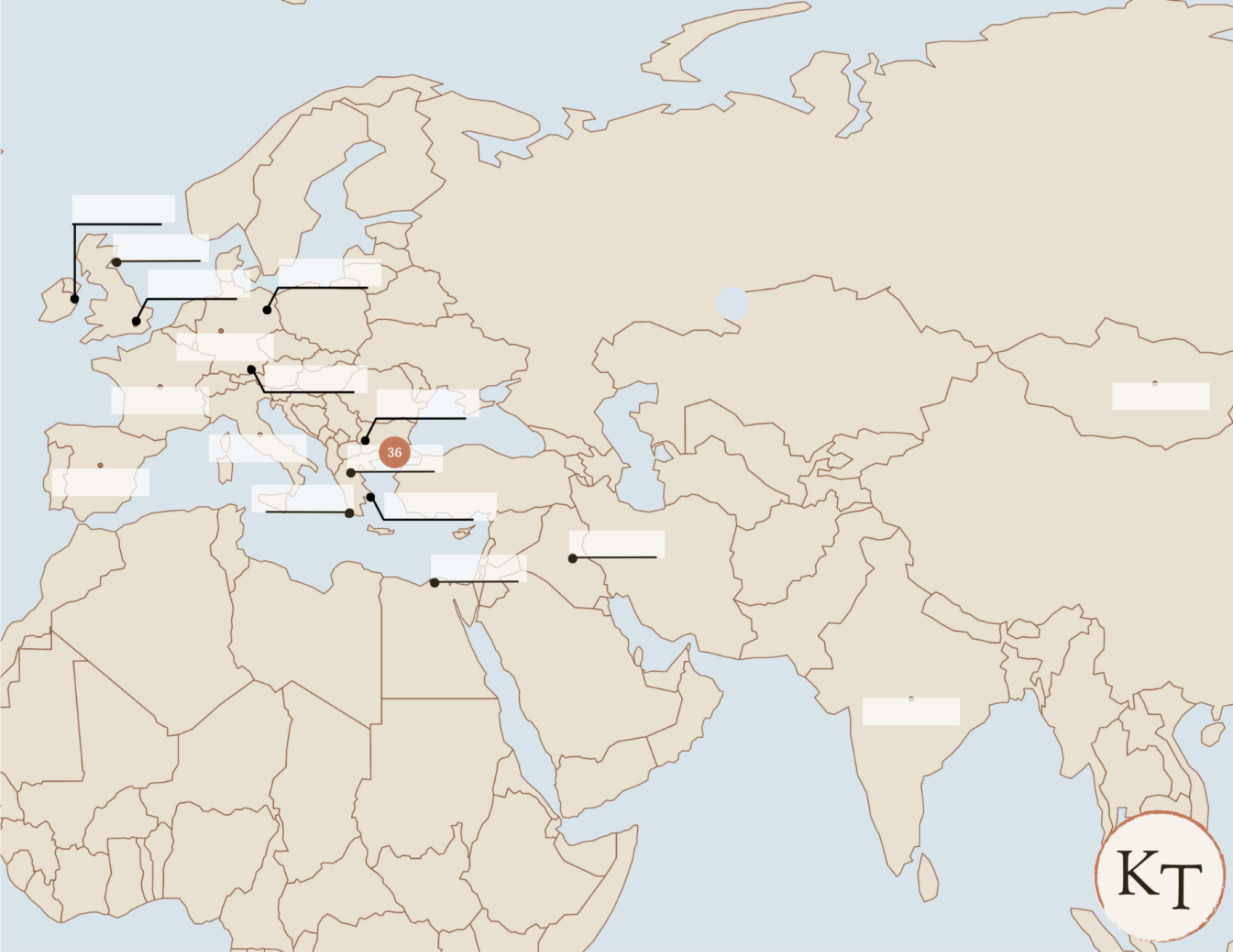
This matches the map in your Lesson Guide.
The Books come Alive!
Read or listen to Chapter 36 of Fifty Famous Stories Retold, the Kindred Thicket Enhanced Edition, read by Laura Caldwell.
Read by Laura Caldwell for LibriVox (public domain), professionally adjusted and trimmed by Kindred Thicket.
What do the Teacher’s Notes tell us about Chapter 36 of Fifty Famous Stories Retold?Parent review
This is a Kindred Thicket Enhanced Edition. Baldwin’s 1896 words are read exactly as he wrote them, and we add Teacher’s Notes with historical and literary context.
- About the whole bookFifty Famous Stories Retold gathers real history together with well-loved legends and traditions. These notes tell you, story by story, which is which.
- opening lineNo one here is named. The king is Xerxes I of Persia, the year is 480 BC, and his army came along the northern coast with the fleet beside it.
- the messengersAsking for earth and water was a real Persian custom, the tokens of surrender. Not every city was asked, though. Athens and Sparta were skipped, because they had thrown Darius's earlier messengers into a pit and a well.
- "No: we will be free."No one wrote down these words. The refusal was real, but the line is a summary rather than a quotation. The nearest recorded speech is a Spartan telling a Persian: you know how to be a slave, but you have never tasted freedom.
- the weeping womenSpartan women were remembered for composure, not tears. One handed her son his shield and said, come back with this or on it. Another, told her son had died bravely, answered simply, yes, he was mine.
- "only one way"The pass is Thermopylae, the hot gates. And there was a second way: a mountain path a local man named Ephialtes showed the Persians, which let them come round behind the Greeks. That is what decided the battle.
- "three hundred Spartan soldiers"Three hundred is the Spartan count, not the whole army. Several thousand Greeks held the pass, and at the end seven hundred men from the city of Thespiae stayed to die beside the Spartans when they could have gone home.
- "fight in the shade"Herodotus, writing closest to the battle, gives this reply to one man, a Spartan named Dieneces. Plutarch, four hundred years later, gives it to Leonidas instead. The earlier account carries more weight.
- "when the sun went down"The fighting lasted three days, not one. Everyone who stood in the pass did die, but two of the three hundred were not there. One had been sent away sick, one carried a message. Both lived, and both were shamed for it.
- "twenty thousand"Twenty thousand is Herodotus's figure, faithfully carried over. Modern historians think it is far too high. No one can give a better number, so it is best read as a very great many.
- closing line "And Greece was saved"The pass fell. The Persians came through, and Athens was taken. Greece was saved the next year, at sea off Salamis and on land at Plataea. What Thermopylae saved was Greek courage, not Greece.
- Parents may wish to preview this chapter. At the end every defender dies, fighting with broken weapons and bare hands, and twenty thousand of the enemy are said to have fallen. It is told briefly and without gore.
Memory becomes Action!
Use the Response Resource* to remember and spell tricky names. Choose one way to narrate.
*Materials in the Lesson Guide.
What is the list of names, people, characters, and places that are important in Chapter 36 of Fifty Famous Stories Retold?Leonidas, The three hundred Spartans, The great King of Persia, The narrow pass, Greece, PersiaHave a look
- Leonidas: The king of the Spartans.
- The three hundred Spartans: Leonidas's soldiers.
- The great King of Persia: The ruler of Persia; history knows him as Xerxes I.
- The narrow pass: The way into Greece between the mountains and the sea; history calls it Thermopylae.
- Greece: The country of the Spartans and the other Greek cities.
- Persia: The empire east of Greece.
Chapter 36 Q & A
This is a Kindred Thicket Enhanced Edition. Baldwin’s stories mingle real history with beloved legend, and here is what to know about this one.
Is the story of the three hundred Spartans historical fact?
Yes, in its core: this is real history. The pass is Thermopylae, the year is 480 BC, and King Xerxes I of Persia really did lead his army along the coast, where Leonidas and his Spartans made a stand, as recorded by Herodotus, who wrote closest to the events.
Did only three hundred men defend the pass?
Not the whole story. Three hundred is the Spartan count alone. Several thousand other Greeks held the pass alongside them, and seven hundred men from Thespiae chose to stay and die beside the Spartans rather than leave.
Did every single defender really die?
Nearly, but not quite. Everyone who stood in the pass to the end did die, but two of the three hundred were not there: one had been sent away sick and one was carrying a message. Both survived, and both were shamed for it afterward.
Did "And Greece was saved" happen right there at the pass?
Not immediately. The pass actually fell, the Persians came through, and Athens itself was captured. Greece was saved the following year at the sea battle of Salamis and the land battle of Plataea. What Thermopylae saved was Greek courage and resolve, not Greece itself.