The Listening Grove · Fifty Famous Stories Retold
Chapter 4: The Sons of William the Conqueror
A Charlotte Mason read-aloud lesson. Press play, with the lesson.
What is Fifty Famous Stories Retold Chapter 4, The Sons of William the Conqueror, about?Parent review
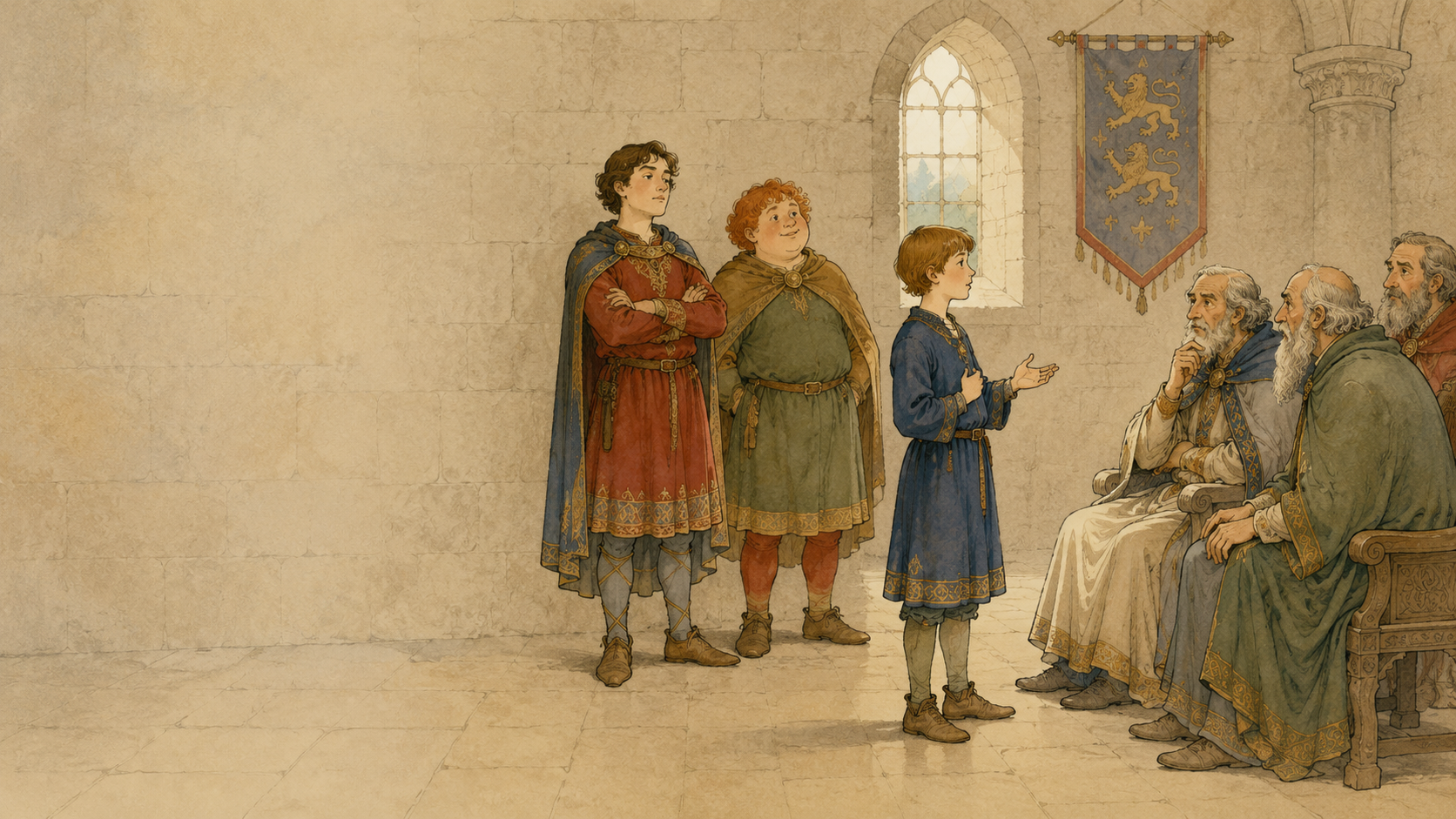
Fifty Famous Stories Retold Chapter 4, The Sons of William the Conqueror, tells how a great king wondered which of his three sons should rule after him. To test them, his wise men ask each boy what bird he would most like to be. Robert, the bold eldest, chooses a hawk. William, the strong second son, chooses an eagle. Henry, the youngest and most book-learned, chooses a starling, a friendly little bird. From their answers the wise men read each boy's nature and foretell his future. It is a neat, patterned tale built on the same question asked three times, and it opens a window on the sons who would go on to shape the history of England and Normandy.
Say what you remember!
Tell what you remember from the last chapter.
What happened in Fifty Famous Stories Retold Chapter 3, King Canute on the Seashore?Have a look
In the last chapter, King Canute on the Seashore, the Danish king Canute grew tired of courtiers who forever flattered him, praising him as so mighty that even the sea must obey. To teach them better, he had his chair carried down to the shore and commanded the rising tide to come no further. The waves rolled in all the same and wet his feet, just as he knew they would. Canute turned to his flatterers and reminded them that no earthly king holds such power, and that God alone rules the sea. He would rather hear the truth than empty praise.
Read the previous lesson: King Canute on the Seashore →Show what you know!
Use your printable Lesson Guide. Fill in the vocabulary you know, then click to check your work and learn some new words today.
What are the difficult or advanced vocabulary words in Fifty Famous Stories Retold Chapter 4, The Sons of William the Conqueror?gallant, prudent, foretold, namesakeHave a look
- gallant: brave, bold, and noble, like a fine knight
- prudent: careful and wise, thinking things through before acting
- foretold: told ahead of time what would happen
- namesake: a person named after someone else
Locate it on the map!
Use your printable Lesson Guide. Use an atlas and fill in the blank map if you can find the geographic location, then click to check your work.
What important geographic location connects with Fifty Famous Stories Retold Chapter 4, The Sons of William the Conqueror?
- Find Rouen (Normandy, France).
See it on the mapHave a look
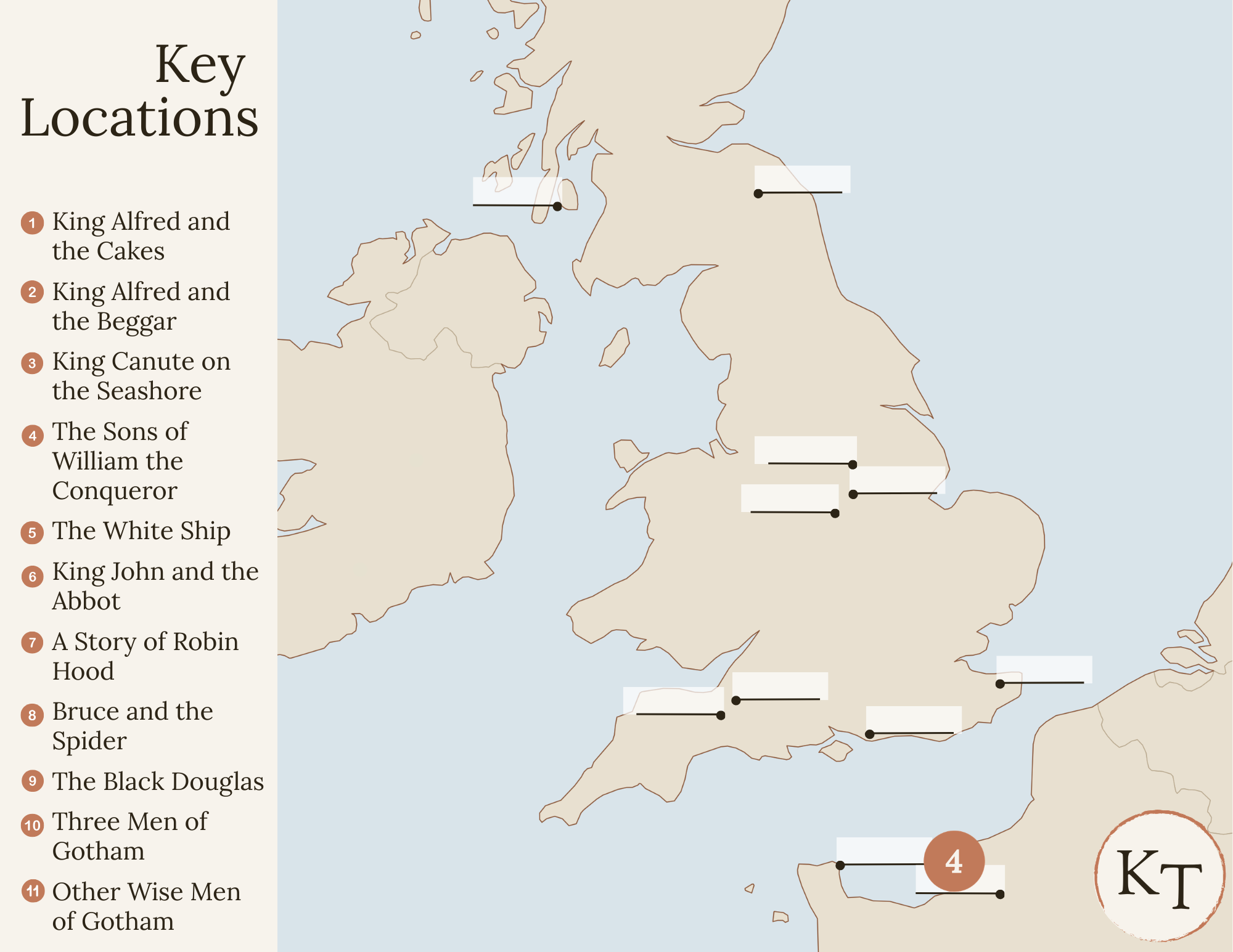
This matches the map in your Lesson Guide.
The Books come Alive!
Read or listen to Chapter 4 of Fifty Famous Stories Retold, the Kindred Thicket Enhanced Edition, read by Laura Caldwell.
Read by Laura Caldwell for LibriVox (public domain), professionally adjusted and trimmed by Kindred Thicket.
What do the Teacher’s Notes tell us about Chapter 4 of Fifty Famous Stories Retold?Parent review
This is a Kindred Thicket Enhanced Edition. Baldwin’s 1896 words are read exactly as he wrote them, and we add Teacher’s Notes with historical and literary context.
- About the whole bookFifty Famous Stories Retold gathers real history together with well-loved legends and traditions. These notes tell you, story by story, which is which.
- This chapterWilliam actually had four sons; Richard died young, so the tale counts the three who grew up.
- This chapterRobert's real nickname, Curthose, did mean short stockings, just as the tale says.
- This chapterWilliam was called Rufus, the Red, for his red or ruddy coloring.
- This chapterHenry truly was called Beauclerc, meaning fine scholar, for his unusual learning.
- This chapterThe bird test and the wise men's forecasts are an invented fable; Baldwin wrote the predictions to fit the brothers' real lives.
- This chapterOn his deathbed in 1087 William did give Normandy to Robert, England to William, and only silver (no land) to Henry.
- This chapterRobert was defeated at Tinchebrai in 1106 and held prisoner until his death in 1134.
- This chapterWilliam Rufus was killed by an arrow while hunting in the New Forest in 1100.
- This chapterHenry became King Henry I in 1100 and took Normandy from Robert in 1106.
Memory becomes Action!
Use the Response Resource* to remember and spell tricky names. Choose one way to narrate.
*Materials in the Lesson Guide.
What is the list of names, people, characters, and places that are important in Chapter 4 of Fifty Famous Stories Retold?William the Conqueror, Robert (nicknamed Short Stocking), William Rufus (the Red), Henry (Beauclerc, the Handsome Scholar), The Wise Men, England, France (Normandy)Have a look
- William the Conqueror: The great king of England who worried which of his three sons should rule after him.
- Robert (nicknamed Short Stocking): The bold eldest son who wished to be a hawk; he lost his lands and died at last in prison.
- William Rufus (the Red): The strong, cruel second son who wished to be an eagle; he became King of England and died a violent death.
- Henry (Beauclerc, the Handsome Scholar): The wise, book-learned youngest son who wished to be a starling; he became King of England in the end.
- The Wise Men: The king's counselors who tested each prince with a single question about birds.
- England: The kingdom William had won, which passed in time to his son William Rufus and then to Henry.
- France (Normandy): The lands across the sea that William held and left to his eldest son, Robert.
Chapter 4 Q & A
This is a Kindred Thicket Enhanced Edition. Baldwin’s stories mingle real history with beloved legend, and here is what to know about this one.
Is the story of the bird test true?
No, the bird test is an invented fable. Baldwin wrote the three boys' answers to fit the real lives they would grow into. The sons themselves, however, were real: Robert, William Rufus, and Henry were the three grown sons of William the Conqueror, and each truly did play a part in the history of England and Normandy.
Who was William the Conqueror?
William was the powerful ruler who conquered England in 1066 and held lands in Normandy, in France. This tale finds him near the end of his life, worried about which son should follow him. In truth he had four sons, but one, Richard, died young, so the story counts only the three who grew up.
What really happened to the three sons?
All three led eventful lives. On his deathbed in 1087 William gave Normandy to Robert, England to William Rufus, and only silver to Henry. Robert was later defeated and held prisoner until his death. William Rufus was killed by an arrow while hunting. Henry became King Henry I and took Normandy from Robert in 1106.
Were the nicknames real?
Yes, the nicknames come from history. Robert was really called Curthose, which did mean short stockings, just as the tale says. William was called Rufus, the Red, for his ruddy coloring. Henry was called Beauclerc, meaning fine scholar, for his unusual learning. Baldwin kept these true names even while inventing the bird test around them.