The Listening Grove · Fifty Famous Stories Retold
Chapter 3: King Canute on the Seashore
A Charlotte Mason read-aloud lesson. Press play, with the lesson.
What is Fifty Famous Stories Retold Chapter 3, King Canute on the Seashore, about?Parent review
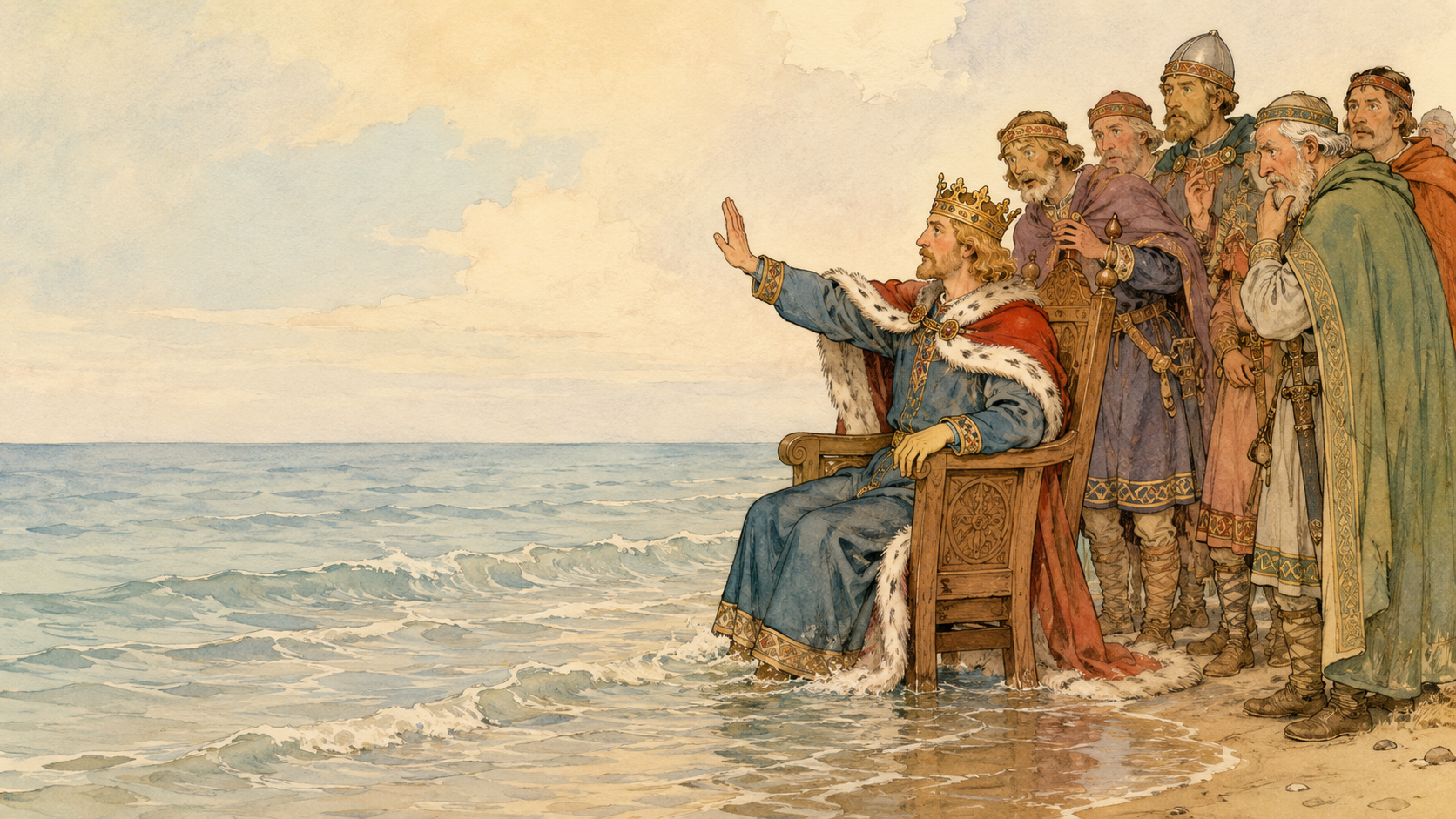
Fifty Famous Stories Retold Chapter 3, King Canute on the Seashore, is a wise old lesson about flattery and humble truth. Canute, a Danish king who ruled England, grows weary of the courtiers who forever praise him as so mighty that even the sea must obey him. To teach them, he has his chair carried down to the shore and commands the rising tide to come no further. The waves, of course, pay him no heed and wet his feet. The king turns to his flatterers and reminds them that no earthly ruler is truly all-powerful, and that God alone commands the sea. It is a gentle picture of a king who would rather hear the truth than empty praise.
Say what you remember!
Tell what you remember from the last chapter.
What happened in Fifty Famous Stories Retold Chapter 2, King Alfred and the Beggar?Have a look
In the last chapter, King Alfred and the Beggar, King Alfred was still in hiding from the Danes, sheltering on a little island in the marshes with a single servant. A ragged beggar came asking for food, and Alfred gave away half of his last loaf and half of his wine, though he had scarcely enough for himself. That night the beggar returned to him in a vision and foretold that the king would soon triumph over his enemies. Not long after, Alfred called his men together, beat the Danes at last, and went on to rule wisely and well.
Read the previous lesson: King Alfred and the Beggar →Show what you know!
Use your printable Lesson Guide. Fill in the vocabulary you know, then click to check your work and learn some new words today.
What are the difficult or advanced vocabulary words in Fifty Famous Stories Retold Chapter 3, King Canute on the Seashore?bade, lapping, hollow, senseHave a look
- bade: told or ordered someone to do something
- lapping: (of water) gently washing against something in little waves
- hollow: a cupped or empty space, like the curved inside of a hand
- sense: good judgment and understanding
Locate it on the map!
Use your printable Lesson Guide. Use an atlas and fill in the blank map if you can find the geographic location, then click to check your work.
What important geographic location connects with Fifty Famous Stories Retold Chapter 3, King Canute on the Seashore?
- Find Bosham (West Sussex, England).
See it on the mapHave a look
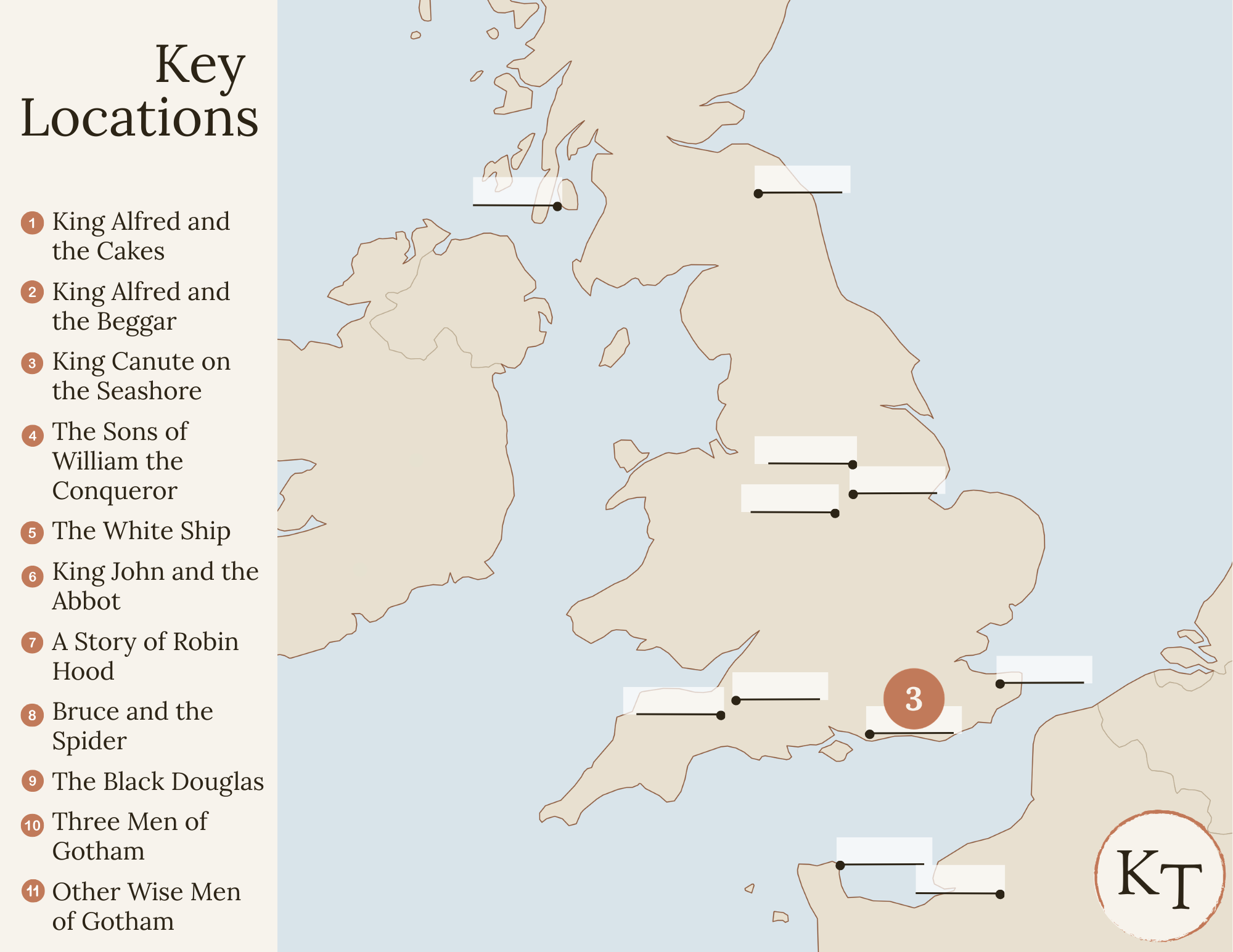
This matches the map in your Lesson Guide.
The Books come Alive!
Read or listen to Chapter 3 of Fifty Famous Stories Retold, the Kindred Thicket Enhanced Edition, read by Laura Caldwell.
Read by Laura Caldwell for LibriVox (public domain), professionally adjusted and trimmed by Kindred Thicket.
What do the Teacher’s Notes tell us about Chapter 3 of Fifty Famous Stories Retold?Parent review
This is a Kindred Thicket Enhanced Edition. Baldwin’s 1896 words are read exactly as he wrote them, and we add Teacher’s Notes with historical and literary context.
- About the whole bookFifty Famous Stories Retold gathers real history together with well-loved legends and traditions. These notes tell you, story by story, which is which.
- This chapterCanute was king of England from 1016 to 1035, a little over a century after Alfred.
- This chapterCanute really was a Dane, and by his day the Danes were largely Christian and settled, so calling them fierce and cruel is opinion.
- This chapterThe tide story is a much later legend, first written down by Henry of Huntingdon about a hundred years afterward.
Memory becomes Action!
Use the Response Resource* to remember and spell tricky names. Choose one way to narrate.
*Materials in the Lesson Guide.
What is the list of names, people, characters, and places that are important in Chapter 3 of Fifty Famous Stories Retold?King Canute (also Cnut), Canute's Officers, The Danes, Alfred the Great, EnglandHave a look
- King Canute (also Cnut): The Danish king of England who set his chair by the sea to show his flatterers that even he could not command the tide.
- Canute's Officers: The courtiers who forever praised the king as all-powerful, until the rising water proved them wrong.
- The Danes: Canute's own people, once fierce enemies of Alfred, by his day the rulers of England.
- Alfred the Great: The earlier English king whose day, a hundred years before, the tale recalls to place Canute in time.
- England: The kingdom Canute ruled a hundred years after Alfred the Great.
Chapter 3 Q & A
This is a Kindred Thicket Enhanced Edition. Baldwin’s stories mingle real history with beloved legend, and here is what to know about this one.
Is the story of King Canute and the tide true?
Canute was a real king who ruled England from 1016 to 1035, so the king himself is history. But the famous scene on the seashore is a much later legend. It was first written down by a monk named Henry of Huntingdon about a hundred years after Canute died, so we cannot know whether it truly happened.
Who was King Canute?
Canute, also spelled Cnut, was a Danish king who ruled England from 1016 to 1035, a little over a century after Alfred the Great. By his day the Danes were largely Christian and settled in England rather than raiding it. He is remembered as a strong and capable ruler, and this tale shows him as wise and humble.
Why did Canute command the sea?
He did it to teach his flatterers a lesson. His courtiers kept praising him as so mighty that even the waves would obey him. Canute set his chair by the water and ordered the tide to stop, knowing it would not. When his feet grew wet, he reminded them that no earthly king holds that kind of power.
What is the lesson of the story?
The story warns against flattery and teaches humility. A wise ruler, it says, would rather face plain truth than swallow empty praise. Canute uses the tide to show his proud courtiers that human power has limits. For a young learner it gently teaches that honest words are worth more than flattering ones.