On YouTube
The read-aloud with the words and pictures, free, ready to play on your living room television. Each chapter is text-on-screen with the Teacher's Notes shown as you watch.
Watch the playlist
Kindred Thicket Enhanced Edition
Jennie Hall's 1902 collection of fifteen connected Norse stories, following Harald from infancy to kingship and then west with the Norse voyages to Iceland, Greenland, and Wineland, built into a Kindred Thicket Enhanced Edition with historical updates and context in the corresponding Teacher's Notes.
Read by Faerie Book Mama and Gillian Hendrie for LibriVox (public domain). The audio has been professionally adjusted and trimmed by Kindred Thicket.
The reading is free, whichever way you use it. Watch on YouTube, listen in the Listening Grove, or take it anywhere on Yoto, all with the same Lesson Guide.
The read-aloud with the words and pictures, free, ready to play on your living room television. Each chapter is text-on-screen with the Teacher's Notes shown as you watch.
Watch the playlistThe Viking Tales audiobook on a page, structured the Charlotte Mason way, so you can listen together with no video to watch.
Browse the chaptersFor the car or bedtime, a free Kindred Thicket audio pack compatible with the Yoto app, so the same narration travels with your family.
Get the Yoto packGet your Lesson Guide and Copywork ready before you begin.
Print them now so you have a prepared lesson for your kids this week, instead of scrambling to pull everything together as you go.
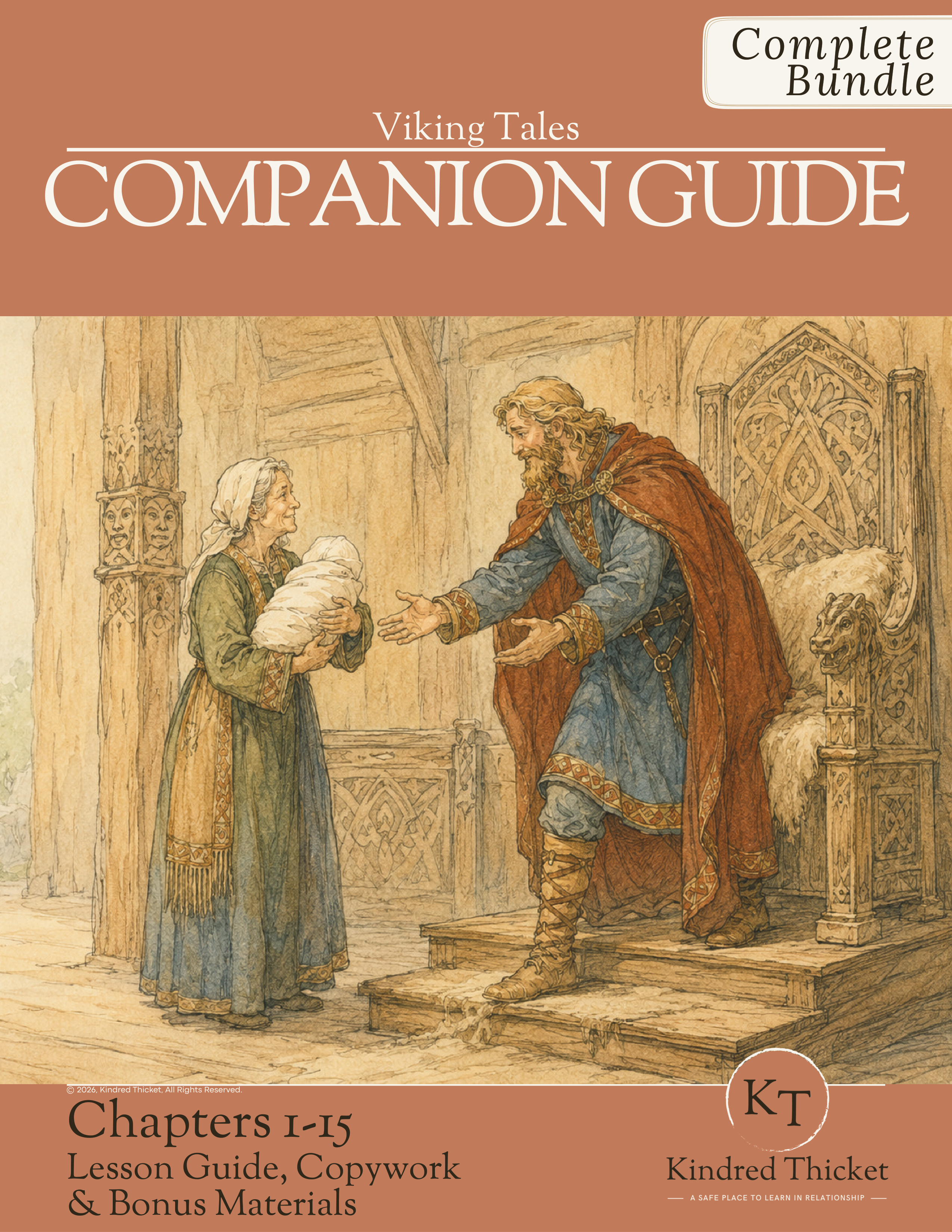 Complete Companion Guide
Viking Tales follows Harald from infancy to kingship and then follows the Norse voyages west to Iceland, Greenland, and Wineland.
The fifteen connected chapters include Norse customs, beliefs, battles, settlements, and sea voyages. Real people and places are presented through Jennie Hall's warm storytelling and the saga traditions surrounding them.
Jennie Hall wrote Viking Tales, which was first published by Rand McNally in 1902.
Hall was an educator and author who wrote history and travel books for young readers. In Viking Tales, she presents the Norse world through short, connected narratives designed to be vivid and memorable for children.
Viking Tales contains fifteen chapters. Chapters 1 through 11 follow Harald's childhood, training, battles, kingship, and marriage. Chapters 12 through 15 follow the Norse settlements and voyages to Iceland, Greenland, and Wineland.
The first eleven chapters follow Harald from infancy to kingship. Children hear the stories told by Olaf, watch Harald learn the skills expected of a young Norse warrior, and follow his vows, battles, wedding, and rise to power. Harald is remembered in Norse saga tradition as the king who brought Norway under one rule.
The final four chapters carry the story west across the sea. Norse families make new homes in Iceland, Eric the Red reaches Greenland, Leif Ericsson sails to the country called Wineland, and Thorfinn and Gudrid later lead another voyage to North America.
Along the way children encounter dragon-ships and long sea voyages; Norse homes, feast halls, weddings, and funerals; Thor, Asgard, Valhalla, and traditional Norse beliefs; skalds and oral storytelling; raids, battles, exile, courage, and settlement; the historical practice of thralldom; and the lands of Norway, Iceland, Greenland, and Wineland.
Yes. Viking Tales is rooted in real people, places, customs, settlements, and voyages.
The book also draws from Norse sagas and storytelling traditions. The Teacher's Notes provide context on selected points so families can understand how history and saga work together within the book.
Yes. Viking Tales is written as a connected narrative filled with memorable people, vivid settings, and significant ideas rather than as a list of facts. Its storytelling style makes it well suited to oral narration, family reading, and the living-book approach commonly used in Charlotte Mason education.
Harald is the central figure in the first eleven chapters of Viking Tales. The book follows him from infancy through his training, early kingship, battles, vow, and marriage to Gyda. Norse sagas remember Harald Hairfair as the king who brought Norway under one rule.
Harald Hairfair is remembered as an early king of Norway and is an important figure in Norse saga tradition. The stories surrounding his life combine historical memory with details preserved through later sagas, and the Kindred Thicket Teacher's Notes help families understand that background while enjoying Hall's connected account of his life.
A thrall was an enslaved person in Norse society. Thralldom appears in several chapters of Viking Tales, especially in the stories about Olaf and the settlement of Iceland. The Teacher's Notes explain the term and provide historical context for the role it plays in the book.
Wineland is Jennie Hall's spelling of the Norse place-name often written as Vinland. In the book, Leif Ericsson reaches a wooded land west of Greenland, and later Norse voyagers attempt to settle there. The name became associated with the Norse voyages to North America.
Yes. The Norse reached North America around the year 1000. The one proven Norse settlement site is L'Anse aux Meadows in Newfoundland. Indigenous peoples had already lived throughout North America for thousands of years before the Norse arrived.
No. Viking Tales includes more than one person named Leif. The Leif in Homes in Iceland is Ingolf's foster-brother. Leif Ericsson is the son of Eric the Red and appears in the later chapters about Greenland and Wineland.
A Kindred Thicket Enhanced Edition keeps the original public-domain text unchanged and adds Teacher's Notes that appear with the reading. For Viking Tales, the notes give historical and cultural background on selected Norse customs, terms, traditions, and events, so the parent has the context right there while Jennie Hall's 1902 words stay exactly as written.
It is different from a Revised Edition, where we update the text itself before recording. Both are the updated version; the Enhanced Edition simply keeps the original words and adds the notes.
No. Jennie Hall's original 1902 text remains unchanged. Kindred Thicket adds Teacher's Notes alongside the story rather than rewriting or replacing Hall's words.
The Teacher's Notes give parents concise historical and cultural background on selected points in the book. They help answer natural questions such as: What was a thrall? What did the Norse believe about Valhalla? How do the sagas remember Harald Hairfair? Did the Norse really reach North America? Who was already living there when they arrived? What does the name Wineland mean?
The notes also provide calm guidance when the original 1902 text uses historical terms or descriptions that may be unfamiliar to a modern child. Their purpose is not to replace the book or turn the reading into a lecture, but to give the parent enough background to answer questions confidently while Jennie Hall's story stays at the center of the lesson.
The Viking Tales copywork gives children a meaningful way to work more closely with the language of the book. Copying well-written passages develops attention, handwriting, spelling, punctuation, and familiarity with sentence structure. Used alongside the readings, the copywork creates a natural connection between listening, narration, and written expression.
Families can use Viking Tales as a history read-aloud, a living book for oral narration, part of Morning Time, or a companion to a wider study of the Norse world.
The short chapters make it easy to read one complete story at a time. Kindred Thicket's video, audio, Teacher's Notes, and copywork resources provide additional ways to experience and extend the book.
Viking Tales is available now in the Listening Grove, with a page for every chapter that combines the audiobook and its Charlotte Mason lesson, and on YouTube, where the illustrated read-aloud chapters are being released. Yoto-compatible listening is available now, with free Read Mode and Lesson Mode packs for the whole book.
This title is available across all three Kindred Thicket formats. The free Yoto packs are download-and-go, making the stories portable through Read Mode and Lesson Mode; join the email list to get them.
Read Mode presents the story as a simple audiobook experience. Lesson Mode includes more of the guided Kindred Thicket lesson for families who want the additional support while listening away from a screen.
Yes. Jennie Hall's Viking Tales, first published in 1902, is in the public domain. Kindred Thicket's Teacher's Notes, recordings, illustrations, lesson materials, and copywork are separate Kindred Thicket resources.
Viking Tales includes raids, battles, death, thralldom, revenge, animal sacrifice, dangerous voyages, and Norse beliefs about death and Valhalla. These events are generally told directly and without graphic detail. Homes in Iceland contains several of the book's more intense events, including a feud, revenge, and sacrifice.
The final chapters describe encounters between the Norse voyagers and the Indigenous people already living in North America. Some terms and descriptions reflect the language of Hall's time, and the Teacher's Notes provide helpful parent context.
We do the planning. The books come alive. Your child does the learning.
Last updated July 12, 2026