The Listening Grove · Aesop's Fables
Fable 13: The Bundle of Sticks
A Charlotte Mason fable lesson. Press play, with the lesson.
What is Aesop's fable The Bundle of Sticks about?Parent review
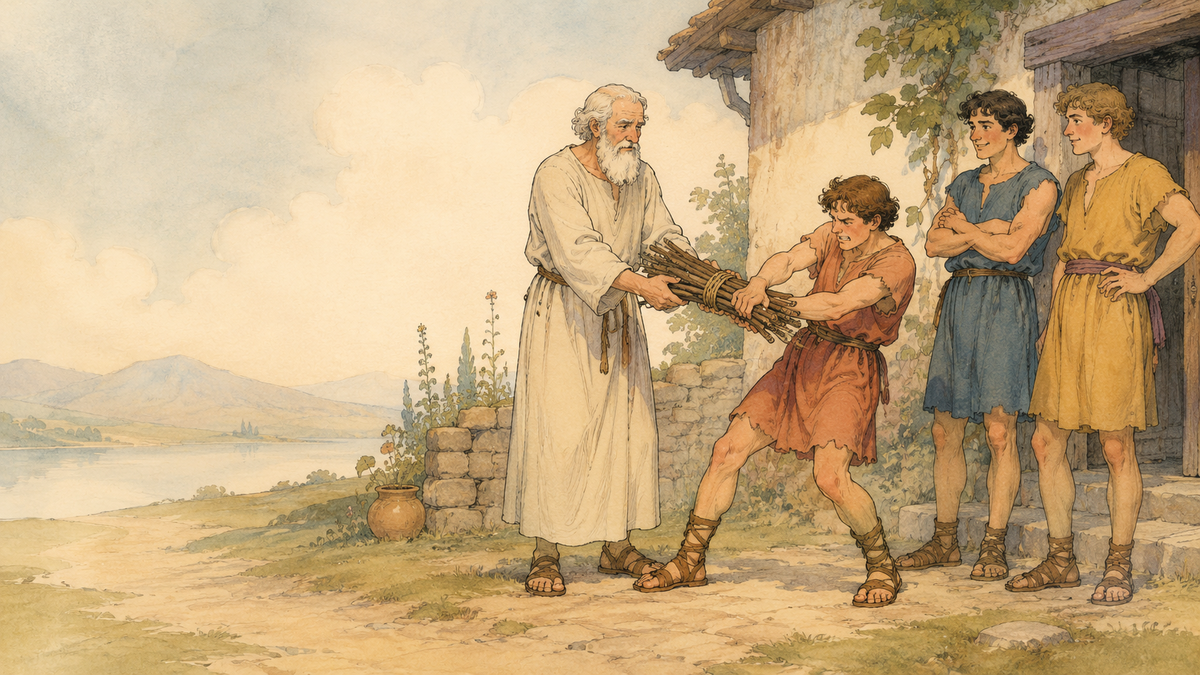
Aesop's Fable 13, The Bundle of Sticks, is a story about the strength that comes from sticking together. A father, worn out by his sons' constant quarreling, hands each of them a tied bundle of sticks and asks them to break it. Not one of them can. Then he unties the bundle and gives them the sticks one at a time, and each snaps easily. So he shows his sons that together they cannot be broken, but divided they are as weak as a single stick.
Say what you remember!
Tell what you remember from the last fable.
What happened in Aesop's fable The Fox and the Grapes?Have a look
In the last fable, The Fox and the Grapes, a hungry Fox leaped again and again for a bunch of ripe grapes hanging out of reach. When he could not get them, he walked away with his nose in the air, telling himself the grapes were sour and not worth having anyway.
Back to the previous lesson: The Fox and the Grapes →The Books come Alive!
Read or listen to The Bundle of Sticks, the Kindred Thicket Revised Edition.
Read by Kindred Thicket, from the Kindred Thicket Revised Edition.
Read along with the fableRead along
A certain Father had a family of Sons, who were forever quarreling among themselves. No words he could say did the least good, so he cast about in his mind for some very striking example that should make them see that discord would lead them to misfortune.
One day when the quarreling had been much more violent than usual and each of the Sons was moping in a surly manner, he asked one of them to bring him a bundle of sticks. Then handing the bundle to each of his Sons in turn he told them to try to break it. But although each one tried his best, none was able to do so.
The Father then untied the bundle and gave the sticks to his Sons to break one by one. This they did very easily.
"My Sons," said the Father, "do you not see how certain it is that if you agree with each other and help each other, it will be impossible for your enemies to injure you? But if you are divided among yourselves, you will be no stronger than a single stick in that bundle."
Memory becomes Action!
Use the character cards* to remember who is in the fable. Choose one way to narrate.
*Character cards are free with the email list; the Composition Prompt and Drawn Narration Sheet are in the Companion Guide.
What is the list of the names, people, characters, and places that are important in Aesop's fable The Bundle of Sticks?The Father, The Sons, The bundle of sticksHave a look
- The Father: The wise father who cures his sons' quarreling with a bundle of sticks.
- The Sons: The quarrelsome sons who learn that together they cannot be broken.
- The bundle of sticks: Whole, it will not break; one by one the sticks snap easily, the father's living lesson.
What is the moral of Aesop's fable The Bundle of Sticks?Have a look
“In unity is strength.”
Each son could snap a single stick with ease, but no one could break the whole bundle while it was tied together. So it is with a family: divided, they are easily harmed; united, they cannot be broken.
The Bundle of Sticks Q & A
Common questions about this fable: the other titles it goes by, where it comes from, its lesson, and how to help your child narrate it.
Is this the fable about the bundle of sticks that can't be broken?
Yes. This fable is sometimes called "The Bundle of Sticks" and sometimes "The Old Man and His Sons," but it is the same story: a father shows his quarreling sons that a bundle of sticks tied together cannot be broken, though the sticks snap easily one by one. Whatever your book calls it, look for the father, the sons, and the bundle, and you have the right one. The read-aloud on this page gives you the full text.
Where does this story come from, and where else will my child meet it?
The Bundle of Sticks is a very old fable credited to Aesop and retold across the centuries. It is often told of the Scythian king Scilurus, who used a bundle of spears to teach his many sons, and it has given many languages their proverb that "union is strength." When your child meets this fable, she is meeting one of the oldest lessons in the world about standing together.
What is the lesson of this fable? Do I need to explain the moral?
The sons cannot break the bundle while it is whole, but snap the sticks easily one at a time, and so learn that they are strong together and weak apart. You do not need to spell this out. Charlotte Mason found that children "readily appropriate the moral" of a fable on their own (Towards a Philosophy of Education, Vol. 6), and a fable does its best work when a child reaches the point herself. Read it well and let it do its quiet work.
How do I help my young child narrate this fable?
Read it through once, without stopping to quiz, then invite your child to tell it back in her own words. Mason believed a single hearing was enough, noting that "few grown-ups could 'tell' one of Æsop's Fables with the terse directness which children reproduce" (Towards a Philosophy of Education, Vol. 6). If she stalls, one gentle prompt restarts her: "What could the sons not break? What happened when the sticks were untied?" For a child who is not yet writing, drawn narration works beautifully here, letting her draw the sons straining at the bundle, or the father snapping the sticks one by one. And if she needs something to hold while she tells, the character cards in our free bonus materials give her the father and his sons to point to as the story unfolds.
Should I go over the vocabulary before we read this fable?
Usually not, and this is where fables differ from history or science. In those subjects a single unfamiliar word can carry the whole meaning of a passage, so it is worth a quick look beforehand. A fable works the other way. Its gift is exposure, and the way a child quietly infers what a word means from the story around it. So read this one straight through and let the context do the teaching. If a word truly blocks understanding, say what it means in a breath and read on, keeping the whole of the story in one piece.