The Listening Grove · Aesop's Fables
Fable 14: The Wolf and the Crane
A Charlotte Mason fable lesson. Press play, with the lesson.
What is Aesop's fable The Wolf and the Crane about?Parent review
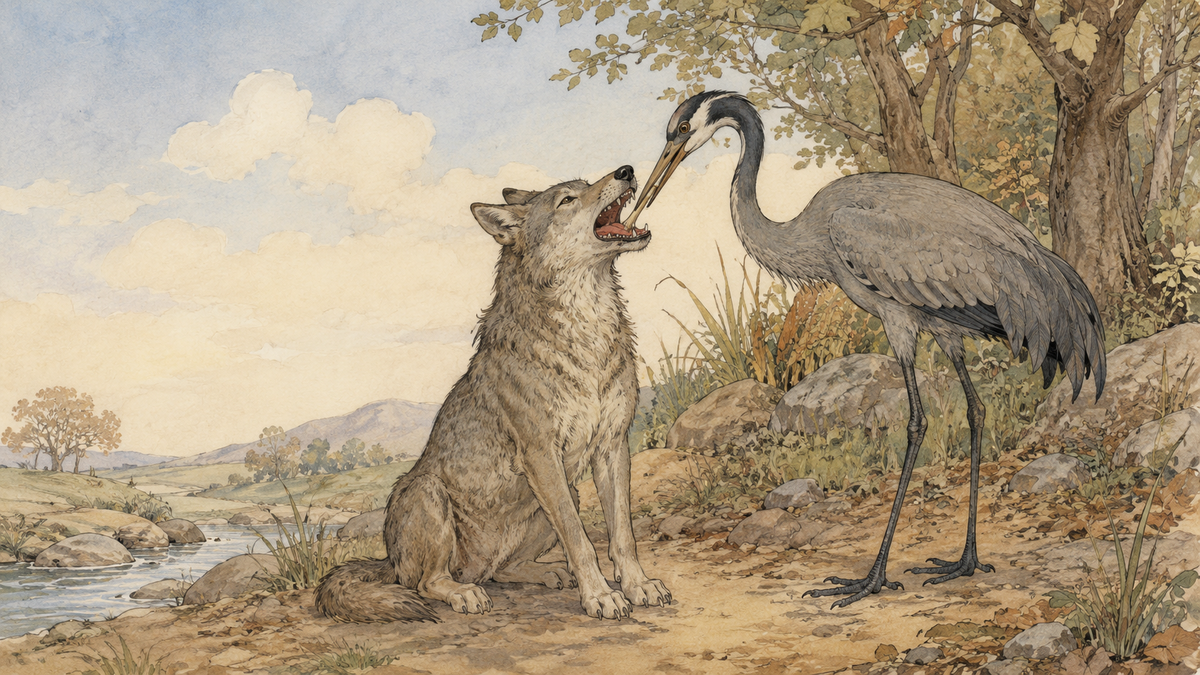
Aesop's Fable 14, The Wolf and the Crane, is a story about serving the wicked and expecting thanks. A greedy Wolf gets a bone stuck in his throat and begs the long-necked Crane to pull it out, promising a handsome reward. The Crane reaches down his throat and frees the bone, then asks for her payment, and the Wolf only sneers that her reward is having taken her head out of a wolf's mouth alive.
Say what you remember!
Tell what you remember from the last fable.
What happened in Aesop's fable The Bundle of Sticks?Have a look
In the last fable, The Bundle of Sticks, a father whose sons were always quarreling gave them a tied bundle of sticks to break, and not one of them could. But when he untied it and handed them the sticks one by one, each snapped with ease, and so he showed them that together they were strong.
Back to the previous lesson: The Bundle of Sticks →The Books come Alive!
Read or listen to The Wolf and the Crane, the Kindred Thicket Revised Edition.
Read by Kindred Thicket, from the Kindred Thicket Revised Edition.
Read along with the fableRead along
A Wolf had been feasting too greedily, and a bone had stuck crosswise in his throat. He could get it neither up nor down, and of course he could not eat a thing. Naturally that was an awful state of affairs for a greedy Wolf.
So away he hurried to the Crane. He was sure that she, with her long neck and bill, would easily be able to reach the bone and pull it out.
"I will reward you very handsomely," said the Wolf, "if you pull that bone out for me."
The Crane, as you can imagine, was very uneasy about putting her head in a Wolf's throat. But she was grasping in nature, so she did what the Wolf asked her to do.
When the Wolf felt that the bone was gone, he started to walk away.
"But what about my reward!" called the Crane anxiously.
"What!" snarled the Wolf, whirling around. "Haven't you got it? Isn't it enough that I let you take your head out of my mouth without snapping it off?"
Memory becomes Action!
Use the character cards* to remember who is in the fable. Choose one way to narrate.
*Character cards are free with the email list; the Composition Prompt and Drawn Narration Sheet are in the Companion Guide.
What is the list of the names, people, characters, and places that are important in Aesop's fable The Wolf and the Crane?The Wolf, The CraneHave a look
- The Wolf: The greedy wolf with a bone in his throat, who repays help with a sneer instead of a reward.
- The Crane: The long-necked crane who pulls the bone free, then finds her only reward is escaping with her head.
What is the moral of Aesop's fable The Wolf and the Crane?Have a look
“Expect no reward for serving the wicked.”
The Crane did a dangerous favor for a wicked creature and expected to be paid, but the Wolf felt he had already been generous by not eating her. Those who serve the wicked should not be surprised to go unrewarded.
The Wolf and the Crane Q & A
Common questions about this fable: the other titles it goes by, where it comes from, its lesson, and how to help your child narrate it.
My book calls this bird a Heron, not a Crane. Is it the same fable?
Yes. This fable is told with a Crane in some books and a Heron or a Stork in others; the long-necked bird changes, but the story does not. Look for the wolf with a bone in his throat, the long-billed bird who pulls it out, and the wolf who refuses to pay, and you have the right one. The read-aloud on this page gives you the full text so you can be sure.
Where does this story come from, and where else will my child meet it?
The Wolf and the Crane is an ancient fable found in the Greek collections of Aesop and retold by the Roman poet Phaedrus and later by La Fontaine. A very similar tale appears in the Indian Jataka stories, where a lion and a bird take the wolf's and crane's places. When your child meets this fable, she is joining a story told across many lands and centuries.
What is the lesson of this fable? Do I need to explain the moral?
The Crane risks her life to help the Wolf and asks for the reward he promised, only to be told that her reward is that he did not eat her. You do not need to spell this out. Charlotte Mason found that children "readily appropriate the moral" of a fable on their own (Towards a Philosophy of Education, Vol. 6), and a fable does its best work when a child reaches the point herself. Read it well and let it do its quiet work.
How do I help my young child narrate this fable?
Read it through once, without stopping to quiz, then invite your child to tell it back in her own words. Mason believed a single hearing was enough, noting that "few grown-ups could 'tell' one of Æsop's Fables with the terse directness which children reproduce" (Towards a Philosophy of Education, Vol. 6). If she stalls, one gentle prompt restarts her: "What was wrong with the Wolf? What reward did the Crane get?" For a child who is not yet writing, drawn narration works beautifully here, letting her draw the Crane's head deep in the Wolf's throat, or the Wolf snarling as he walks away. And if she needs something to hold while she tells, the character cards in our free bonus materials give her the wolf and the crane to point to as the story unfolds.
Should I go over the vocabulary before we read this fable?
Usually not, and this is where fables differ from history or science. In those subjects a single unfamiliar word can carry the whole meaning of a passage, so it is worth a quick look beforehand. A fable works the other way. Its gift is exposure, and the way a child quietly infers what a word means from the story around it. So read this one straight through and let the context do the teaching. If a word truly blocks understanding, say what it means in a breath and read on, keeping the whole of the story in one piece.