The Listening Grove · Aesop's Fables
Fable 15: The Donkey and His Driver
A Charlotte Mason fable lesson. Press play, with the lesson.
What is Aesop's fable The Donkey and His Driver about?Parent review
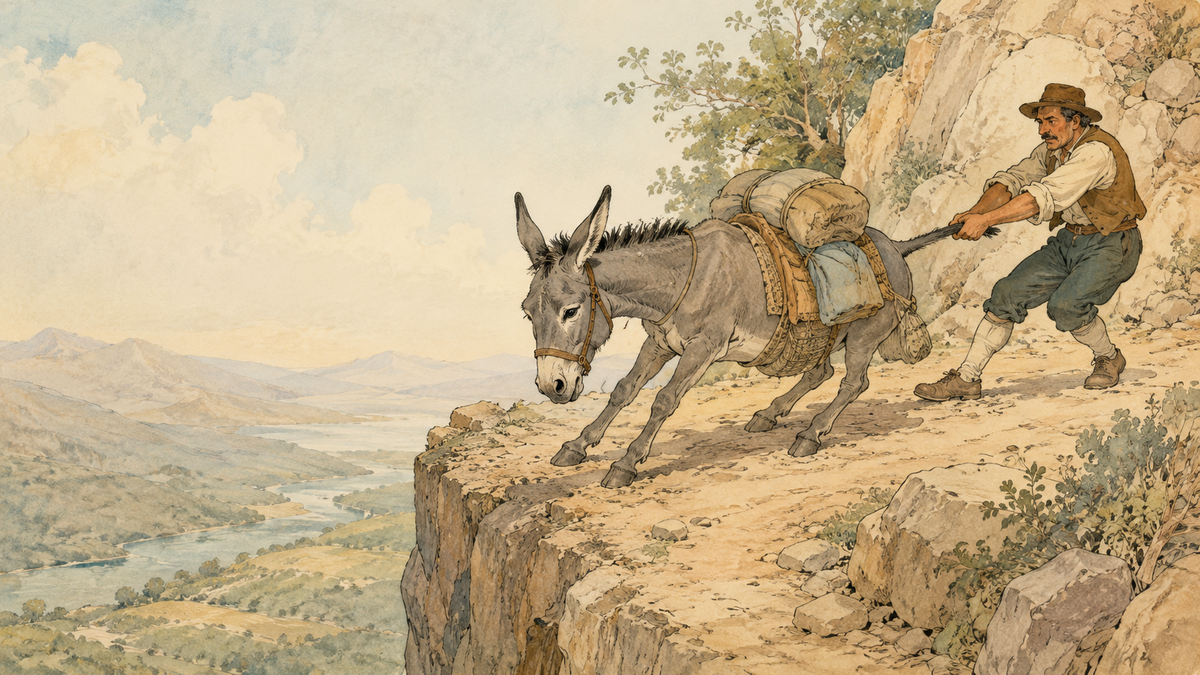
Aesop's Fable 15, The Donkey and His Driver, is a story about stubbornness and refusing good advice. As a driver leads his donkey down a mountain road, the donkey decides to take his own shortcut straight over the edge of a cliff. His master grabs his tail to pull him back, but the willful donkey strains the other way. At last the master lets go, saying "Go your own way, then," and the foolish donkey tumbles head over heels down the mountainside.
Say what you remember!
Tell what you remember from the last fable.
What happened in Aesop's fable The Wolf and the Crane?Have a look
In the last fable, The Wolf and the Crane, a greedy Wolf with a bone stuck in his throat begged the long-necked Crane to pull it out for a reward. She did, reaching right down his throat, but the ungrateful Wolf told her that her only reward was keeping her head.
Back to the previous lesson: The Wolf and the Crane →The Books come Alive!
Read or listen to The Donkey and His Driver, the Kindred Thicket Revised Edition.
Read by Kindred Thicket, from the Kindred Thicket Revised Edition.
Read along with the fableRead along
A Donkey was being driven along a road leading down the mountain side, when he suddenly took it into his silly head to choose his own path. He could see his stall at the foot of the mountain, and to him the quickest way down seemed to be over the edge of the nearest cliff. Just as he was about to leap over, his master caught him by the tail and tried to pull him back, but the stubborn Donkey would not yield and pulled with all his might.
"Very well," said his master, "go your way, you willful beast, and see where it leads you."
With that he let go, and the foolish Donkey tumbled head over heels down the mountain side.
Memory becomes Action!
Use the character cards* to remember who is in the fable. Choose one way to narrate.
*Character cards are free with the email list; the Composition Prompt and Drawn Narration Sheet are in the Companion Guide.
What is the list of the names, people, characters, and places that are important in Aesop's fable The Donkey and His Driver?The Donkey, The DriverHave a look
- The Donkey: The stubborn donkey who insists on his own dangerous shortcut and will not be pulled back.
- The Driver: The master who tries to save the donkey, then lets him go his willful way.
What is the moral of Aesop's fable The Donkey and His Driver?Have a look
“They who will not listen to reason but stubbornly go their own way against the friendly advice of those who are wiser than they, are on the road to misfortune.”
The donkey would not listen to the master who knew the safe road, and his stubbornness carried him over the cliff. Those who will not heed wiser advice and insist on their own way are on the road to trouble.
The Donkey and His Driver Q & A
Common questions about this fable: the other titles it goes by, where it comes from, its lesson, and how to help your child narrate it.
My book calls this animal an Ass, not a Donkey. Is it the same story?
Yes. Older editions of Aesop often say "Ass" where we now say "Donkey," but it is exactly the same fable: the animal insists on his own path down the mountain, his master tries to pull him back, and he tumbles over the cliff. Our Kindred Thicket Revised Edition simply uses the friendlier word "Donkey." The read-aloud on this page gives you the full text.
Where does this story come from, and where else will my child meet it?
The Donkey and His Driver comes down to us in the Greek collections of Aesop and was retold in Latin and in La Fontaine's French verse. It belongs to a whole family of Aesop's donkey fables about stubbornness and folly. When your child meets it, she is meeting one of the oldest pictures of what willfulness can cost.
What is the lesson of this fable? Do I need to explain the moral?
The donkey refuses the master who knows the safe way and insists on his own path, straight over the cliff. You do not need to spell this out. Charlotte Mason found that children "readily appropriate the moral" of a fable on their own (Towards a Philosophy of Education, Vol. 6), and a fable does its best work when a child reaches the point herself. Read it well and let it do its quiet work.
How do I help my young child narrate this fable?
Read it through once, without stopping to quiz, then invite your child to tell it back in her own words. Mason believed a single hearing was enough, noting that "few grown-ups could 'tell' one of Æsop's Fables with the terse directness which children reproduce" (Towards a Philosophy of Education, Vol. 6). If she stalls, one gentle prompt restarts her: "Which way did the donkey want to go? What did his master finally do?" For a child who is not yet writing, drawn narration works beautifully here, letting her draw the donkey pulling toward the cliff edge, or tumbling down the mountainside. And if she needs something to hold while she tells, the character cards in our free bonus materials give her the donkey and his driver to point to as the story unfolds.
Should I go over the vocabulary before we read this fable?
Usually not, and this is where fables differ from history or science. In those subjects a single unfamiliar word can carry the whole meaning of a passage, so it is worth a quick look beforehand. A fable works the other way. Its gift is exposure, and the way a child quietly infers what a word means from the story around it. So read this one straight through and let the context do the teaching. If a word truly blocks understanding, say what it means in a breath and read on, keeping the whole of the story in one piece.