The Listening Grove · Aesop's Fables
Fable 16: The Oxen and the Wheels
A Charlotte Mason fable lesson. Press play, with the lesson.
What is Aesop's fable The Oxen and the Wheels about?Parent review
Aesop's Fable 16, The Oxen and the Wheels, is a short story about who complains the loudest. A pair of oxen strain to pull a heavy wagon through deep mud, saying not a word, while the wagon wheels, doing far less work, creak and groan at every turn. At last the weary oxen turn and ask the wheels what they have to complain about, when it is the oxen who carry all the weight in silence.
Say what you remember!
Tell what you remember from the last fable.
What happened in Aesop's fable The Donkey and His Driver?Have a look
In the last fable, The Donkey and His Driver, a stubborn donkey chose his own shortcut down the mountain, straight toward a cliff. His master tried to pull him back by the tail, but the willful donkey strained the other way, until the master let go and the donkey tumbled down the slope.
Back to the previous lesson: The Donkey and His Driver →The Books come Alive!
Read or listen to The Oxen and the Wheels, the Kindred Thicket Revised Edition.
Read by Kindred Thicket, from the Kindred Thicket Revised Edition.
Read along with the fableRead along
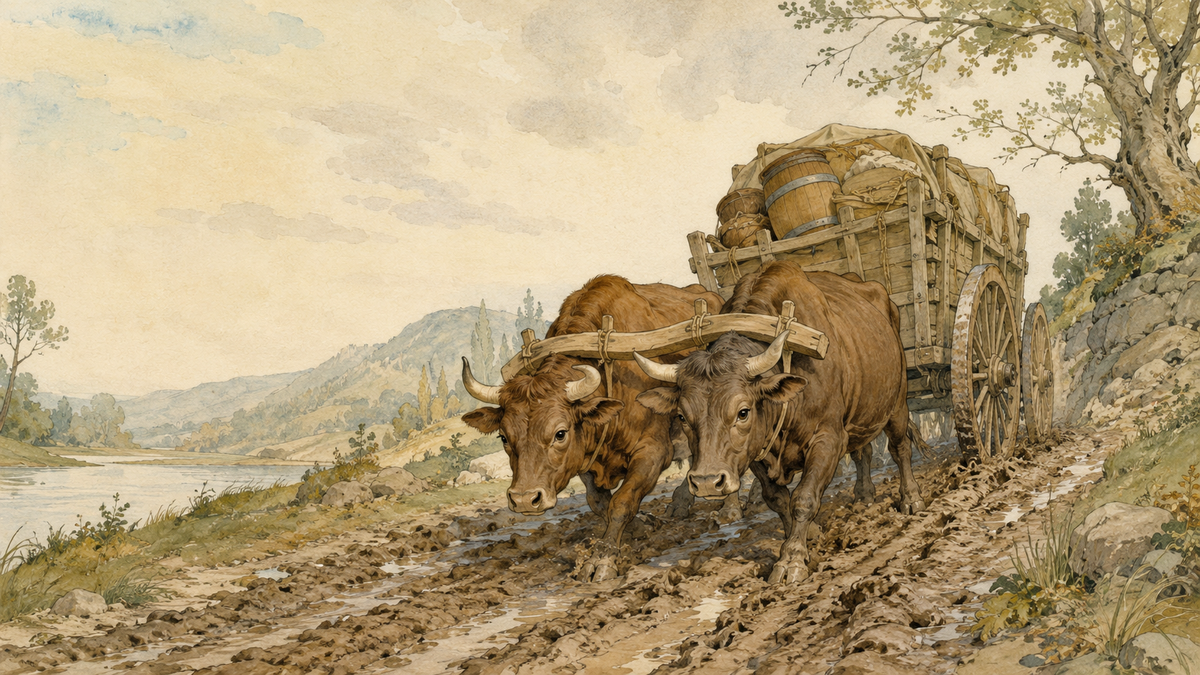
A pair of Oxen were drawing a heavily loaded wagon along a miry country road. They had to use all their strength to pull the wagon, but they did not complain.
The Wheels of the wagon were of a different sort. Though the task they had to do was very light compared with that of the Oxen, they creaked and groaned at every turn. The poor Oxen, pulling with all their might to draw the wagon through the deep mud, had their ears filled with the loud complaining of the Wheels. And this, you may well know, made their work so much the harder to endure.
"Silence!" the Oxen cried at last, out of patience. "What have you Wheels to complain about so loudly? We are drawing all the weight, not you, and we are keeping still about it besides."
Memory becomes Action!
Use the character cards* to remember who is in the fable. Choose one way to narrate.
*Character cards are free with the email list; the Composition Prompt and Drawn Narration Sheet are in the Companion Guide.
What is the list of the names, people, characters, and places that are important in Aesop's fable The Oxen and the Wheels?The Oxen, The WheelsHave a look
- The Oxen: The hardworking oxen who pull the heavy wagon through the mud without complaint.
- The Wheels: The wagon wheels that do the least work yet creak and groan the loudest.
What is the moral of Aesop's fable The Oxen and the Wheels?Have a look
“They complain most who suffer least.”
The oxen bore the whole weight of the wagon in silence, while the wheels, with far less to bear, complained at every turn. It is often those who suffer least who make the most noise about it.
The Oxen and the Wheels Q & A
Common questions about this fable: the other titles it goes by, where it comes from, its lesson, and how to help your child narrate it.
This fable is so short. Is that the whole story?
Yes, that is the whole fable, and its shortness is part of its charm. Aesop's fables are often only a few lines long, and this one makes its point in a single scene: the oxen straining in silence, the wheels creaking loudly. The little tale is complete, and the read-aloud on this page gives you every word of it.
Where does this story come from, and where else will my child meet it?
The Oxen and the Wheels, sometimes called "The Axle and the Ox" or "The Coach-wheels and the Oxen," is one of the shorter fables in the Aesop collections and has been retold in many languages. It is a cousin of our modern saying that the squeaky wheel gets the grease. When your child meets it, she is meeting a very old observation about complaint.
What is the lesson of this fable? Do I need to explain the moral?
The oxen carry the whole load without a word, while the wheels, with far less to do, groan at every turn. You do not need to spell this out. Charlotte Mason found that children "readily appropriate the moral" of a fable on their own (Towards a Philosophy of Education, Vol. 6), and a fable does its best work when a child reaches the point herself. Read it well and let it do its quiet work.
How do I help my young child narrate this fable?
Read it through once, without stopping to quiz, then invite your child to tell it back in her own words. Mason believed a single hearing was enough, noting that "few grown-ups could 'tell' one of Æsop's Fables with the terse directness which children reproduce" (Towards a Philosophy of Education, Vol. 6). If she stalls, one gentle prompt restarts her: "Who was doing the hard work? Who was making all the noise?" For a child who is not yet writing, drawn narration works beautifully here, letting her draw the oxen straining in the mud, or the creaking wagon wheels. And if she needs something to hold while she tells, the character cards in our free bonus materials give her the oxen and the wheels to point to as the story unfolds.
Should I go over the vocabulary before we read this fable?
Usually not, and this is where fables differ from history or science. In those subjects a single unfamiliar word can carry the whole meaning of a passage, so it is worth a quick look beforehand. A fable works the other way. Its gift is exposure, and the way a child quietly infers what a word means from the story around it. So read this one straight through and let the context do the teaching. If a word truly blocks understanding, say what it means in a breath and read on, keeping the whole of the story in one piece.