The Listening Grove · Birds of the Air
Chapter 10: Bird-Food in Winter
A Charlotte Mason nature-study lesson. Press play, with the lesson.
What is Birds of the Air Chapter 10, Bird-Food in Winter, about?Parent review
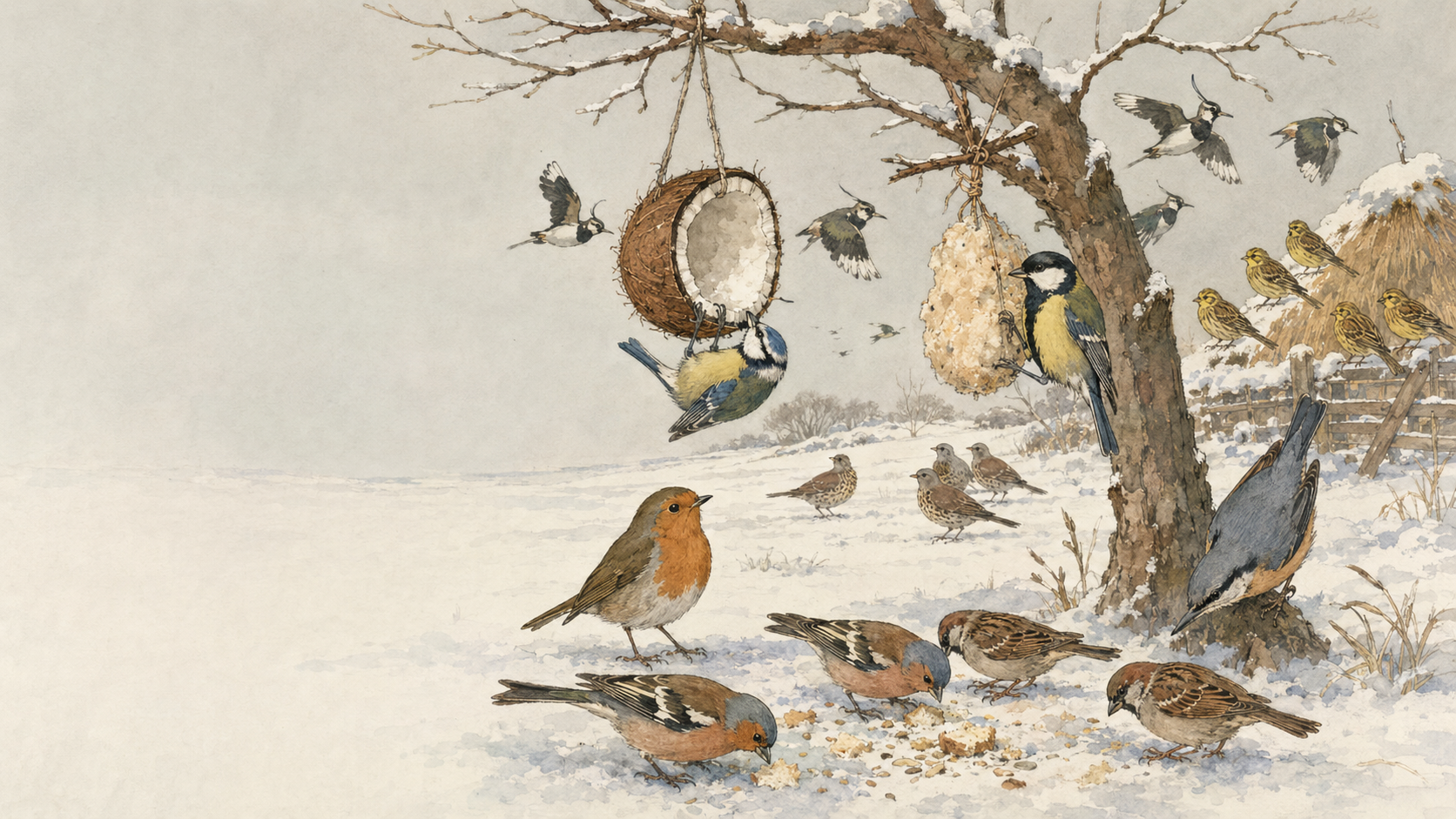
Birds of the Air Chapter 10, Bird-Food in Winter, shows how hard the winter is for little birds and how a child can help them through it. Arabella Buckley describes how thrushes, robins, wrens, and wagtails still find slugs, seeds, and grubs while the weather is mild, then how a hard frost and deep snow drive the larks and linnets under the banks and send the lapwings crying to the sea-coast to feed on the mudflats. She explains that birds are not killed by the cold itself, for the air under their feathers keeps them warm, but by starvation when the frost hides all their food. She teaches your child to save up crusts, crumbs, cold potatoes, and scraps of fat, to clear the snow and scatter the food, to hang fat and a bone from a branch for the tits and jackdaws, and to keep water from freezing in a swinging cocoa-nut cup. She promises that a child who feeds the birds all winter will come to know them closely, so that next summer they will sing to an old friend. It is a lesson in kindness, gratitude, and the quiet care of small creatures.
Say what you remember!
Tell what you remember from the last chapter.
What happened in Birds of the Air Chapter 9, Migrating in Autumn?Have a look
In the last chapter, Migrating in Autumn, Arabella Buckley watched the birds move as the summer ended and food grew scarce. She showed the insect-eaters leaving first, the cuckoo in July, the swifts in August, and the swallows and martins gathering on a church tower before flying off together to Africa. She explained how many birds simply shift about within England, and how fieldfares, redwings, and extra starlings arrive from Norway and Germany to spend the winter with us. She noticed how the little birds gather into flocks in winter, larks, finches, and bullfinches all keeping company as they hunt for seeds.
Read the previous lesson: Migrating in Autumn →Show what you know!
Use your printable Lesson Guide. Fill in the vocabulary you know, then click to check your work and learn some new words today.
What are the difficult or advanced vocabulary words in Birds of the Air Chapter 10, Bird-Food in Winter?mild, paling, bustle, gristleHave a look
- mild: Not harsh; gentle and fairly warm in weather.
- paling: A fence made of pointed wooden stakes.
- bustle: To move about busily and quickly.
- gristle: The tough, rubbery part of meat.
The Books come Alive!
Read or listen to Chapter 10 of Birds of the Air, the Kindred Thicket Enhanced Edition, read by Laura Caldwell.
Teacher’s Notes
This is a Kindred Thicket Enhanced Edition. We checked every claim in this chapter against modern ornithology.
Every winter-feeding observation in this chapter still holds up today, so there are no corrections to keep in mind. We checked the lapwing’s move to the coast, the missel-thrush and its mistletoe berries, and the nuthatch coming to nuts against the BTO and RSPB. Just enjoy the reading.
Read by Laura Caldwell for LibriVox (public domain), cleaned and trimmed by Kindred Thicket.
Memory becomes Action!
Use the Response Resource* to remember and spell tricky names. Choose one way to narrate.
*Materials in the Lesson Guide.
What is the list of names, people, characters, birds, and places that are important in Chapter 10 of Birds of the Air?Thrush, Robin, Wren, Wagtail, Tree-creeper, Nuthatch, Lark, Linnet, Chaffinch, Yellow-hammer, Fieldfare, Lapwing, Rook, TitHave a look
- Thrush: Picks slugs and snails from walls and palings while the weather is mild.
- Robin: Bustles about looking for seeds and insects; a good bird to feed in frost.
- Wren: Hunts for seeds and insects through the cold.
- Wagtail: Runs about the lawns wagging its tail, looking for a stray grub or beetle.
- Tree-creeper: Hunts spiders and insect eggs in the bark of the trees.
- Nuthatch: Feeds under the beeches, and will come for nuts left on a window-sill.
- Lark: Crouches under the banks of the cornfields to keep warm in the frost.
- Linnet: Crouches with the larks under the banks when snow lies deep.
- Chaffinch: Flies round the farmer’s ricks for grains of wheat and oats.
- Yellow-hammer: Pulls grains and grass seeds from the ricks in hard weather.
- Fieldfare: Wanders sadly about in flocks, searching for food.
- Lapwing: Cries 'peewit' mournfully and journeys to the coast to feed on the sands.
- Rook: Flies from field to field cawing, seeking ground the wind has cleared of snow.
- Tit: Hangs head-downwards on a string to peck at fat hung from a tree.
Chapter 10 Q & A
This is a Kindred Thicket Enhanced Edition. We read every chapter against modern science, and here is what we found in this chapter.
Is Birds of the Air Chapter 10, Bird-Food in Winter, scientifically accurate?
Birds of the Air Chapter 10, Bird-Food in Winter, is accurate throughout. We checked every claim against modern ornithology (BTO BirdFacts and the RSPB), and Buckley’s account of the lapwing’s move to the coast, the missel-thrush and its mistletoe berries, the tits hanging upside down for fat, and the nuthatch coming to nuts all hold up. This is a Kindred Thicket Enhanced Edition, and this chapter needed no corrections.
Why do lapwings go to the sea-coast in a hard winter?
Lapwings move to the sea-coast in a hard winter because frozen ground hides the worms and grubs they feed on inland. On the sands and mudflats the tide keeps the ground soft and open, so the birds can still find food when fields are locked under frost and snow. The Northern Lapwing is well documented as a hard-weather migrant that shifts west and south to the coast, so Buckley’s description is accurate.
Do birds die from the cold in winter?
Birds are rarely killed by the cold itself, because the layer of air trapped under their feathers keeps them warm. What kills them in a long frost is starvation, when snow and ice hide all their food and they cannot replace the energy they burn to stay warm. Buckley’s observation that a starved bird is found with its bones barely covered by skin and feathers is accurate.
How is a missel-thrush different from a song-thrush?
The missel-thrush, now usually spelled mistle thrush, is the larger of the two, with a bold white-spotted breast, while the song-thrush is smaller and browner. In late winter the mistle thrush is strongly tied to mistletoe berries and will even defend a clump of mistletoe as its own food store. Buckley’s description of the big missel-thrush and its white spotted breast is accurate.
What can a child do to feed birds in winter?
A child can feed winter birds with everyday scraps: crusts and crumbs, cold potatoes and their skins, cabbage, apple parings, and a little fat or gristle. Buckley suggests clearing the snow and scattering the food, hanging fat and a bone from a branch for the tits and jackdaws, and keeping water from freezing in a swinging cocoa-nut cup. This is classic winter bird-feeding advice that is still sound today.
Will a nuthatch come to a window-sill for nuts?
A nuthatch will come to a window-sill for nuts if one lives nearby, especially in autumn and winter. Nuthatches are regular garden visitors where they are resident and readily take peanuts and sunflower seeds, so Buckley’s note that the nuthatch may come to fetch nuts left on the sill is accurate.