The Listening Grove · Birds of the Air
Chapter 9: Migrating in Autumn
A Charlotte Mason nature-study lesson. Press play, with the lesson.
What is Birds of the Air Chapter 9, Migrating in Autumn, about?Parent review
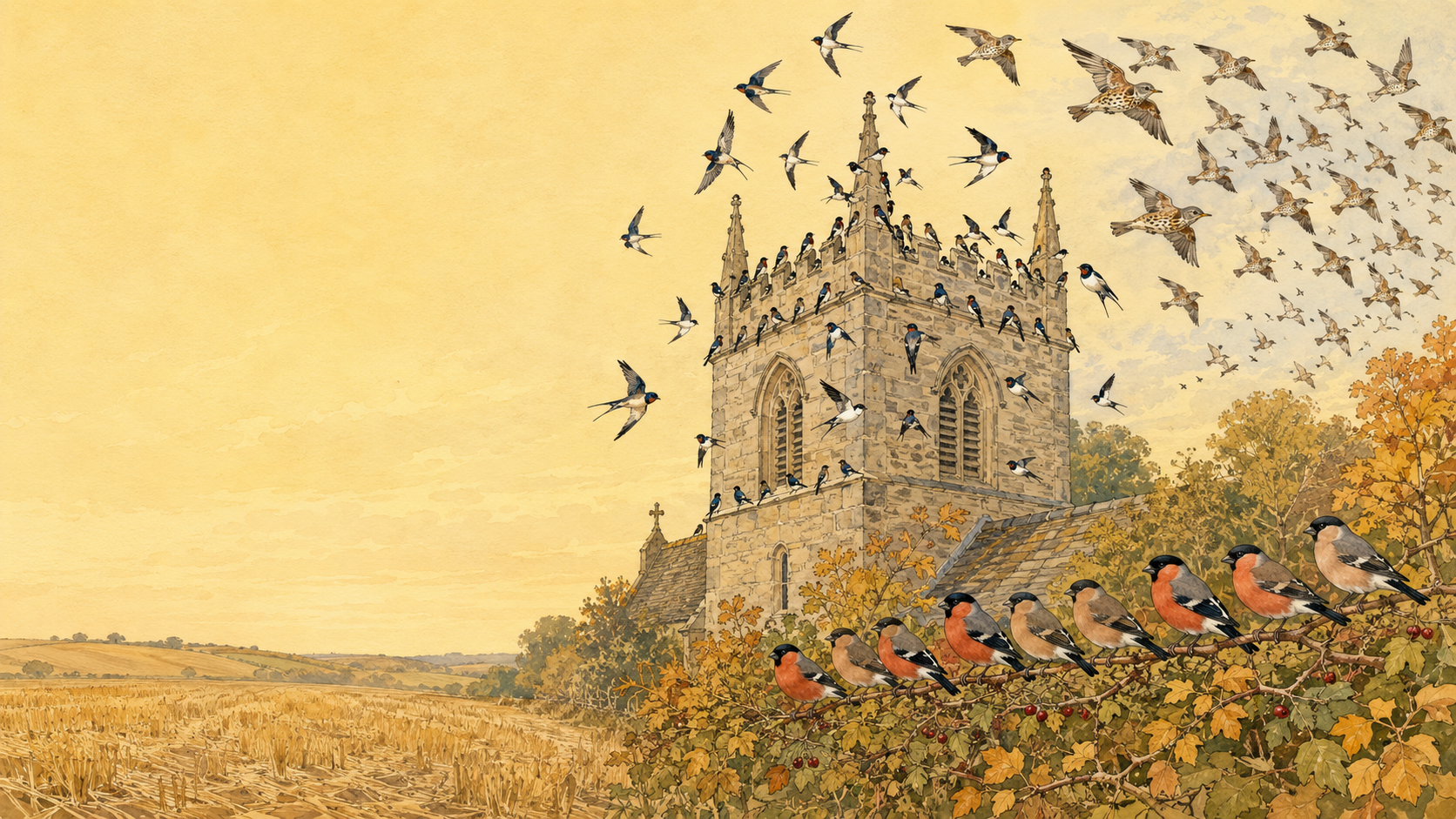
Birds of the Air Chapter 9, Migrating in Autumn, follows the great autumn journeys as summer ends and food grows scarce. Arabella Buckley shows how the birds that live on flying insects leave first: the cuckoo by the end of July, the swifts in August, and the swallows and martins gathering on church towers and barn roofs about the middle of September before they set off in huge flocks for warm Africa. She invites your child to watch the flycatchers, nightingales, and chiff-chaff slip away too, while at home many little birds move about in flocks, larks and finches hunting seeds together and bullfinches flying one behind another along the hedges. Then she turns it around, for as our summer birds leave, colder countries send us their own: fieldfares wheeling over from Norway and Sweden, and redwings, thrushes, and starlings arriving to spend the winter feeding on hips, haws, and berries. Through it all the thrush and the robin stay and sing whenever the weather is mild. It is a lesson in watching the seasons turn, and noticing which birds come and go with the cold.
Say what you remember!
Tell what you remember from the last chapter.
What happened in Birds of the Air Chapter 8, Feeding in Summer?Have a look
In the last chapter, Feeding in Summer, Arabella Buckley took us out on a fine summer morning to watch how each bird finds its food. We saw the house-sparrow and the chaffinch cracking seeds, the lark hunting in the furrows, and the swallows and martins skimming low to snap up flies and gnats. We watched the thrush pull a worm from the grass, the wagtail and wren and spotted flycatcher chase insects, and the bright blue tomtit hang upside down after spiders. She reminded us how useful these birds are for eating slugs, caterpillars, and grubs, and left us with her great secret: to look at every bird you see and try to learn something about it.
Read the previous lesson: Feeding in Summer →Show what you know!
Use your printable Lesson Guide. Fill in the vocabulary you know, then click to check your work and learn some new words today.
What are the difficult or advanced vocabulary words in Birds of the Air Chapter 9, Migrating in Autumn?migrate, flock, scarce, moorHave a look
- migrate: To move from one region to another as the seasons change.
- flock: A group of birds gathered or flying together.
- scarce: Hard to find; not enough to go around.
- moor: Open, rough land covered with heather and coarse grass.
The Books come Alive!
Read or listen to Chapter 9 of Birds of the Air, the Kindred Thicket Enhanced Edition, read by Laura Caldwell.
Teacher’s Notes
This is a Kindred Thicket Enhanced Edition. We checked every claim in this chapter against modern ornithology.
Every migration account in this chapter still holds up today, so there are no corrections to keep in mind. We checked the departure and arrival times, the flocking habits, and the plumage descriptions against the BTO and RSPB. Just enjoy the reading.
Read by Laura Caldwell for LibriVox (public domain), cleaned and trimmed by Kindred Thicket.
Memory becomes Action!
Use the Response Resource* to remember and spell tricky names. Choose one way to narrate.
*Materials in the Lesson Guide.
What is the list of names, people, characters, birds, and places that are important in Chapter 9 of Birds of the Air?Cuckoo, Swift, Swallow, Martin, Fly-catcher, Nightingale, Chiff-chaff, Robin, Thrush, Redwing, Bullfinch, Fieldfare, Starling, LarkHave a look
- Cuckoo: Generally gone by the end of July, one of the first birds to leave.
- Swift: Starts off in August as the flying insects grow scarce.
- Swallow: Gathers in flocks on church towers in mid-September, then flies to Africa for the winter.
- Martin: Collects with the swallows and flies off together for the long journey south.
- Fly-catcher: Leaves about the same time as the swallows.
- Nightingale: Departs in early autumn for warmer countries.
- Chiff-chaff: Goes away in October, one of the last of the summer birds to leave.
- Robin: Some leave, but many stay and sing all year when the weather is mild.
- Thrush: Many arrive from Norway and Germany to spend the winter with us.
- Redwing: Comes to us from Norway and Germany when food grows scarce.
- Bullfinch: Keeps in small flocks, flying one behind the other along the hedges.
- Fieldfare: Flies over from Norway in parties of forty or fifty; a shy grey bird with a speckled breast.
- Starling: Comes from Norway and Germany, flocking with the rooks and chattering.
- Lark: Gathers in great numbers together by November.
Chapter 9 Q & A
This is a Kindred Thicket Enhanced Edition. We read every chapter against modern science, and here is what we found in this chapter.
Is Birds of the Air Chapter 9, Migrating in Autumn, scientifically accurate?
Birds of the Air Chapter 9, Migrating in Autumn, is accurate throughout. We checked every migration detail against modern ornithology (BTO BirdFacts, the BTO Migration Atlas, and the RSPB), and Buckley’s timing for the cuckoo, swift, swallow, flycatcher, nightingale, and chiff-chaff leaving, along with the redwing, fieldfare, and starling arriving for the winter, all holds up. This is a Kindred Thicket Enhanced Edition, and this chapter needed no corrections.
When do swallows leave Britain in the autumn?
Swallows leave Britain mainly in September, gathering first in large flocks on church towers, barn roofs, wires, and willows before setting off. Buckley’s date of about the 15th of September is a reasonable peak for their departure, and they fly for hundreds of miles to winter in sub-Saharan Africa. Her account is accurate.
Which birds arrive in Britain for the winter?
Redwings, fieldfares, and many thrushes and starlings arrive in Britain for the winter, flying over from Norway, Sweden, and Germany from about October. They come as our summer visitors leave, so a southern English garden can hold more birds in winter than in summer. Buckley’s account of these winter arrivals is accurate.
Why do birds migrate in autumn?
Birds migrate in autumn because their food grows scarce once summer ends. The birds that feed on flying insects, such as the cuckoo, swift, swallow, and flycatcher, leave first because gnats, flies, and moths disappear, while others simply shift from cold moors and mountains to milder country in search of berries and seeds. Buckley’s explanation is accurate.
What does a fieldfare look like?
A fieldfare is a shy, gregarious winter visitor with a grey head and rump, chestnut-brown back and wings, and a warm buff breast marked with dark chevron spots. Buckley describes it as a pretty grey bird with brown-red wings and a buff speckled breast, flying in parties of forty or fifty, which is a fair lay description. Her account is accurate.
Do robins and thrushes leave Britain in winter?
Robins and thrushes do not all leave Britain in winter; some move away, but many stay and go on singing whenever the weather is mild. At the same time, extra thrushes and redwings arrive from Scandinavia and Germany to spend the winter here. Buckley’s point that the thrush and the robin sing all the year through is accurate.