The Listening Grove · Birds of the Air
Chapter 11: Other Small Birds
A Charlotte Mason nature-study lesson. Press play, with the lesson.
What is Birds of the Air Chapter 11, Other Small Birds, about?Parent review
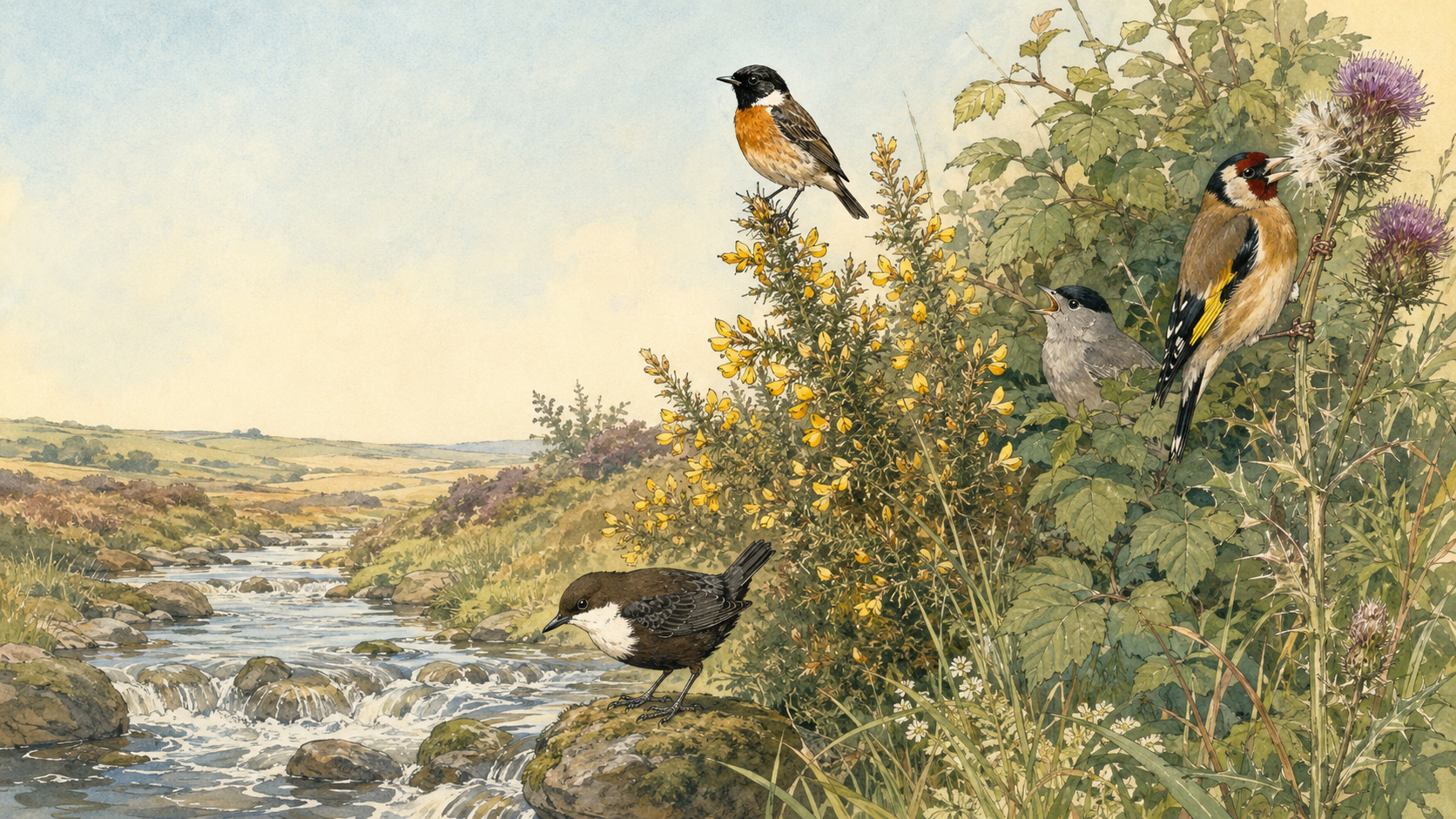
Birds of the Air Chapter 11, Other Small Birds, gathers up a handful of little birds your child can hunt for out of doors. Arabella Buckley starts with the Goldfinch, so useful because it eats thistle and dandelion seeds, and shows how to tell it from the Bullfinch by its pale brown breast. She moves to the cock-Linnet with his crimson breast, and pauses to explain moulting and why the father-birds are more gaudy while the quieter hen-birds sit hidden on the nest. She points out the Nuthatch coming head-downwards along a nut tree, the Blackcap who sings almost as sweetly as a nightingale, the chattering Whitethroat or nettle-creeper, the Stonechat crying chat, chat, chat from the furze, and the Dipper that hops in the beds of rapid streams. She ends by noting the Magpie and Jay, which most children already know. It is a lesson in patient watching and in caring for small birds that are too often caught and caged.
Say what you remember!
Tell what you remember from the last chapter.
What happened in Birds of the Air Chapter 10, Bird-Food in Winter?Have a look
In the last chapter, Bird-Food in Winter, Arabella Buckley showed how hard the cold months are for little birds. When frost and snow come, the larks and linnets crouch under the banks, the thrushes hunt the last mistletoe berries, and the lapwings cry peewit as they journey to the sea-coast. She reminded us that birds die more from hunger than from cold, and asked children to save scraps, crusts, cold potatoes, and fat for the birds that sang to them all summer. She even showed how to make a bird drinking-cup from half a cocoa-nut hung on a tree.
Read the previous lesson: Bird-Food in Winter →Show what you know!
Use your printable Lesson Guide. Fill in the vocabulary you know, then click to check your work and learn some new words today.
What are the difficult or advanced vocabulary words in Birds of the Air Chapter 11, Other Small Birds?molt, commons, gaudy, furzeHave a look
- molt: To shed old feathers so new ones can grow.
- commons: Open public land where anyone may walk or graze animals.
- gaudy: Very bright and showy in a flashy way.
- furze: A spiny evergreen shrub with yellow flowers, also called gorse.
The Books come Alive!
Read or listen to Chapter 11 of Birds of the Air, the Kindred Thicket Enhanced Edition, read by Laura Caldwell.
Teacher’s Notes
This is a Kindred Thicket Enhanced Edition. We checked every claim in this chapter against modern ornithology, and there is one small correction to keep in mind as you listen.
- “a black head and a pale grey breast”Only the male Blackcap has a glossy black cap. The female (and the young) has a warm reddish-brown, chestnut cap instead of a black one.
Read by Laura Caldwell for LibriVox (public domain), cleaned and trimmed by Kindred Thicket.
Memory becomes Action!
Use the Response Resource* to remember and spell tricky names. Choose one way to narrate.
*Materials in the Lesson Guide.
What is the list of names, people, characters, birds, and places that are important in Chapter 11 of Birds of the Air?Goldfinch, Linnet, Bullfinch, Nuthatch, Blackcap, Whitethroat, Stonechat, Dipper, Magpie, JayHave a look
- Goldfinch: Useful for eating thistle and dandelion seeds; red forehead, black wings barred with yellow.
- Linnet: The cock has a crimson breast and a red patch on his head; feeds in big winter flocks.
- Bullfinch: Has a rich red breast and grey and black wings.
- Nuthatch: Climbs down trees head-first and hammers nuts into bark cracks to break them.
- Blackcap: Sings almost as well as a nightingale; the male has a black cap, the female a chestnut-brown one.
- Whitethroat: Creeps under hedges chattering; often called the “nettle-creeper.”
- Stonechat: Lives on commons, sits atop furze bushes, and cries “chat, chat, chat.”
- Dipper: A black bird with a white breast that hops in stream beds and dips its head.
- Magpie: A familiar bird you most likely know already.
- Jay: A familiar bird you most likely know already.
Chapter 11 Q & A
This is a Kindred Thicket Enhanced Edition. We read every chapter against modern science, and here is what we found in this chapter.
Is Birds of the Air Chapter 11, Other Small Birds, scientifically accurate?
Birds of the Air Chapter 11, Other Small Birds, is detailed and well observed, and almost every description holds up today. We checked each bird against modern ornithology (BTO BirdFacts and the RSPB), and Buckley’s accounts of the Goldfinch, Linnet, Nuthatch, Whitethroat, Stonechat, and Dipper are all accurate. There is one small correction: she describes the Blackcap’s black cap, but only the male Blackcap has a black cap; the female (and the young) has a chestnut-brown cap. This is a Kindred Thicket Enhanced Edition, so that one point is noted for you.
Does a female blackcap have a black cap?
A female Blackcap does not have a black cap. Only the male Blackcap has the glossy jet-black cap the bird is named for; the female, and the young birds, have a warm reddish-brown or chestnut cap instead. Buckley’s description in this chapter fits the male, so we note that the female looks different.
How can you tell a goldfinch from a bullfinch?
You tell a Goldfinch from a Bullfinch by the breast and face. The Goldfinch has a bright red forehead and throat, black wings barred with yellow, and a pale brown breast, while the Bullfinch has a rich red breast and grey and black wings. Buckley’s comparison is accurate.
Why does the nuthatch climb down trees head-first?
The Nuthatch climbs down tree trunks head-first to find food other birds miss. It is the only British bird that habitually goes down a trunk head-downwards, and it wedges nuts into cracks in the bark and hammers them open with its beak. Buckley’s description of this habit is accurate.
What is a nettle-creeper?
A nettle-creeper is an old country name for the Whitethroat, a small brown-grey warbler. It creeps and chatters along the bottom of hedges, then sometimes flies higher and sings louder, which is how it earned the name. Buckley’s description is accurate.
What is the Dipper or water-ouzel?
The Dipper, also called the water-ouzel, is a bird that hops about on the stones in the beds of rapid streams and rivers. It looks black, is a little smaller than a thrush, and has a snowy-white breast, a very short tail, and a habit of dipping its head and flirting its tail. Buckley’s description is accurate.