The Listening Grove · Birds of the Air
Chapter 12: Birds of Prey
A Charlotte Mason nature-study lesson. Press play, with the lesson.
What is Birds of the Air Chapter 12, Birds of Prey, about?Parent review
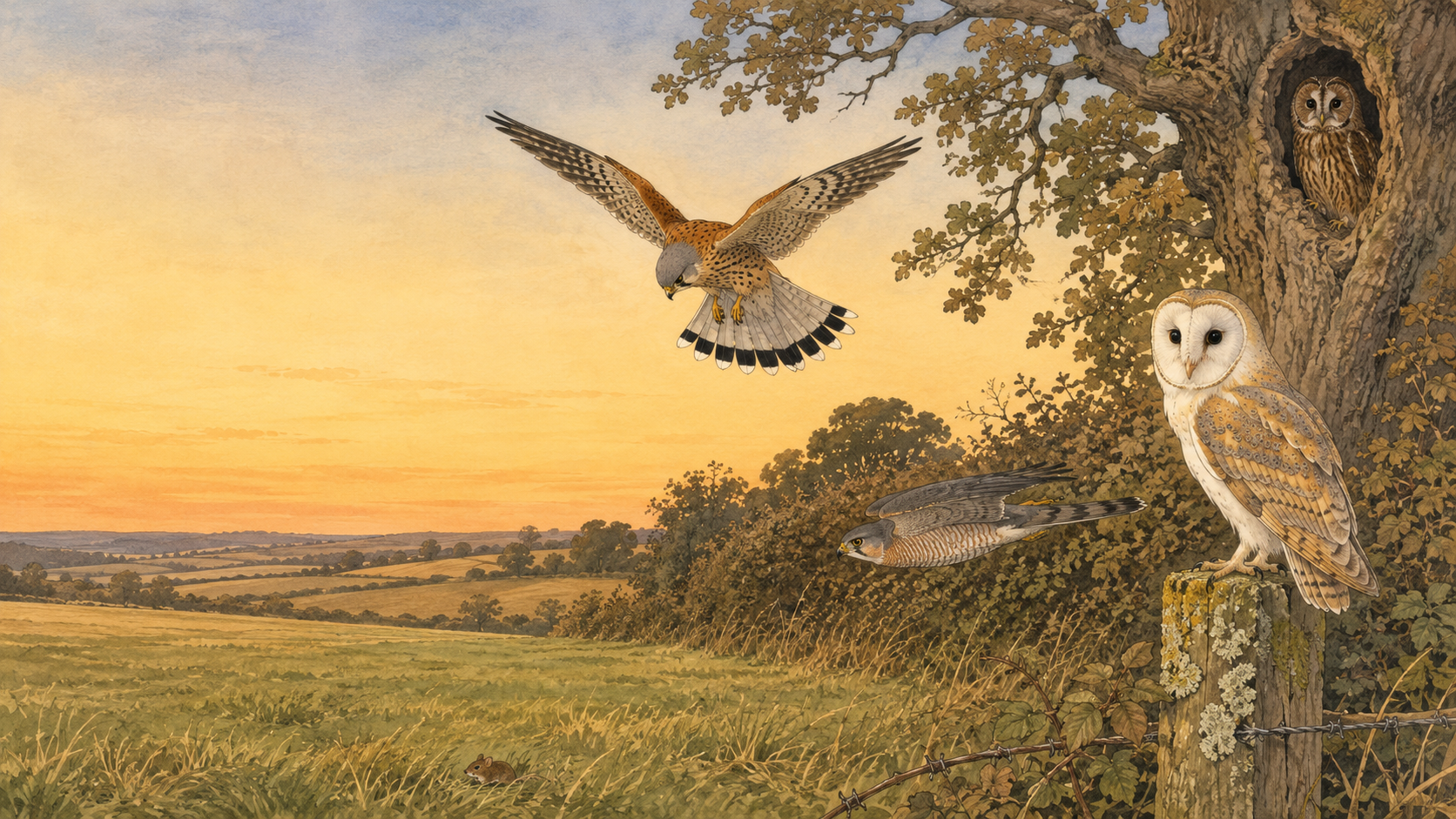
Birds of the Air Chapter 12, Birds of Prey, looks at the birds that hunt other animals: eagles, falcons, hawks, and owls. Arabella Buckley watches the Kestrel, the common hawk that country people call the "wind-hover," beating its pointed wings so fast it seems to hang still in the air before it drops on a mouse in the grass. She shows the hooked beak and long piercing claws that all birds of prey share, and the Sparrow-hawk gliding along the hedges after small birds and mice. Then she turns to the owls, whose eyes face forward like ours, whose pupils open wide to gather what little light there is, and whose soft, downy feathers let them fly almost silently as they hunt by night. She ends with the brown or Tawny Owl of the woods and the pale Barn Owl, the "Screech Owl," that clears the barns of mice. It is a lesson in seeing how each hunter is fitted for its work.
Say what you remember!
Tell what you remember from the last chapter.
What happened in Birds of the Air Chapter 11, Other Small Birds?Have a look
In the last chapter, Other Small Birds, Arabella Buckley introduced a handful of little birds worth finding out for yourself. We met the Goldfinch, with its red face and yellow-barred wings, feeding on thistle seeds, and the crimson-breasted Linnet that gathers in winter flocks. She told us to listen for the Blackcap, who practises his song quietly in a bush before trilling like a nightingale, and for the chattering Whitethroat, the "nettle-creeper," under the hedges. She ended with two more to watch for: the Stonechat crying "chat, chat, chat" on the gorse, and the Dipper that bobs on the stones of rushing streams.
Read the previous lesson: Other Small Birds →Show what you know!
Use your printable Lesson Guide. Fill in the vocabulary you know, then click to check your work and learn some new words today.
What are the difficult or advanced vocabulary words in Birds of the Air Chapter 12, Birds of Prey?prey, vermin, hover, pupilHave a look
- prey: An animal that is hunted and eaten by another.
- vermin: Small wild animals or pests that do damage, such as mice.
- hover: To stay in one place in the air, like a hawk on beating wings.
- pupil: The dark round opening in the middle of the eye that lets in light.
The Books come Alive!
Read or listen to Chapter 12 of Birds of the Air, the Kindred Thicket Enhanced Edition, read by Laura Caldwell.
Teacher’s Notes
This is a Kindred Thicket Enhanced Edition. As you listen, keep this one correction to Birds of the Air in mind.
- “crying "to-whoo, to-whoo" is the brown or Tawny Owl”The famous "tu-whit, tu-whoo" is really a duet between two Tawny Owls, not one bird saying the whole phrase. The female calls a sharp "ke-wick," and the male answers with a long hooting "hoo-hoo-oooo."
Read by Laura Caldwell for LibriVox (public domain), cleaned and trimmed by Kindred Thicket.
Memory becomes Action!
Use the Response Resource* to remember and spell tricky names. Choose one way to narrate.
*Materials in the Lesson Guide.
What is the list of names, people, characters, birds, and places that are important in Chapter 12 of Birds of the Air?Eagle, Falcon, Kestrel, Sparrow-hawk, Tawny Owl, Barn Owl, Hawk, OwlHave a look
- Eagle: A great bird of prey of the Scottish and northern mountains.
- Falcon: One of the chief birds of prey found in our country.
- Kestrel: The common hawk or "wind-hover"; hovers still in the air, then drops on a mouse.
- Sparrow-hawk: Glides along hedges after birds and mice; the mother is larger than the father.
- Tawny Owl: The brown owl that hunts at dawn and dusk; the famous "tu-whit, tu-whoo" is really a male’s hoot answered by the female.
- Barn Owl: The light "Screech Owl" with a white face; hunts mice by night with a loud screech.
- Hawk: Has eyes on the sides of its head, a hooked beak, and long piercing claws.
- Owl: Has eyes set in front like ours, soft silent feathers, and sharp hearing for night hunting.
Chapter 12 Q & A
This is a Kindred Thicket Enhanced Edition. We read every chapter against modern science, and here is what we found in this chapter.
Is Birds of the Air Chapter 12, Birds of Prey, scientifically accurate?
Birds of the Air Chapter 12, Birds of Prey, is well observed and accurate in almost every detail. We checked each claim against modern ornithology (BTO BirdFacts, the RSPB, and the Barn Owl Trust), and Buckley’s accounts of the Kestrel hovering to drop on a mouse, the Sparrowhawk gliding along the hedges, the larger female sparrowhawk, and the forward-facing eyes and silent feathers of owls all hold up. The one correction is that the Tawny Owl’s "tu-whit, tu-whoo" is not one bird but a duet: a male’s hoot answered by the female’s "ke-wick." This is a Kindred Thicket Enhanced Edition, so you’ll find that correction in the Teacher’s Notes.
Does one owl really say "tu-whit, tu-whoo"?
No single owl says the whole "tu-whit, tu-whoo." The familiar phrase is really a duet between two Tawny Owls: the female gives a sharp "ke-wick" contact call, and the male answers with a long, wavering hoot, "hoo-hoo-oooo." The idea that one bird says the whole thing is an old misconception, at least as old as Shakespeare. When Buckley writes that the Tawny Owl cries "to-whoo," the hooting part is the male; the "twit" is the female replying.
How does a kestrel hunt?
The Kestrel hunts by hovering: it beats its long pointed wings so fast that it seems to hang still in the air, watching the ground with its keen eyes, then drops suddenly on a mouse or vole in the grass. Country people call it the "wind-hover" for this reason. Buckley’s description is accurate, and modern study adds that kestrels can even follow the ultraviolet trails that voles leave in their urine.
Why is the mother sparrow-hawk larger than the father?
The mother Sparrow-hawk really is larger than the father, by about a quarter. This "reverse" size difference, where the female is bigger than the male, is one of the most marked of any British bird of prey, and it lets a pair hunt prey of different sizes. Buckley noticed it correctly.
How are an owl’s eyes different from a hawk’s?
An owl’s eyes face forward, set in the front of its face like a human’s, while a hawk’s eyes sit on the sides of its head. The owl’s forward eyes give it the depth perception it needs to judge distance while hunting in dim twilight, and its pupils open very wide, like a cat’s, to gather what little light there is. Buckley’s comparison is accurate.
Why can an owl fly so quietly?
An owl flies almost silently because its feathers are exceptionally soft and downy, with comb-like fringes on the flight feathers that break up the rush of air. This near-silent flight lets the owl hear the faint sounds of its prey and take it by surprise in the dark. Buckley describes both the soft feathers and the owl’s large, hidden ears, and both are accurate.