The Listening Grove · Birds of the Air
Chapter 13: Rooks and Their Companions
A Charlotte Mason nature-study lesson. Press play, with the lesson.
What is Birds of the Air Chapter 13, Rooks and Their Companions, about?Parent review
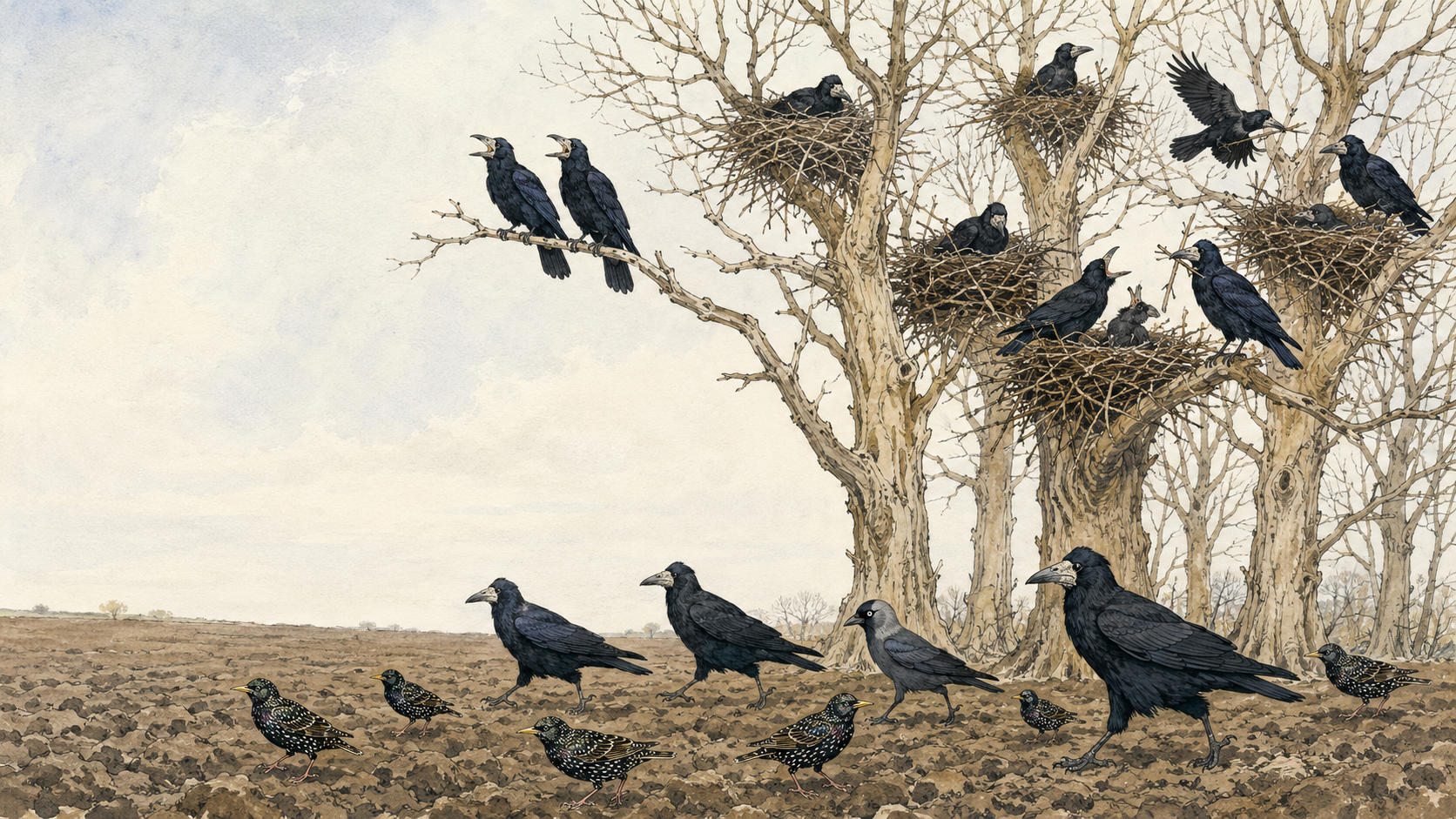
Birds of the Air Chapter 13, Rooks and Their Companions, watches the noisy, sociable rook and the birds that keep it company. Arabella Buckley opens with a Devonshire farmer scolding the rooks for eating his seed, then shows that the same birds save whole crops by pulling wire-worms and cockchafer grubs from the roots, doing far more good than harm. She takes your child up into the busy rookery, where rooks build huge nests high in the trees, use them year after year, and refuse to let strange rooks join them. She teaches how to tell a rook from a crow, which lives in pairs and is more mischievous, and points out the bald grey patch above a grown rook’s beak. She watches the rooks walk gravely across a field with a sentinel or two on watch to cry the alarm, and ends with the companions they welcome to feed beside them: the sprightly grey-naped jackdaw, the glossy starling, and the winter fieldfare. It is a lesson in looking past a bird’s bad name to the useful work it quietly does.
Say what you remember!
Tell what you remember from the last chapter.
What happened in Birds of the Air Chapter 12, Birds of Prey?Have a look
In the last chapter, Birds of Prey, Arabella Buckley looked at the hunters of the bird world: the eagles, falcons, hawks, and owls that feed on smaller animals. We watched the Kestrel, the "wind-hover," beat its wings so fast it hangs still in the air before dropping on a mouse, and met the Sparrow-hawk that glides along the hedges after birds. She showed how a bird of prey’s hooked beak, long toes, and sharp claws help it catch and tear its food, and how the furry skins and bones come back up in a little ball. She ended with the owls, the "to-whoo" Tawny Owl and the pale screeching Barn Owl, whose front-facing eyes, soft silent feathers, and keen ears let them hunt in the dark.
Read the previous lesson: Birds of Prey →Show what you know!
Use your printable Lesson Guide. Fill in the vocabulary you know, then click to check your work and learn some new words today.
What are the difficult or advanced vocabulary words in Birds of the Air Chapter 13, Rooks and Their Companions?mischievous, grub, reward, rookeryHave a look
- mischievous: Causing small trouble or harm in a playful or sly way.
- grub: The small, worm-like young form of an insect.
- reward: Something given in return for a service or good deed.
- rookery: A group of rooks’ nests high in the trees.
The Books come Alive!
Read or listen to Chapter 13 of Birds of the Air, the Kindred Thicket Enhanced Edition, read by Laura Caldwell.
Teacher’s Notes
This is a Kindred Thicket Enhanced Edition. We checked every claim in this chapter against modern ornithology.
Every observation of the rook and its companions in this chapter still holds up today, so there are no corrections to keep in mind. We checked each one against the BTO and RSPB, including the bald patch that tells a grown rook from a crow. Just enjoy the reading.
Read by Laura Caldwell for LibriVox (public domain), cleaned and trimmed by Kindred Thicket.
Memory becomes Action!
Use the Response Resource* to remember and spell tricky names. Choose one way to narrate.
*Materials in the Lesson Guide.
What is the list of names, people, characters, birds, and places that are important in Chapter 13 of Birds of the Air?Rook, Crow, Jackdaw, Starling, FieldfareHave a look
- Rook: Eats wire-worms and grubs that would ruin crops; builds huge nests high in trees and walks gravely across the field.
- Crow: Lives in pairs, not flocks; more mischievous, feeding on birds and young lambs.
- Jackdaw: Smaller and livelier than a rook, with a grey patch on his head.
- Starling: A walking bird, black but bright with colored feather-tips; feeds with the rooks.
- Fieldfare: Allowed to feed alongside the rooks in winter.
Chapter 13 Q & A
This is a Kindred Thicket Enhanced Edition. We read every chapter against modern science, and here is what we found in this chapter.
Is Birds of the Air Chapter 13, Rooks and Their Companions, scientifically accurate?
Birds of the Air Chapter 13, Rooks and Their Companions, is accurate and well observed throughout. We checked every claim against modern ornithology (BTO BirdFacts and the RSPB), and Buckley’s accounts of the rook’s feeding, its closed rookeries, its walking gait, its sentinels, and its mixed feeding flocks all hold up. The key field mark she gives, the bald grey patch that distinguishes a grown rook from a carrion crow, is real, and the descriptions of the jackdaw, starling, and fieldfare are correct too. This is a Kindred Thicket Enhanced Edition, and this chapter needed no corrections.
How do you tell a rook from a crow?
You tell a rook from a crow by the bald patch and by their company. After a rook is about a year old it moults to show a pale, bare grey-white patch of skin around the base of its beak, where the carrion crow keeps its face fully feathered. Crows also live in pairs and are rarely seen in numbers, while rooks gather in noisy flocks, so seeing many black birds together usually means rooks. Buckley’s description is accurate.
Are rooks good or bad for farm crops?
Rooks do far more good than harm on a farm. They eat some newly sown corn, birds’ eggs, and green walnuts, but they also pull huge numbers of wire-worms, leatherjackets, cockchafer grubs, snails, slugs, and other pests out of the roots of the crops. Buckley’s tale of the Devonshire farmers who paid a reward for rooks’ heads and then lost three years of crops to insects reflects real cases where removing corvids let pests erupt. Her account is accurate.
What is a rookery?
A rookery is the colony of large stick nests that rooks build high in the forks of tall trees, often near old houses. Rooks return to the same rookery and the same nest tree year after year, and an established rookery is a closed colony that will not let strange rooks join. In late summer they often move off to sleep in beech and pine woods, calling back at the rookery now and then until they settle again in spring. Buckley’s description is accurate.
Which birds feed alongside rooks?
The birds that feed alongside rooks are jackdaws, starlings, and fieldfares. Rooks will not let another party of their own kind join them, but they tolerate these companions, and mixed autumn and winter flocks of rooks, jackdaws, and starlings on farmland are a common British sight. The jackdaw is smaller and more sprightly with a grey nape, and the starling looks glossy and colourful in the light despite its dark body. Buckley’s description is accurate.
Why does a rook walk instead of hopping?
A rook walks because that is simply how corvids move on the ground. Rather than hopping like a thrush or a sparrow, a rook strides one foot after the other with a characteristic rolling, gravely gait, giving a little jump now and then. While the flock feeds, one or two sentinel rooks stay in the nearby trees, and their "caw-caw" sends the whole flock into the air. Buckley’s description is accurate.