The Listening Grove · Birds of the Air
Chapter 3: The Nests of Birds
A Charlotte Mason nature-study lesson. Press play, with the lesson.
What is Birds of the Air Chapter 3, The Nests of Birds, about?Parent review
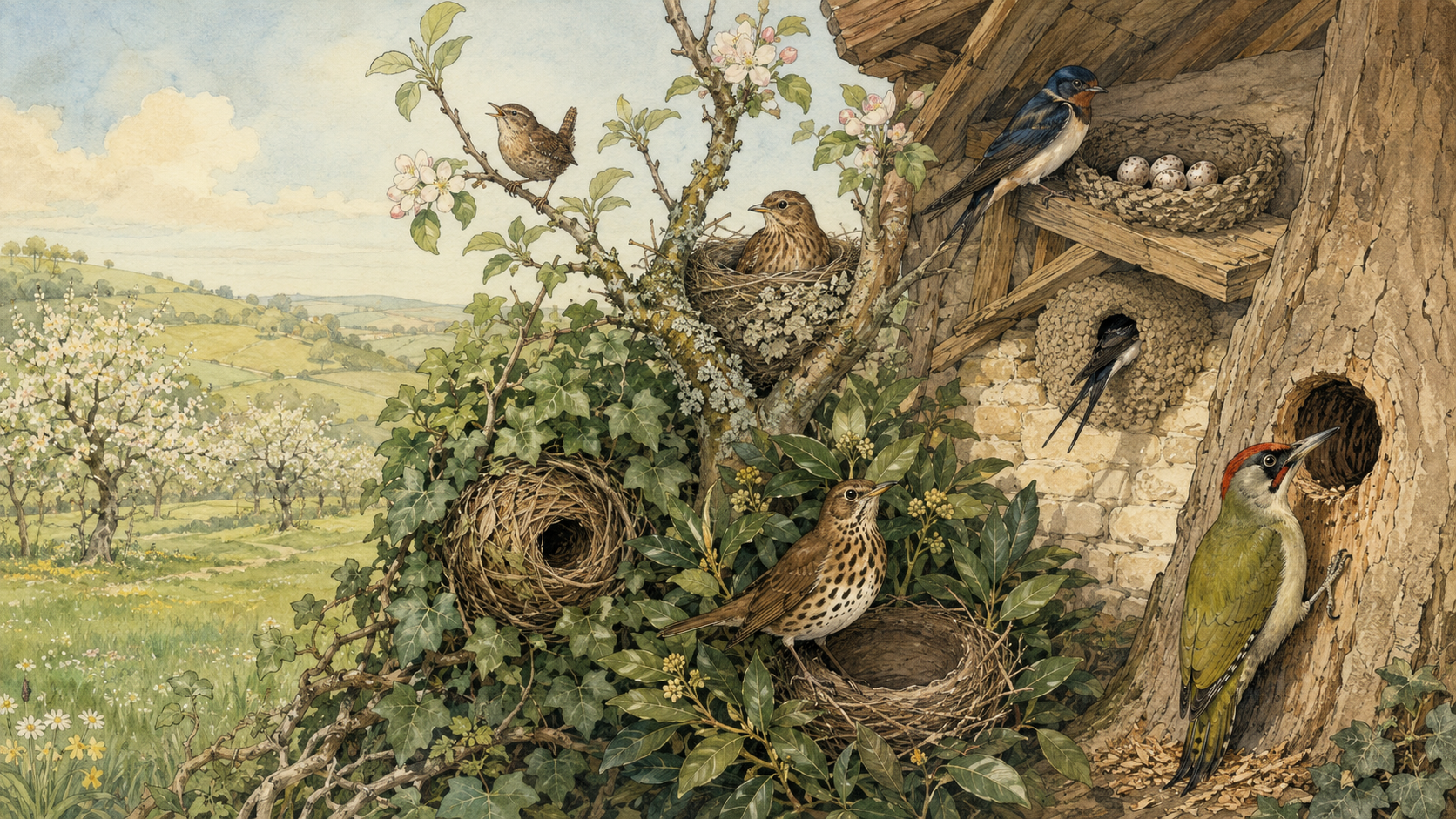
Birds of the Air Chapter 3, The Nests of Birds, looks closely at how cleverly birds build their homes. Arabella Buckley invites your child to gather a few deserted nests and take them gently apart, discovering that no one can weave them back together as neatly as the bird did. She compares the Hedge-sparrow’s simple hawthorn nest with the Chaffinch’s deep cup of grass, moss, and wool, decorated on the outside with grey lichen to hide it in the apple tree, and the Thrush’s nest plastered inside with mud until it is almost as hard as a cocoa-nut shell. She shows the Swallow’s mud basin on the barn rafter, the Martin’s clay bag under the eaves, the Woodpecker’s hole lined with chips, and the Nuthatch walling up its doorway with clay. She ends with the tiny Wren, whose cock builds several unfinished "cock’s nests" for the hen to choose from, and a real account of a wren pair building for more than a week. It is a lesson in looking closely and leaving nests undisturbed.
Say what you remember!
Tell what you remember from the last chapter.
What happened in Birds of the Air Chapter 2, The Song of Birds?Have a look
In the last chapter, The Song of Birds, Arabella Buckley listened to why and how birds sing. We heard the spring dawn chorus, when Robins, Thrushes, Blackbirds, Chaffinches, and Wrens burst into song at sunrise, and learned to pick out one voice from another. She played with the words people use to imitate bird song, the Yellowhammer’s "a little bit of bread and no cheese," the Chiff-chaff calling its own name, and the cooing Wood-pigeon, and lingered on the Nightingale, who sings nearly all night in the warm south. She ended with the father bird singing to the mother on her nest and teaching his young their song.
Read the previous lesson: The Song of Birds →Show what you know!
Use your printable Lesson Guide. Fill in the vocabulary you know, then click to check your work and learn some new words today.
What are the difficult or advanced vocabulary words in Birds of the Air Chapter 3, The Nests of Birds?deserted, woven, lichen, fortnightHave a look
- deserted: Left empty and abandoned, with no one there anymore.
- woven: Made by passing threads or strands over and under each other.
- lichen: A crusty, papery living thing, made of an alga and a fungus growing together, found on bark and rocks.
- fortnight: A period of two weeks, or fourteen days.
The Books come Alive!
Read or listen to Chapter 3 of Birds of the Air, the Kindred Thicket Enhanced Edition, read by Laura Caldwell.
Teacher’s Notes
This is a Kindred Thicket Enhanced Edition. We checked every claim in this chapter against modern ornithology.
Every nest description in this chapter still holds up today, so there are no corrections to keep in mind. We checked each one against the BTO and RSPB. Just enjoy the reading.
Read by Laura Caldwell for LibriVox (public domain), cleaned and trimmed by Kindred Thicket.
Memory becomes Action!
Use the Response Resource* to remember and spell tricky names. Choose one way to narrate.
*Materials in the Lesson Guide.
What is the list of names, people, characters, birds, and places that are important in Chapter 3 of Birds of the Air?Hedge-sparrow, Chaffinch, Thrush, Rook, Lark, Plover (Peewit), Swallow, Martin, Woodpecker, Nuthatch, Pigeon, Reed-warbler, Wren, Long-tailed TitmouseHave a look
- Hedge-sparrow: Builds a simple nest in hawthorn bushes, hard to rebuild as neatly as the bird did.
- Chaffinch: Weaves a deep cup of grass and moss, lined with hair, and hidden with lichen.
- Thrush: Builds a large, firm nest plastered hard inside with mud, in a laurel or fir.
- Rook: Builds high in trees with sticks and clay; easy to watch and not shy.
- Lark: Makes her nest of grass in a rut or furrow of the field.
- Plover (Peewit): Lays a few bits of grass in a marsh; her young run about as soon as hatched.
- Swallow: Builds a shallow basin of mud and straw on barn rafters, lined with feathers.
- Martin: Builds a bag of clay under the eaves, with only a small hole at the top.
- Woodpecker: Makes a hole in a tree and lines it with chips of wood.
- Nuthatch: Lines a hole in a branch, then walls up the opening with clay.
- Pigeon: Builds a nest so loose the eggs almost slip through.
- Reed-warbler: Weaves its nest round two or three reeds near the water.
- Wren: Builds a ball-shaped nest with a side hole, in walls, trees, and banks.
- Long-tailed Titmouse: Loves to build its ball-shaped nest in the gorse bushes.
Chapter 3 Q & A
This is a Kindred Thicket Enhanced Edition. We read every chapter against modern science, and here is what we found in this chapter.
Is Birds of the Air Chapter 3, The Nests of Birds, scientifically accurate?
Birds of the Air Chapter 3, The Nests of Birds, is accurate throughout. We checked every nest description against modern ornithology (BTO BirdFacts and the RSPB), and Buckley’s accounts of the Chaffinch, Thrush, Swallow, Martin, Woodpecker, Nuthatch, Wren, Lark, Lapwing, and Reed Warbler nests all hold up. This is a Kindred Thicket Enhanced Edition, and this chapter needed no corrections.
How does a chaffinch build its nest?
The Chaffinch builds a deep cup of dry grass and moss matted together with wool, lined with hair and feathers, and decorated on the outside with grey lichen. The lichen helps hide the nest against the bark of an apple tree; in a green hedge the bird uses green moss instead. Buckley’s description is one of the most precise in British ornithology, and it is accurate.
Why is a thrush’s nest so hard inside?
A Song Thrush lines the inside of its nest with mud, cow-dung, or rotten wood, smoothing it until it is almost as hard as the inside of a cocoa-nut shell. This mud-plastered cup is a diagnostic feature that tells a thrush’s nest apart from the soft nest of a hedge-sparrow. Buckley’s description is accurate.
What is a wren’s "cock’s nest"?
A cock’s nest is one of several extra, unlined nests that the male Wren builds. The female inspects them, chooses one, and lines it herself before laying, while the others are left empty. Scientists still think this is linked to mate choice, and, as Buckley honestly notes, the full reason is not completely understood.
How does a nuthatch make its nest safe?
A Nuthatch takes a ready-made hole in a branch and plasters clay around the opening until only one small entrance is left. This walled-up doorway keeps larger birds out, and it is one of the Nuthatch’s most distinctive habits. Buckley’s description is accurate.
Is "Peewit" the right name for the plover in this chapter?
"Peewit" is an old country name for the Northern Lapwing, the plover Buckley describes nesting in marshy fields. The name imitates the bird’s call and is still used today, though its formal name is now the Lapwing. Its young, as Buckley says, can run about almost as soon as they hatch.