The Listening Grove · Birds of the Air
Chapter 4: Birds’ Eggs
A Charlotte Mason nature-study lesson. Press play, with the lesson.
What is Birds of the Air Chapter 4, Birds’ Eggs, about?Parent review
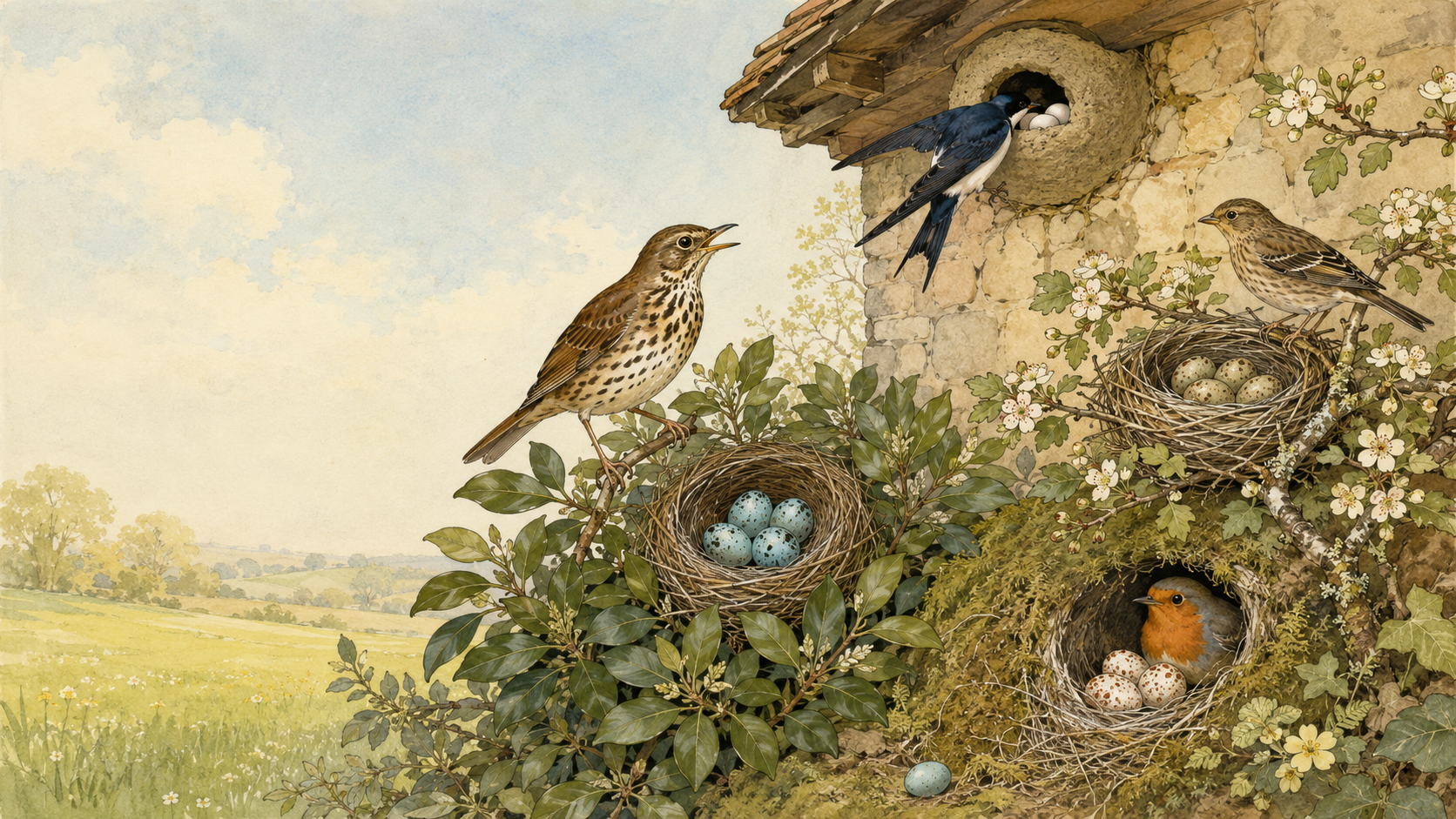
Birds of the Air Chapter 4, Birds' Eggs, moves from the nest to the treasures inside it. Arabella Buckley invites your child to hunt for eggs near home, but never to take or even touch them, since a wood-pigeon will desert a nest that has been handled and each egg is a little bird waiting to hatch. She teaches your child to read an egg like a page: the Thrush's blue eggs spotted with black, the Blackbird's greener ones, the Mistle-thrush's buff, the Chaffinch's and Bullfinch's pale spotted eggs, and the plain white eggs of the Martin, Swallow, Robin, Tomtit, and Owl. She counts the eggs, watches how long they take to hatch (about a fortnight for small birds, a day or two longer for rooks and pigeons), and notices that the young bird always breaks out at the large end. At the close she draws out a lovely secret: white eggs are always tucked in holes, deep nests, or high out of reach, while spotted eggs, coloured like moss and twigs, lie in open nests where their marks keep them hidden. It is a lesson in looking closely and letting the eggs lie quietly where they belong.
Say what you remember!
Tell what you remember from the last chapter.
What happened in Birds of the Air Chapter 3, The Nests of Birds?Have a look
In the last chapter, The Nests of Birds, Arabella Buckley showed how cleverly birds build their homes. We pulled apart a Hedge-sparrow’s simple nest and found we could not weave it back as neatly as the bird did, then compared the Chaffinch’s deep cup hidden with grey lichen and the Thrush’s nest plastered hard inside with mud. She walked us past the Swallow’s mud basin on a barn rafter, the Martin’s clay bag under the eaves, the Woodpecker’s hole lined with chips, and the Nuthatch walling up its doorway with clay. She ended with the tiny Wren, whose cock builds spare "cock’s nests," and a real account of a wren pair building patiently for more than a week.
Read the previous lesson: The Nests of Birds →Show what you know!
Use your printable Lesson Guide. Fill in the vocabulary you know, then click to check your work and learn some new words today.
What are the difficult or advanced vocabulary words in Birds of the Air Chapter 4, Birds’ Eggs?blotches, speckled, cunningly, particularHave a look
- blotches: Large, uneven spots or patches of color.
- speckled: Covered with many small spots or specks.
- cunningly: In a clever way meant to trick or to avoid being noticed.
- particular: Very careful or fussy about how things are done.
The Books come Alive!
Read or listen to Chapter 4 of Birds of the Air, the Kindred Thicket Enhanced Edition, read by Laura Caldwell.
Teacher’s Notes
This is a Kindred Thicket Enhanced Edition. We checked every claim in this chapter against modern ornithology.
Every egg description in this chapter still holds up today, so there are no corrections to keep in mind. We checked each one against the BTO and RSPB. Just enjoy the reading.
Read by Laura Caldwell for LibriVox (public domain), cleaned and trimmed by Kindred Thicket.
Memory becomes Action!
Use the Response Resource* to remember and spell tricky names. Choose one way to narrate.
*Materials in the Lesson Guide.
What is the list of names, people, characters, birds, and places that are important in Chapter 4 of Birds of the Air?Thrush, Blackbird, Mistle-thrush, Chaffinch, Bullfinch, Martin, Sparrow, Swallow, Robin, Tomtit, Owl, Water-wagtail, Rook, JackdawHave a look
- Thrush: Four to six beautiful blue eggs, about an inch long, spotted black at the large end.
- Blackbird: Greener eggs with red-brown spots; the nest is lined with fine roots and grass.
- Mistle-thrush: Light buff eggs spotted with reddish brown and pale lilac, usually in a tree.
- Chaffinch: Pale brown-green eggs with brown spots, about a third the size of a thrush's.
- Bullfinch: Pale blue eggs spotted with dark brown, in the ivy of a wall.
- Martin: Pure white eggs without spots, under the eaves of the house.
- Sparrow: Grey eggs with brown blotches, in a nest of straw lined with feathers.
- Swallow: About five white eggs with dark red patches, in an open nest on a rafter.
- Robin: White eggs spotted with light red, in almost every bank or hedgerow.
- Tomtit: Many little white eggs speckled with red; the bold mother hisses and pecks.
- Owl: Large white eggs in the barn, sometimes with young birds beside them.
- Water-wagtail: Greyish-white spotted eggs in a riverbank or a hole in a wall.
- Rook: Bluish-green eggs, high up and not easy to reach.
- Jackdaw: Builds and lays its eggs in chimneys.
Chapter 4 Q & A
This is a Kindred Thicket Enhanced Edition. We read every chapter against modern science, and here is what we found in this chapter.
Is Birds of the Air Chapter 4, Birds’ Eggs, scientifically accurate?
Birds of the Air Chapter 4, Birds’ Eggs, is accurate or very close throughout. We checked every egg description against modern ornithology (BTO BirdFacts and the RSPB), and Buckley’s accounts of the Thrush, Blackbird, Mistle-thrush, Chaffinch, Martin, Swallow, Robin, and the incubation times all hold up, as does her camouflage principle that white eggs stay hidden while spotted eggs lie in the open. Only a couple of egg-colour details are slightly imprecise, such as calling the Bullfinch’s spots "brown or purple" when they are really dark brown to black. This is a Kindred Thicket Enhanced Edition, and the chapter needed no corrections beyond that minor note.
What colour are a song thrush’s eggs?
A Song Thrush lays a clutch of three to six clear sky-blue eggs, spotted with black mainly at the large end, just as Buckley describes. The bright blue with black speckling makes them one of the easiest British eggs to recognise. Her description is accurate.
How long does it take for a bird’s eggs to hatch?
A bird’s eggs take about a fortnight, or fourteen days, to hatch for most small garden birds, and a day or two longer for larger birds like rooks and pigeons. Buckley’s figures match modern nest-record data: Song Thrush eggs hatch in roughly eleven to fifteen days, while Rooks and Wood Pigeons take about sixteen to eighteen. Her account is accurate.
Why are some birds’ eggs white and others spotted?
Birds’ eggs are white when the nest is hidden in a hole, a bank, a deep cavity, or high out of reach, because no camouflage is needed there, and spotted or greenish when the nest sits out in the open, so the marks blend with the moss, leaves, and twigs. Buckley points to the white eggs of the owl, martin, woodpecker, kingfisher, and pigeon as examples. This is a well-established pattern in modern ornithology, and her principle is sound.
Are a bullfinch’s eggs really spotted with brown or purple?
A Bullfinch’s eggs are pale blue to pale greenish-blue with sparse dark brown to blackish spots and streaks, often forming a ring at the large end. Buckley is right that they are pale blue and spotted, but "brown or purple" is slightly imprecise, since the spots are dark brown to black rather than purple. This is the one small imprecision in the chapter.
Why should children never touch birds’ eggs?
Children should never touch or take birds’ eggs because some birds, like the wood-pigeon, will desert a nest whose eggs have been handled, and every egg is a living little bird waiting to hatch. Buckley’s warning is sound advice and also good law today: in the UK it is illegal to take or disturb the eggs of wild birds. The kind thing, as she says, is to look well and leave them where they lie.