The Listening Grove · Birds of the Air
Chapter 5: Baby Birds
A Charlotte Mason nature-study lesson. Press play, with the lesson.
What is Birds of the Air Chapter 5, Baby Birds, about?Parent review
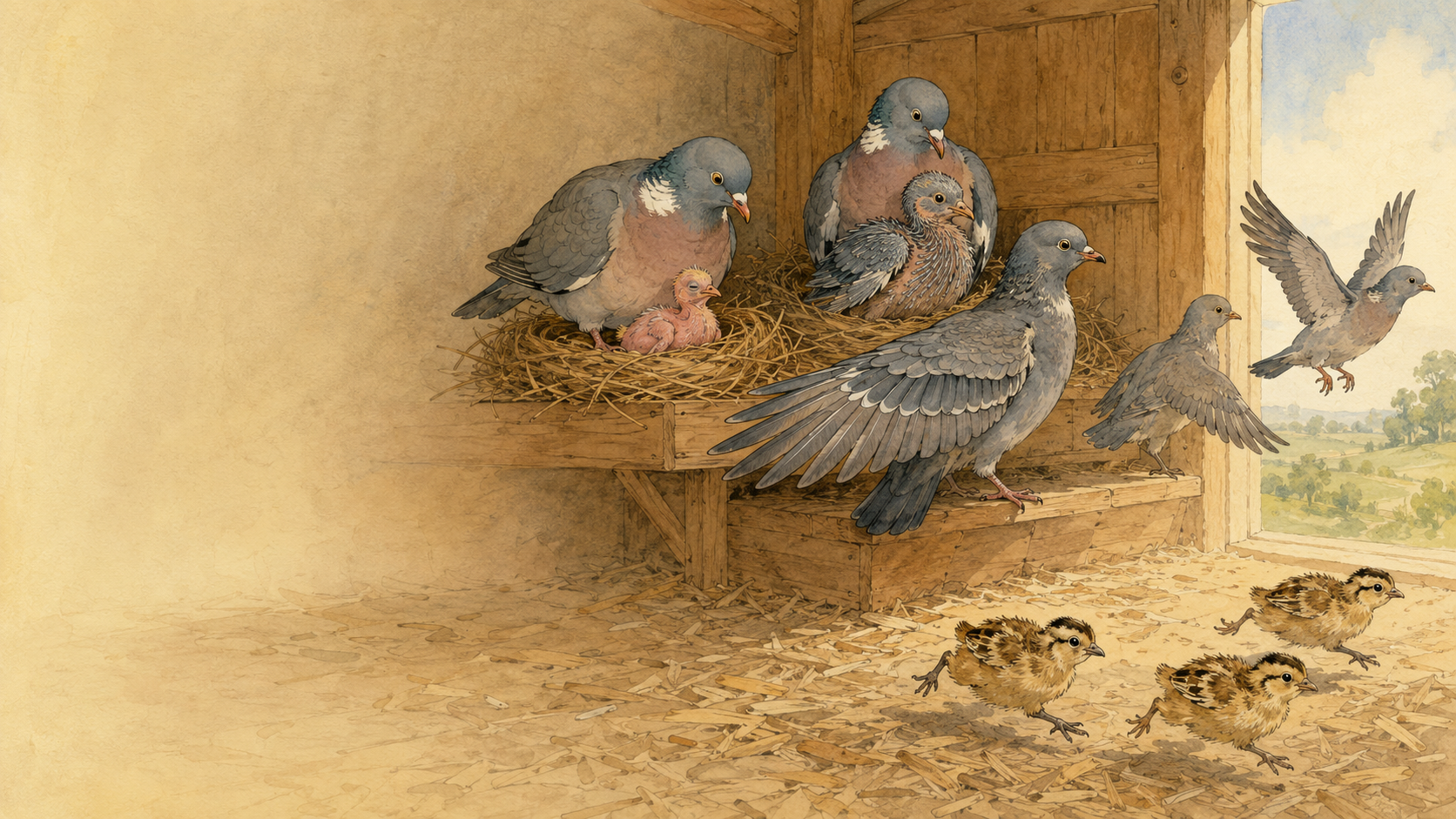
Birds of the Air Chapter 5, Baby Birds, follows a young bird from the shell to its first flight. Arabella Buckley shows how the chick taps its way out with a little horny tip on its beak, and how some babies, like chickens, ducks, and partridges, hatch downy and run about at once, while others, like pigeons, sparrows, and thrushes, hatch naked, blind, and helpless in the nest. Watching a baby pigeon day by day, she points out that its wing has three joints just like your arm, at the shoulder, elbow, and wrist, and traces how the down feathers come first, then the flat covering feathers, then the long quill feathers of the wing and tail. She looks closely at a single flight feather, its tapering quill and its featherlets hooked together so tightly that air cannot pass through. She ends as the young pigeon flaps to the ledge and, about a month after hatching, flutters down to feed beside its parents. It is a lesson in watching a living thing grow, gently and without disturbing it.
Say what you remember!
Tell what you remember from the last chapter.
What happened in Birds of the Air Chapter 4, Birds' Eggs?Have a look
In the last chapter, Birds’ Eggs, Arabella Buckley showed us how to hunt for eggs without ever taking them, since each one would grow into a happy little bird. We learned to tell one kind from another by colour and markings, the Thrush’s blue eggs spotted with black, the Blackbird’s greener eggs, the Martin’s plain white against the Sparrow’s grey and blotchy ones. She reminded us that some birds, like the wood-pigeon, will desert the nest if their eggs are touched, and that white eggs are always tucked out of sight while spotted eggs blend in with moss and twigs. It was a lesson in looking carefully and leaving every nest just as we found it.
Read the previous lesson: Birds' Eggs →Show what you know!
Use your printable Lesson Guide. Fill in the vocabulary you know, then click to check your work and learn some new words today.
What are the difficult or advanced vocabulary words in Birds of the Air Chapter 5, Baby Birds?downy, limp, taper, quillHave a look
- downy: Covered with down, the soft, fluffy feathers of a young bird.
- limp: Soft and floppy, not stiff or firm.
- taper: To grow gradually narrower toward one end.
- quill: The hard, hollow central stem of a feather.
The Books come Alive!
Read or listen to Chapter 5 of Birds of the Air, the Kindred Thicket Enhanced Edition, read by Laura Caldwell.
Teacher’s Notes
This is a Kindred Thicket Enhanced Edition. We checked every claim in this chapter against modern ornithology.
Every claim in this chapter’s reading still holds up today, so there are no corrections to keep in mind as you listen. We checked the hatching, the wing joints, the order the feathers grow in, the tiny hooks that seal a flight feather, and the way the wings beat, all against modern ornithology. Just enjoy the reading.
Read by Laura Caldwell for LibriVox (public domain), cleaned and trimmed by Kindred Thicket.
Memory becomes Action!
Use the Response Resource* to remember and spell tricky names. Choose one way to narrate.
*Materials in the Lesson Guide.
What is the list of names, people, characters, birds, and places that are important in Chapter 5 of Birds of the Air?Chicken, Duck, Partridge, Pigeon, Sparrow, Thrush, DoveHave a look
- Chicken: A very active baby-bird; runs about as soon as it hatches, and the horny tip soon falls off.
- Duck: Hatches with downy feathers and finds its own food, sheltering under the mother’s wing.
- Partridge: Comes out downy and able to run and feed itself at once.
- Pigeon: Hatched naked, blind, and helpless; fed by its parents until it can fly about a month later.
- Sparrow: Born naked and helpless, unable to leave the nest until fed and grown.
- Thrush: Hatched blind and helpless, fed in the nest by both parents.
- Dove: Kept in cages or boxes, where you can watch the young grow day by day.
Chapter 5 Q & A
This is a Kindred Thicket Enhanced Edition. We read every chapter against modern science, and here is what we found in this chapter.
Is Birds of the Air Chapter 5, Baby Birds, scientifically accurate?
Birds of the Air Chapter 5, Baby Birds, is accurate and insightful throughout. We checked every claim in the reading against modern ornithology (the BTO and standard avian anatomy), and Buckley’s account of hatching with the egg tooth, downy versus naked chicks, the three joints of the wing, the order the feathers grow in, the hooked barbules that seal a flight feather, and the beat of the wings all hold up. There is one small correction worth knowing: a bird’s grip on its perch is really a tendon mechanism, not a muscle one, though that particular detail belongs to a later chapter, not this reading. This is a Kindred Thicket Enhanced Edition, so wherever a correction applies to what you actually hear, you’ll find it in the Teacher’s Notes.
How does a bird grip its perch while sleeping?
A bird grips its perch while sleeping by a tendon-locking mechanism, not by working its muscles. When the bird settles and bends its legs, the flexor tendons that run down behind the ankle are stretched automatically, and this pulls the toes closed and locks the claws around the branch. The grip holds with no effort at all, which is why a bird does not fall off its perch as it sleeps; it releases only when the bird straightens its legs to stand. Buckley, writing in 1895, described this outcome correctly but called it a "muscle," where "tendon" is the more accurate word.
How does a baby bird get out of its egg?
A baby bird gets out of its egg using a little horny tip that grows on the top of its beak, called the egg tooth. It taps away at the big end of the shell until the shell cracks and the chick works its way out. Soon after hatching the egg tooth falls off, which is why Buckley tells you to be quick if you want to see it on a newly hatched chicken. This is accurate.
Which baby birds can run about as soon as they hatch?
The baby birds that can run about as soon as they hatch are the ones that come out of the egg covered in down, such as chickens, ducks, and partridges. These downy chicks find food for themselves and cuddle under their mother’s wing, while birds like pigeons, sparrows, and thrushes hatch naked, blind, and helpless and must be fed in the nest. Naturalists call the active, downy chicks precocial and the helpless, nest-bound ones altricial, and Buckley’s examples on both sides are correct.
Does a bird’s wing really have three joints like a human arm?
Yes, a bird’s wing really has three joints just like a human arm, at the shoulder, the elbow, and the wrist. The wing is a modified forelimb, so it folds by drawing the elbow back and touching the shoulder with the hand, and it opens when the hand is drawn out straight, exactly as Buckley describes on a baby pigeon. This comparison to your own arm is anatomically sound.
Why can’t air pass through a bird’s flight feather?
Air cannot pass through a bird’s flight feather because the tiny featherlets along each side are held together by rows of minute hooks. Each little branch is hooked onto the next, so the vane seals into a smooth, flat surface, and the narrow side of one feather also lies over the broad side of the next. When the wing beats down, the air cannot slip through and is driven backwards, which is how the bird pushes itself along. Buckley’s description of these hooked barbules is accurate.