The Listening Grove · Birds of the Air
Chapter 6: Birds Feeding Their Young
A Charlotte Mason nature-study lesson. Press play, with the lesson.
What is Birds of the Air Chapter 6, Birds Feeding Their Young, about?Parent review
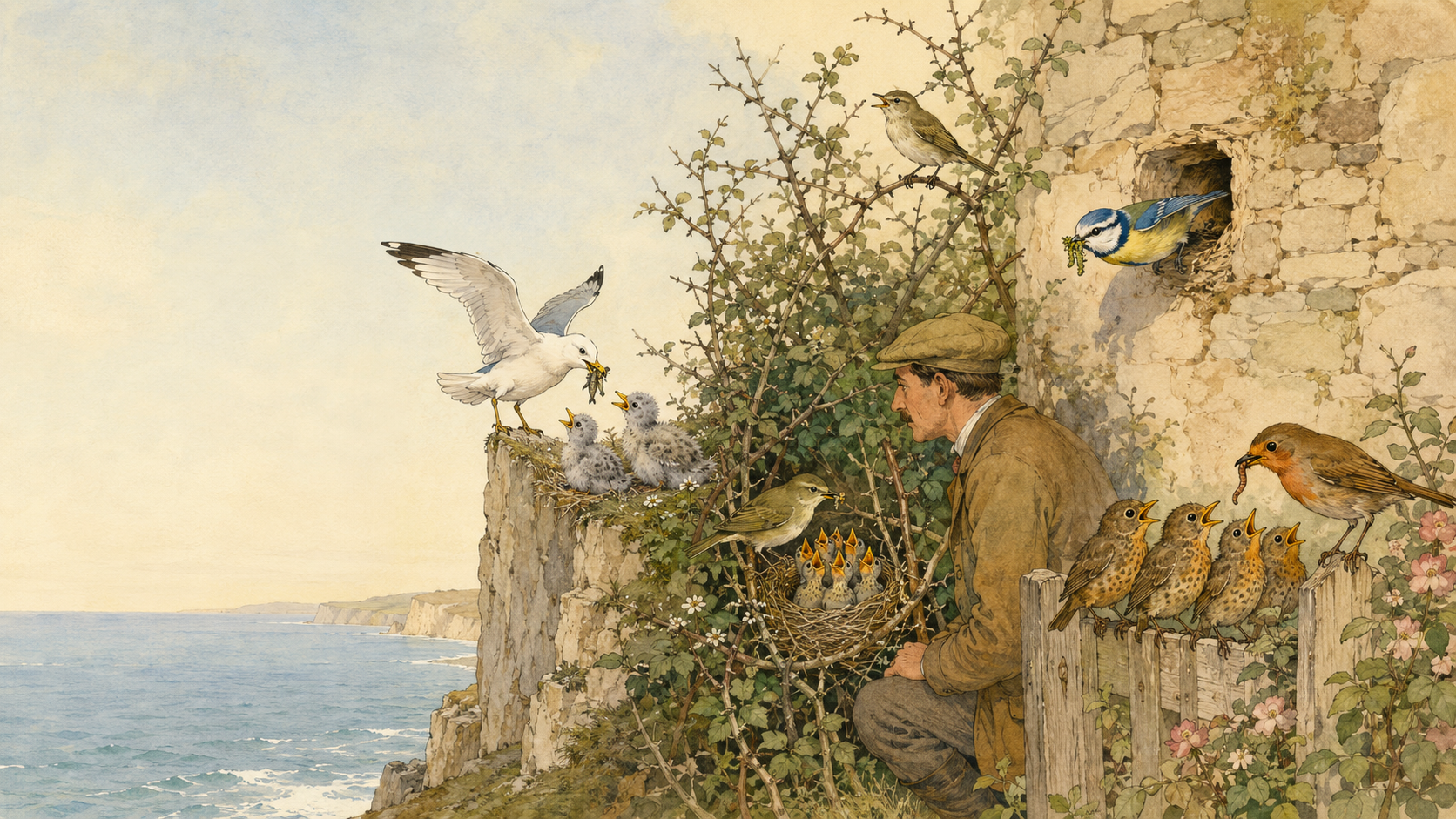
Birds of the Air Chapter 6, Birds Feeding Their Young, invites your child to peep into nests and see how differently birds begin life and how tenderly they are fed. Arabella Buckley shows that some babies, like the Water-hen’s black fluffy chicks, hatch ready to swim away after their mother, while others, like the Kingfisher, Owl, and Hawk, come out naked or blind and helpless and must wait to be fed. She listens to young gulls mewing on the cliffs for fish, and watches Mr. Kearton help a busy little Chiff-chaff mother carry caterpillars to her five open beaks and clean out the nest between journeys. She tells of Tomtits sharing the work, a family of Robins fed by three birds including a helpful "uncle," and Blackbirds pulling worms to pieces so each young one gets a share. She ends with the clever way the Jay and Pigeon pour food from the crop, and sparrows sitting in a row to be fed each in turn. It is a lesson in patient, faithful care.
Say what you remember!
Tell what you remember from the last chapter.
What happened in Birds of the Air Chapter 5, Baby Birds?Have a look
In the last chapter, Baby Birds, Arabella Buckley watched how birds first come into the world. We heard the chicks tapping their way out of the shell with the little horny tip on their beaks, and learned that some babies, like chickens and ducks, hatch downy and run about at once, while others, like the pigeon and sparrow, are naked, blind, and helpless. She looked closely at a baby pigeon, feeling the three joints of its wing just like our own arm, and followed its feathers growing in day by day until it could stretch, flutter, and at last fly down to feed with its parents.
Read the previous lesson: Baby Birds →Show what you know!
Use your printable Lesson Guide. Fill in the vocabulary you know, then click to check your work and learn some new words today.
What are the difficult or advanced vocabulary words in Birds of the Air Chapter 6, Birds Feeding Their Young?helpless, crop, pellet, gracefulHave a look
- helpless: Not able to look after or protect oneself.
- crop: A pouch in a bird’s throat where food is stored before digesting.
- pellet: A small, rounded lump, such as the waste cleaned from a nest.
- graceful: Moving in a smooth and beautiful way.
The Books come Alive!
Read or listen to Chapter 6 of Birds of the Air, the Kindred Thicket Enhanced Edition, read by Laura Caldwell.
Teacher’s Notes
This is a Kindred Thicket Enhanced Edition. We checked every claim in this chapter against modern ornithology.
Every account of how these birds feed their young still holds up today, so there are no corrections to keep in mind. We checked each one against the BTO and RSPB. Just enjoy the reading.
Read by Laura Caldwell for LibriVox (public domain), cleaned and trimmed by Kindred Thicket.
Memory becomes Action!
Use the Response Resource* to remember and spell tricky names. Choose one way to narrate.
*Materials in the Lesson Guide.
What is the list of names, people, characters, birds, and places that are important in Chapter 6 of Birds of the Air?Water-hen, Kingfisher, Owl, Hawk, Gull, Chiff-chaff, Tomtit, Robin, Blackbird, Jay, Pigeon, SparrowHave a look
- Water-hen: Its black fluffy chicks leave the egg and swim away after the mother at once.
- Kingfisher: Hatched naked and helpless; the mother feeds them on fish till their feathers grow.
- Owl: Young are blind and helpless though downy; fed on insects, mice, and rabbits.
- Hawk: Nestlings are blind and helpless; the mother brings small animals till they are full-grown.
- Gull: Young sea-mews or kittiwakes mew on the cliffs, waiting for parents to bring fish.
- Chiff-chaff: The little mother carries caterpillars and flies to her young every few minutes all day.
- Tomtit: Both father and mother fetch caterpillars together for the young.
- Robin: Sometimes fed by three birds at once, even an 'uncle' helping the parents.
- Blackbird: Feeds the young with large worms pulled to pieces, a bit for each.
- Jay: Pours food from her crop into the mouth of the little one.
- Pigeon: The young bird sucks food from the side of its mother’s beak.
- Sparrow: Young sit in a row while the mother feeds each one in turn.
Chapter 6 Q & A
This is a Kindred Thicket Enhanced Edition. We read every chapter against modern science, and here is what we found in this chapter.
Is Birds of the Air Chapter 6, Birds Feeding Their Young, scientifically accurate?
Birds of the Air Chapter 6, Birds Feeding Their Young, is highly observational and accurate. We checked every claim against modern ornithology (BTO BirdFacts and the RSPB), and Buckley’s accounts of Kingfishers, Owls, Hawks, Gulls, the Chiff-chaff, and the crop-feeding of the Jay and Pigeon all hold up. The one slight imprecision is her description of Water-hen (Moorhen) chicks as having "red heads": the red is really on the bill and shield, not the whole head. The Robin "uncle" is genuine alloparental behaviour ("helpers at the nest"), presented honestly as a family’s own observation. This is a Kindred Thicket Enhanced Edition, and this chapter needed no corrections.
Do water-hen (moorhen) chicks really have red heads?
Water-hen chicks, which belong to the Common Moorhen, hatch as black downy balls and do show red, but Buckley’s "red heads" is a slight overstatement. The red is on the bill and frontal shield, with only a small bald reddish patch on the crown, while the rest of the head is black-downed like the body. "Red bill" would be the more precise way to say it, and her point that the chicks swim away after their mother at once is fully accurate.
Why are some baby birds helpless while others can swim right away?
Baby birds differ because some hatch precocial and some hatch altricial. Precocial chicks like the Water-hen’s come out downy, with open eyes, and can swim or run within hours, while altricial chicks like the Kingfisher’s come out naked, blind, and helpless and must be fed in the nest until their feathers grow. Buckley’s side-by-side picture of these two kinds of babies is accurate.
Can a robin family really be fed by an "uncle"?
A robin family being helped by a third bird, an "uncle," describes real behaviour that scientists call alloparenting, or "helpers at the nest." Extra birds helping to feed young is well documented in some species, though it has not been formally confirmed as regular in European Robins. Buckley shares it honestly as her own household’s observation, so it makes a lovely point for family discussion rather than a settled fact.
How do the jay and pigeon feed their young from the crop?
The Jay and Pigeon feed their young by bringing food up from the crop, a storage pouch in the throat. The Jay pours food from her crop into the little one’s mouth, and the Pigeon produces a protein-rich "crop milk" that the chick sucks by putting its beak in at the side of the parent’s beak. Buckley’s description of this crop-feeding is accurate.
Why does the chiff-chaff mother clean pellets out of the nest?
The Chiff-chaff mother cleans pellets of dung out of the nest to keep it healthy for her young. These are faecal sacs, and passerine parents carry them away to keep the nest clean and to avoid drawing predators with the smell. Buckley’s account, watched by Mr. Kearton as she fed caterpillars every few minutes and tidied between journeys, is accurate.