The Listening Grove · Birds of the Air
Chapter 7: Where Do Birds Sleep?
A Charlotte Mason nature-study lesson. Press play, with the lesson.
What is Birds of the Air Chapter 7, Where Do Birds Sleep?, about?Parent review
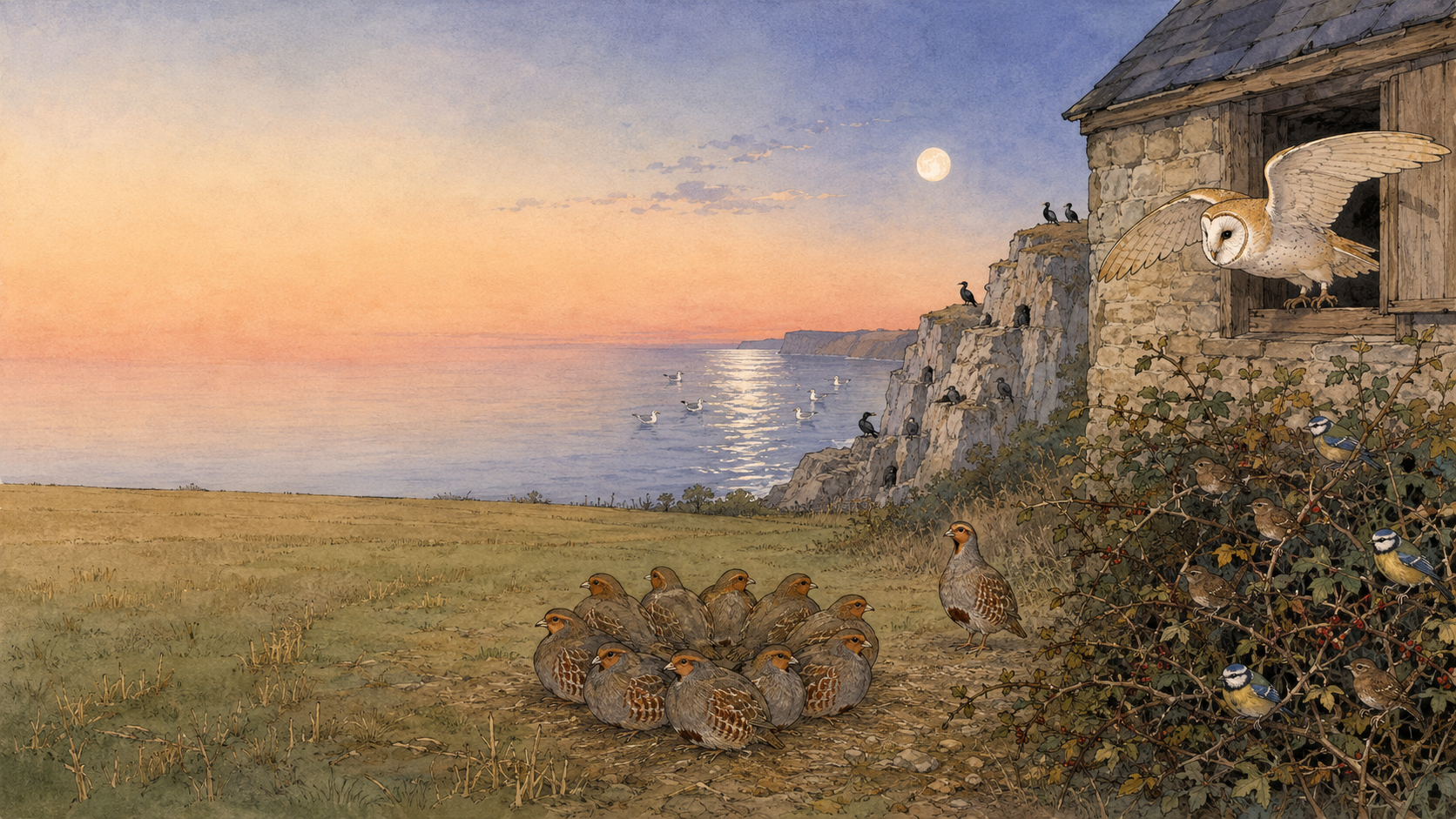
Birds of the Air Chapter 7, Where Do Birds Sleep?, asks the quiet question a child rarely thinks about: once the evening song is over and the birds vanish, where do they all go? Arabella Buckley shows how the small birds hide deep in the hedges, safe from owls and weasels, and explains the wonder of how a sleeping bird keeps its grip, for as it bends its legs the grip on its toes tightens by itself and its claws stay clasped round the branch. She describes the warm blanket of air a bird traps by puffing out its feathers, and the snug nooks that sparrows, tits, wrens, and owls seek out in cold weather. She walks us through the woods, where wood-pigeons, pheasants, and partridges settle down, the partridges sleeping in a ring with a father on watch, and out to the sea-cliffs, where jackdaws, cormorants, gulls, and ravens come home to roost at dusk. It is a lesson in noticing the hidden habits of birds when the day is done.
Say what you remember!
Tell what you remember from the last chapter.
What happened in Birds of the Air Chapter 6, Birds Feeding Their Young?Have a look
In the last chapter, Birds Feeding Their Young, Arabella Buckley peeped into nests to see how parent birds care for their little ones, some hatched naked and blind, like Kingfishers and young Owls, and others downy and ready to swim, like Water-hens. She told the story of Mr. Kearton, who quietly helped a mother Chiff-chaff by leaving caterpillars on her nest, and watched her feed and clean for her five babies all day long. We met Tomtits working in pairs, three Robins (including an "uncle") feeding one brood, and Blackbirds, Jays, and Pigeons each with their own clever way of passing food to their young. It ended with parents still feeding their fledglings, fairly, one hungry beak at a time, even after the little ones could fly.
Read the previous lesson: Birds Feeding Their Young →Show what you know!
Use your printable Lesson Guide. Fill in the vocabulary you know, then click to check your work and learn some new words today.
What are the difficult or advanced vocabulary words in Birds of the Air Chapter 7, Where Do Birds Sleep??roost, sentinel, plumage, slackHave a look
- roost: To settle down to rest or sleep, as birds do.
- sentinel: A guard who keeps watch and warns of danger.
- plumage: All the feathers that cover a bird.
- slack: Loose, not pulled tight.
The Books come Alive!
Read or listen to Chapter 7 of Birds of the Air, the Kindred Thicket Enhanced Edition, read by Laura Caldwell.
Teacher’s Notes
This is a Kindred Thicket Enhanced Edition. As you listen, keep this correction and update to Birds of the Air in mind.
- “pulls the muscles of his toes”It is really a tendon, not a muscle, that does this. When a bird bends its legs to settle, tendons running down the back of the legs tighten on their own and pull the toes shut around the branch, so it grips tight while fast asleep without any effort or muscle work.
Read by Laura Caldwell for LibriVox (public domain), cleaned and trimmed by Kindred Thicket.
Memory becomes Action!
Use the Response Resource* to remember and spell tricky names. Choose one way to narrate.
*Materials in the Lesson Guide.
What is the list of names, people, characters, birds, and places that are important in Chapter 7 of Birds of the Air?Owl, Nightingale, Corn-crake, House-sparrow, Blue-tit, Wren, Swallow, Swift, Wood-pigeon, Hawk, Pheasant, Partridge, Cormorant, GullHave a look
- Owl: A night bird that hoots and hunts after dark, keeping warm in barns and towers.
- Nightingale: Sings all night in warm summer weather.
- Corn-crake: Cries "craake, craake" long into the night.
- House-sparrow: Makes holes in haystacks for a warm bed in bad weather.
- Blue-tit: Loves to sleep tucked under a thatched roof.
- Wren: Hunts up old nests in winter and huddles together in them to keep warm.
- Swallow: Perches on barn rafters in summer; flits about if disturbed after dark.
- Swift: Roosts on rafters and does not need warmth, flying south in cold weather.
- Wood-pigeon: Roosts on the fir-trees in the wood.
- Hawk: Sleeps on the branches of the taller trees.
- Pheasant: Roosts in trees, calling "crok, crok" as it settles to sleep.
- Partridge: Sleeps on the ground in a circle, heads outward, with the father as sentinel.
- Cormorant: Sails in from the sea to settle on ledges down the cliff face.
- Gull: Roosts on cliff ledges, and many float on the waves all night.
Chapter 7 Q & A
This is a Kindred Thicket Enhanced Edition. We read every chapter against modern science, and here is what we found in this chapter.
Is Birds of the Air Chapter 7, Where Do Birds Sleep?, scientifically accurate?
Birds of the Air Chapter 7, Where Do Birds Sleep?, is almost entirely accurate. We checked every claim against modern ornithology (BTO BirdFacts and BirdNote), and Buckley’s accounts of feather-fluffing for warmth, partridges roosting in a ring with a sentinel, pheasants calling as they go to roost, and the sea-cliff roosting of jackdaws, cormorants, and gulls all hold up. There is one small correction: Buckley calls the sleeping grip a "muscle," when it is really a tendon that locks the toes shut. This is a Kindred Thicket Enhanced Edition, so you’ll find that correction in the Teacher’s Notes.
How does a bird hold onto its perch while it sleeps?
A bird holds onto its perch while it sleeps through a tendon-locking mechanism, not by tensing its muscles. When the bird bends its legs to settle, tendons that run down the back of its legs tighten on their own and pull its toes shut around the branch, so it grips tightly with no effort at all. This is why a sleeping bird does not fall: the more it relaxes, the tighter its claws stay clasped. Buckley describes the effect correctly but calls it a "muscle," which is why the Enhanced Edition notes it is really a tendon.
How do birds keep warm when they sleep outside in winter?
Birds keep warm when they sleep outside by trapping a blanket of air in their feathers. When a bird goes to roost, it tucks its head under its shoulder plumage and puffs out its feathers, letting air settle among the soft down close to its body. That trapped air warms up and cannot escape, so it keeps the bird’s body from being chilled by the cold outside. Buckley’s description of this air-blanket is accurate and matches how ornithologists explain bird thermoregulation today.
Why do partridges sleep in a circle?
Partridges sleep in a circle, called a "jug," as a way of guarding against enemies. Grey Partridges settle on the ground with their heads facing outward and their tails together, and the father often sleeps a little way off as a sentinel. If a fox or weasel approaches, any bird that is awake can spot the danger and warn the others. Buckley’s description of this roosting habit is accurate.
Do pheasants really call out as they go to sleep?
Yes, pheasants really do call out as they go to sleep. Common Pheasants roost in trees overnight, and they give a clucking "crok, crok" call as they settle down, a sound long familiar to country people. As Buckley says, it is curious that they announce exactly where they are going to bed. Her description is accurate.
Which birds come home to roost on the sea-cliffs at dusk?
Many sea-cliff birds come home to roost at dusk, each to its own place on the rocks. Small field birds perch in the bushes at the cliff top, jackdaws creep into crevices, cormorants and gulls settle on the ledges half-way down, and ravens tumble in from the land before they too sit for the night. Some gulls stay floating on the water all night long. Buckley’s account of this evening arrival is accurate.