The Listening Grove · Birds of the Air
Chapter 8: Feeding in Summer
A Charlotte Mason nature-study lesson. Press play, with the lesson.
What is Birds of the Air Chapter 8, Feeding in Summer, about?Parent review
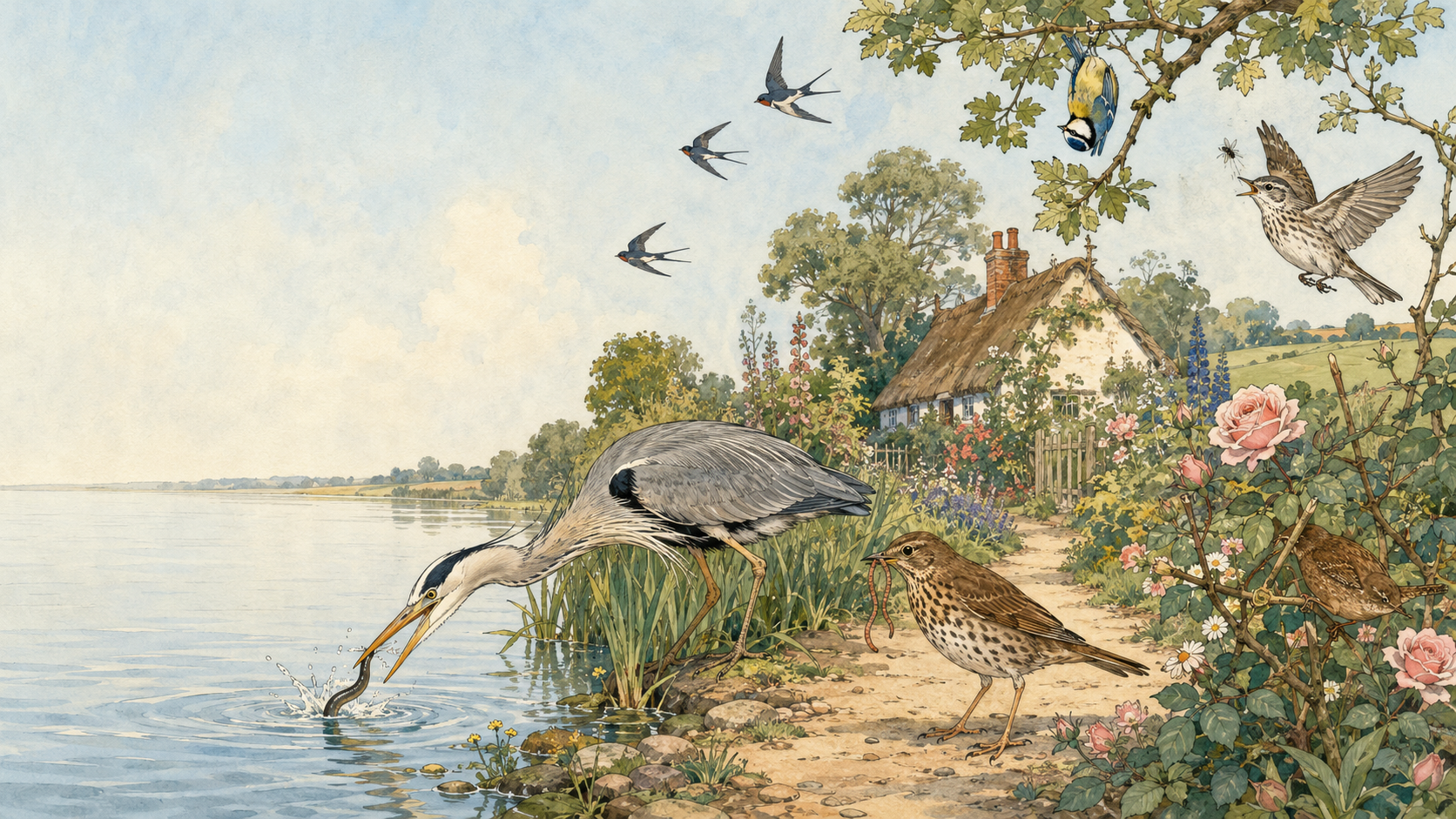
Birds of the Air Chapter 8, Feeding in Summer, invites your child out on a fine summer morning to watch how different birds find their food. Arabella Buckley shows that a bird’s beak and habits tell you what it eats: the House Sparrow will eat almost anything, the Chaffinch and Lark crack seed husks with short sharp beaks, and the Swallow, Swift, and Martin open wide mouths to catch flies on the wing. She points out the Thrush pulling a worm from the grass with its strong feet, the Wagtail, Wren, and Blue Tit hunting insects and spiders, and the Spotted Fly-catcher darting from its perch to snap a fly and return. She follows the rooks, the woodpecker tapping the trees, the Kingfisher plunging for tiny fish, and the grave Heron waiting to spear a big eel. Along the way she gently reminds us that many of these busy birds are friends to the garden, keeping down the caterpillars, slugs, and weeds. It is a lesson in watching closely and learning something about every bird you see.
Say what you remember!
Tell what you remember from the last chapter.
What happened in Birds of the Air Chapter 7, Where Do Birds Sleep??Have a look
In the last chapter, Where Do Birds Sleep?, Arabella Buckley asked where all the birds go when the sun sets and the singing stops. We learned that most small birds hide in the thick hedges, safe from owls and weasels, and that a sleeping bird’s claws lock tight around the twig so it cannot fall. She explained the warm blanket of air a bird traps by puffing out its feathers, and showed where different birds roost, from house-sparrows in hay-stacks and wood-pigeons in the firs to partridges sleeping in a ring on the ground. She ended on the sea-shore at dusk, watching cormorants, gulls, ravens, and sand-martins come home to the cliffs for the night.
Read the previous lesson: Where Do Birds Sleep? →Show what you know!
Use your printable Lesson Guide. Fill in the vocabulary you know, then click to check your work and learn some new words today.
What are the difficult or advanced vocabulary words in Birds of the Air Chapter 8, Feeding in Summer?dainty, husk, skim, whirrHave a look
- dainty: Fussy and hard to please about food.
- husk: The dry outer covering of a seed or grain.
- skim: To move quickly and lightly just above a surface.
- whirr: A low, buzzing sound made by fast-beating wings.
The Books come Alive!
Read or listen to Chapter 8 of Birds of the Air, the Kindred Thicket Enhanced Edition, read by Laura Caldwell.
Teacher’s Notes
This is a Kindred Thicket Enhanced Edition. As you listen, keep this one correction to Birds of the Air in mind.
- “he is one of the warblers”The hedge-sparrow is not a warbler. It is the Dunnock (Prunella modularis), a member of the accentor family, Prunellidae, which is quite separate from the true warblers. So "hedge-warbler" is a charming old name, but "Dunnock" or "hedge-accentor" is the accurate one.
Read by Laura Caldwell for LibriVox (public domain), cleaned and trimmed by Kindred Thicket.
Memory becomes Action!
Use the Response Resource* to remember and spell tricky names. Choose one way to narrate.
*Materials in the Lesson Guide.
What is the list of names, people, characters, birds, and places that are important in Chapter 8 of Birds of the Air?House Sparrow, Chaffinch, Lark, Swallow, Swift, Thrush, Wagtail, Wren, Spotted Fly-catcher, Blue Tit, Hedge-sparrow, Woodpecker, Kingfisher, HeronHave a look
- House Sparrow: Eats almost anything, from a grain of wheat to a scrap of meat or a caterpillar.
- Chaffinch: Splits seed husks with his sharp beak and clears weeds like groundsel and chickweed.
- Lark: Drops from the sky to hunt for seeds in the furrows turned up by the plough.
- Swallow: Catches flies and gnats on the wing with a wide mouth and a small beak.
- Swift: Skims the air for insects, flying low in dull weather and high on bright days.
- Thrush: Pulls worms from the grass with strong feet; eats snails in summer, berries in autumn.
- Wagtail: Hunts insects in the grass, his long tail bobbing up and down.
- Wren: Hops on bushes picking off the green-fly that does so much harm.
- Spotted Fly-catcher: Darts out to snap a fly in the air, then returns to the same perch.
- Blue Tit: Hangs upside down on branches, watching for spiders.
- Hedge-sparrow: Not a true sparrow but a dunnock; flits along the lanes picking up tiny insects, and sings sweetly.
- Woodpecker: Darts out its sticky tongue and taps at the trunks of the trees.
- Kingfisher: Darts down to seize tiny fish from the river.
- Heron: Sits still with neck stretched, then shoots its head forward to catch a big eel.
Chapter 8 Q & A
This is a Kindred Thicket Enhanced Edition. We read every chapter against modern science, and here is what we found in this chapter.
Is Birds of the Air Chapter 8, Feeding in Summer, scientifically accurate?
Birds of the Air Chapter 8, Feeding in Summer, is accurate in its feeding descriptions, with one clear correction. Buckley’s accounts of how the swallow catches flies on the wing, the thrush pulls worms, the spotted fly-catcher sallies from its perch, the blue tit hangs upside down, and the heron and kingfisher fish all match modern ornithology (BTO BirdFacts and the RSPB). The one thing to correct is her claim that the hedge-sparrow is a warbler: it is really the Dunnock, an accentor. This is a Kindred Thicket Enhanced Edition, so you’ll find that correction in the Teacher’s Notes.
Is the hedge-sparrow really a warbler?
The hedge-sparrow is not a warbler, despite what this chapter says. It is the Dunnock (Prunella modularis), a member of the accentor family, Prunellidae, which is entirely separate from the true warblers. Buckley was following an old country habit of calling it the "hedge-warbler," but "Dunnock" or "hedge-accentor" is the accurate name. It is not a true sparrow either, which is why she rightly warns not to confuse it with the house-sparrow.
Why do swallows fly low in dull weather?
Swallows fly low in dull weather because the insects they eat are flying low. On cool or overcast days gnats and midges stay near the ground, so the swallows follow them down; on bright days the insects rise higher and the swallows climb after them. Buckley’s explanation is accurate, and it is a lovely way for a child to read the weather from the birds.
How does a thrush catch a worm?
A thrush catches a worm by planting its strong feet firmly on the grass and pulling steadily until the worm comes free. The Song Thrush has powerful legs and a long, narrow beak suited to this, and in summer it feeds on worms and snails, turning to berries in autumn. Buckley’s description of the thrush hauling out a worm is accurate.
What does a spotted fly-catcher do?
A spotted fly-catcher sits very still on a perch, then darts into the air with its beak wide open to snap up a passing fly, and returns to the very same spot to wait for another. This "sally and return" habit is one of the surest ways to recognise the bird. Buckley’s description is accurate, and the fly-catcher is a summer visitor that returns to Britain in late May.
How does a heron catch a fish?
A heron catches a fish by standing perfectly still at the water’s edge with its neck stretched out, then shooting its head forward in a flash to seize the prey, sometimes bringing up a big eel. This patient "stand-and-wait" strategy is exactly how the Grey Heron feeds today, and eels are a real part of its diet. Buckley’s description is accurate.