The Listening Grove · Our Island Story
Chapter 2: The Coming of the Romans
A Charlotte Mason read-aloud lesson. Press play, with the lesson.
What is Our Island Story Chapter 2, The Coming of the Romans, about?Parent review
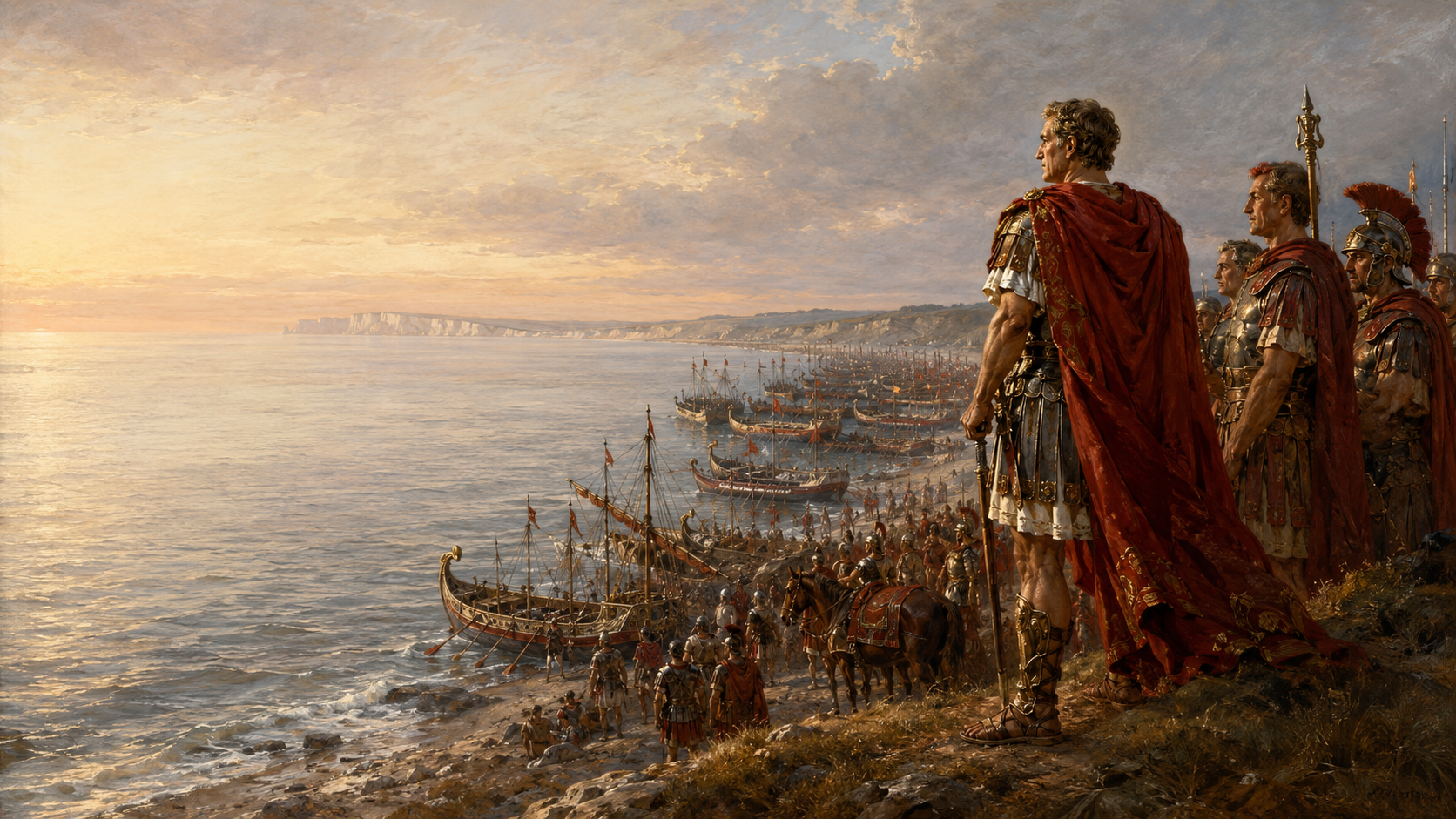
Our Island Story Chapter 2, The Coming of the Romans, moves on from the old legends to the first Roman landing in Britain. Hundreds of years after Brutus, the Roman general Julius Caesar, fighting in Gaul (France), hears of a rich island with white cliffs, fierce people, useful metals, and pearls, and resolves to add it to the Roman Empire. He sets sail with about eighty ships and twelve thousand men, but finds the Britons waiting on the cliffs, so he sails along the coast to a flat shore while the Britons follow on land with their horses and war chariots. When his soldiers hesitate to leap from the galleys into the sea, a brave Roman seizes the golden eagle standard and jumps overboard, and the rest follow rather than lose it. After a fierce fight in the waves and on the shore the Britons are beaten, but Caesar has lost so many men, and so many ships to storms, that he makes peace and sails away with little glory.
Say what you remember!
Tell what you remember from the last chapter.
What happened in Our Island Story Chapter 1, Albion and Brutus?Have a look
In Chapter 1, Albion and Brutus, Marshall told an old legend of how Britain got its names. Neptune, god of the sea, gave each of his sons an island to rule, and a little mermaid helped choose a lovely island of white cliffs and golden sands for his fourth son, Albion, who reigned there until he was killed in a fight with Hercules. Long after, Brutus, a prince from the far-off city of Troy, landed with his men of war, conquered the giants, and became king of all the islands, which he called Britain or Britannia. Marshall said some people think it is only a fairy tale, and then turned to the real people of Britain.
Read the previous lesson: Albion and Brutus →Show what you know!
Say what you think each word means, then click to check your answers and learn some new words today.
What are the difficult or advanced vocabulary words in Our Island Story Chapter 2, The Coming of the Romans?strewn, emblem, ensign, frayHave a look
- strewn: scattered or spread out over a surface
- emblem: an object that stands for something else
- ensign: a flag flown as a symbol or banner
- fray: a fight, struggle, or noisy quarrel
Locate it on the map!
Use an atlas to find the place if you can, then click to check your work on the map.
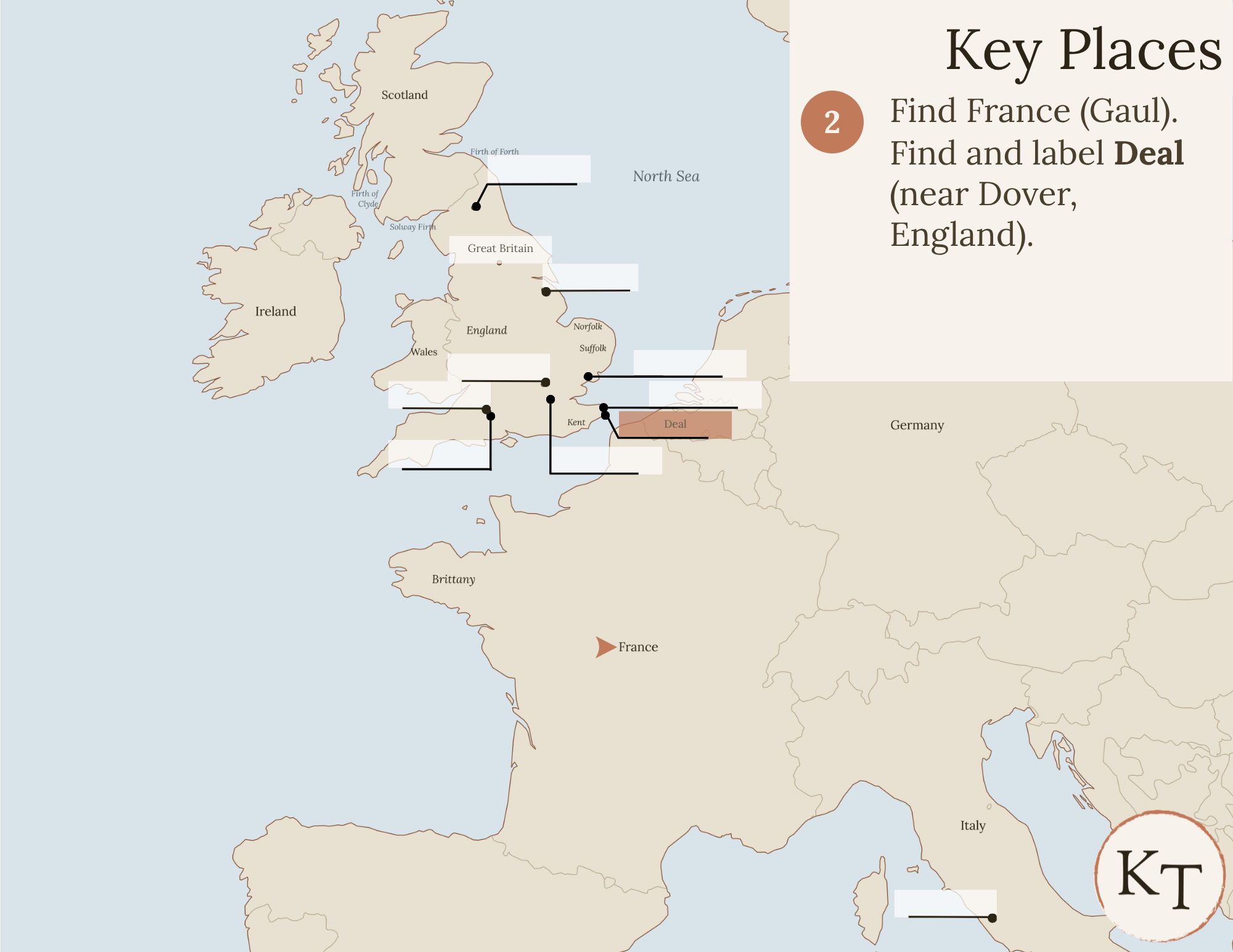
What important geographic locations connect with Our Island Story Chapter 2, The Coming of the Romans?
- Find
- France (Gaul)
- Find and Label
- Deal (near Dover, England)
See it on the mapHave a look
The Books come Alive!
Read or listen to Chapter 2 of Our Island Story, the Kindred Thicket Revised Edition.
Read by Kindred Thicket from the Our Island Story Kindred Thicket Revised Edition.
What corrections are made in Chapter 2 of Our Island Story?Parent review
This is a Kindred Thicket Revised Edition. Factual and historical errors are corrected and dated wording is put right, and these notes tell you plainly what we changed and what we left as Marshall wrote it.
- About this sectionThroughout this section we brought Marshall’s British spellings to American English, keeping the original spelling inside quoted material. Punctuation, readability and grammar may also be adjusted. Where offensive or outdated terminology or descriptions were present in Marshall’s original text, with the exception of direct period quotations, we have made minimal revisions.
- Kindred Thicket Revised Edition UpdatesRome truly was skilled, but it borrowed a great deal from others, including the short sword it took from Spain, so the sentence now credits Roman skill without claiming they outdid everyone on earth.
- Roman rowers at this time were mostly free men and not slaves. We removed the reference to chains to better match what historians know today.
- Chariot wheels in Iron Age Britain almost certainly did not have swords on them. Actual chariots from near this time have been discovered that do not have swords on the wheels. Reliable and detailed descriptions of the weaponry are also available from this time, and they do not mention the swords. For these reasons, we removed the mention of swords on the chariot wheels.
- Teacher's Notes“Our great poet Shakespeare has written about one of these kings who was called King Lear”Marshall mentions that Shakespeare wrote about an ancient British king called Lear. Shakespeare did, but Lear belongs to Britain's legendary early history rather than to its securely documented rulers. We left the reference as a doorway to the famous play and added this note for context.
- “the shores were strewn with precious pearls”Britain really did produce pearls, including freshwater pearls, but ancient Roman writers themselves described British pearls as small or dull-colored. The picture of shores strewn with precious gems is much more flourish than treasure.
- “he turned his ships and sailed along the coast until he came to a place where the shore was flat”In the chapter, Marshall does not name the location of Caesar's 55 BC landing. Scholars believe that he landed near Deal, along the stretch between Walmer and Deal.
Memory becomes Action!
Use the names below to remember and spell tricky names. Choose one way to narrate.
What is the list of names, people, characters, and places that are important in Chapter 2 of Our Island Story?Julius Caesar, The Romans, The Britons, Gaul, Britain, Shakespeare, King Lear, The standard-bearerHave a look
- Julius Caesar: The Roman general who led the first Roman landing in Britain.
- The Romans: The powerful people of Rome, set on conquering Britain.
- The Britons: The native people of the island, known for their war chariots.
- Gaul: The old name for France, where Caesar was fighting.
- Britain: The island Caesar set out to conquer.
- Shakespeare: England's great poet, who wrote the play King Lear.
- King Lear: A legendary early king of Britain.
- The standard-bearer: The Roman soldier who carried the eagle standard.
Chapter 2 Q & A
This is a Kindred Thicket Revised Edition. Marshall’s 1905 history is beautiful but not always right, and here is what the record supports for this chapter.
Did Julius Caesar really invade Britain?
Yes. Julius Caesar crossed from Gaul (France) to Britain in 55 BC. He won the fight on the shore but lost so many men and ships that he made peace and sailed away.
Where did Julius Caesar land in Britain?
Scholars believe Caesar landed near Deal in Kent, along the flat shore between Walmer and Deal, a little north of the white cliffs at Dover.
Did British war chariots have swords on their wheels?
Almost certainly not. Real chariots from near this time have been found in Britain without swords on the wheels, and reliable descriptions of the weapons from this time do not mention them.
Were Roman galley rowers slaves in chains?
Not at this time. Roman rowers were mostly free men, not slaves.
What was the Roman eagle standard?
Instead of flags, each Roman legion carried an eagle of gold, or gilded to look like gold, on a pole. It was the emblem of the soldiers’ honor, and losing it in battle was a terrible disgrace.
Was King Lear a real king of Britain?
Probably not. Lear belongs to Britain’s legendary early history rather than to its documented rulers. He is best known today from Shakespeare’s play King Lear.
Did Britain really have pearls?
Yes, including freshwater pearls, but ancient Roman writers described British pearls as small or dull-colored.
Were the Romans better fighters than everyone else?
No. The Romans were truly skilled soldiers, but they borrowed a great deal from other peoples, including the short sword they took from Spain.