The Listening Grove · Our Island Story
Chapter 3: The Romans Come Again
A Charlotte Mason read-aloud lesson. Press play, with the lesson.
What is Our Island Story Chapter 3, The Romans Come Again, about?Parent review
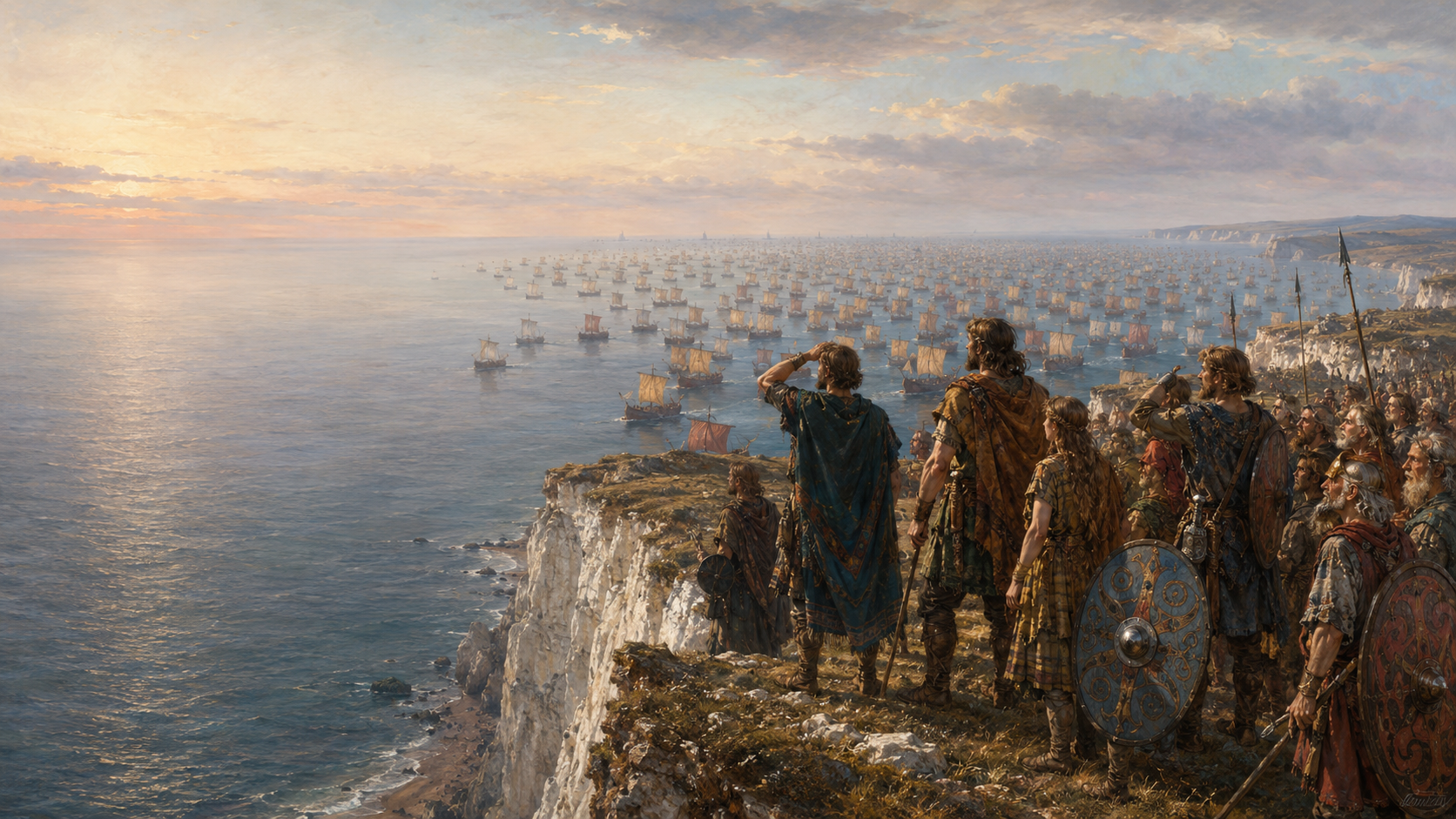
Our Island Story Chapter 3, The Romans Come Again, follows Julius Caesar’s second landing in Britain. Caesar returns the following year with eight hundred ships and many thousands of men. The Britons have never dreamed the world held so many ships, and at first they flee into the forests and hills, but they soon return and many battles are fought, though the Romans have strong armor, shields rimmed with brass or iron, and sharp swords, while the Britons have little armor and shields covered with animal skins. The quarreling British tribes join together under a brave leader, Cassivellaunus, and fight so well that Caesar is glad to make peace. He takes some Britons back to Rome as a sign that they are now Roman subjects, and the Britons promise to pay him money every year. But storms wreck so many of his ships that he cannot carry his army home all at once, and he leaves no soldiers behind, so Britain is not really conquered. The chapter closes by explaining how we count the years as B.C. and A.D.
Say what you remember!
Tell what you remember from the last chapter.
What happened in Our Island Story Chapter 2, The Coming of the Romans?Have a look
In Chapter 2, The Coming of the Romans, Julius Caesar, the great Roman general fighting in Gaul (France), heard of a rich island across the sea and set out to add it to the Roman Empire. The Britons waited for him on the white cliffs, so he sailed along the coast to a flat shore while they followed on land with their horses and war chariots. When his soldiers hesitated to leap into the sea, a brave Roman jumped overboard holding the golden eagle standard, and the rest followed rather than lose it. The Britons were beaten after a fierce fight, but Caesar had lost so many men, and so many ships to storms, that he made peace and sailed away.
Read the previous lesson: The Coming of the Romans →Show what you know!
Say what you think each word means, then click to check your answers and learn some new words today.
What are the difficult or advanced vocabulary words in Our Island Story Chapter 3, The Romans Come Again?resist, rebel, subjects, quarrelHave a look
- resist: to fight against or try to stop
- rebel: to rise up and fight against a ruler
- subjects: people who live under a king's rule
- quarrel: to argue or fight with angry words
Locate it on the map!
Use an atlas to find the place if you can, then click to check your work on the map.
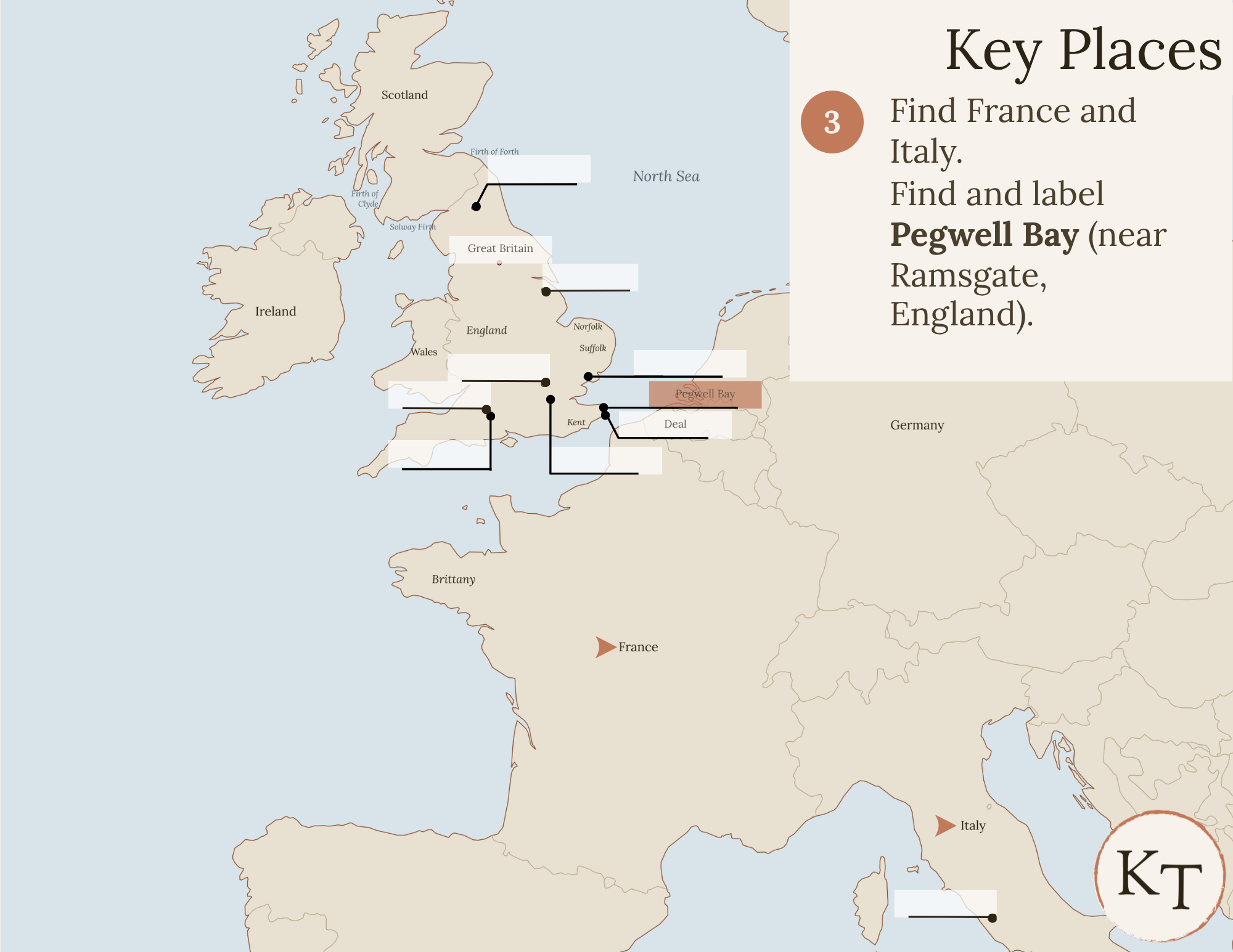
What important geographic locations connect with Our Island Story Chapter 3, The Romans Come Again?
- Find
- France
- Italy
- Find and Label
- Pegwell Bay (near Ramsgate, England)
See it on the mapHave a look
The Books come Alive!
Read or listen to Chapter 3 of Our Island Story, the Kindred Thicket Revised Edition.
Read by Kindred Thicket from the Our Island Story Kindred Thicket Revised Edition.
What corrections are made in Chapter 3 of Our Island Story?Parent review
This is a Kindred Thicket Revised Edition. Factual and historical errors are corrected and dated wording is put right, and these notes tell you plainly what we changed and what we left as Marshall wrote it.
- About this sectionThroughout this section we brought Marshall’s British spellings to American English, keeping the original spelling inside quoted material. Punctuation, readability and grammar may also be adjusted. Where offensive or outdated terminology or descriptions were present in Marshall’s original text, with the exception of direct period quotations, we have made minimal revisions.
- Kindred Thicket Revised Edition UpdatesMarshall's original text says that Caesar's next expedition was in the spring. In fact, it was in July. For this reason, we removed the reference to spring.
- Marshall’s original text described Roman shields as made of steel and British swords as made of soft copper. Roman shields were made of wood with protective coverings and metal reinforcement along their edges. The ancient historian Polybius describes iron reinforcement on the upper and lower rims. Surviving artifacts include Roman shield-binding fragments made of copper alloy. British Iron Age swords had iron blades, though their handles could include copper-alloy fittings or decoration. Roman swords also had iron blades, and some were hardened by quenching. We revised the original text accordingly.
- In Marshall's original text she describes the hostages as being soldiers. Caesar’s account identifies them only as British hostages. He never says that they are specifically soldiers. We have removed the unsupported detail.
- Teacher's Notes“he again sailed over to Britain”When Caesar sailed again from France in 54 BC, some archaeologists believe he may have landed at or near Pegwell Bay on the peninsula of the Isle of Thanet.
Memory becomes Action!
Use the names below to remember and spell tricky names. Choose one way to narrate.
What is the list of names, people, characters, and places that are important in Chapter 3 of Our Island Story?Cassivellaunus, Julius Caesar, The Britons, Neptune, Rome, BritainHave a look
- Cassivellaunus: The British war-leader the tribes chose against Caesar.
- Julius Caesar: The Roman general, on his second invasion of Britain.
- The Britons: The island's tribes, each under its own chief.
- Neptune: The sea god from the first chapter, Albion's father.
- Rome: Caesar's home city, where the British hostages were taken.
- Britain: The island Caesar invaded a second time.
Chapter 3 Q & A
This is a Kindred Thicket Revised Edition. Marshall’s 1905 history is beautiful but not always right, and here is what the record supports for this chapter.
Did Julius Caesar invade Britain twice?
Yes. Caesar first landed in Britain in 55 BC and came back the following year, 54 BC, with a far larger fleet.
When did Caesar's second invasion of Britain happen?
In 54 BC. His second expedition set out in July.
Where did Caesar land in Britain in 54 BC?
Some archaeologists believe Caesar may have landed at or near Pegwell Bay on the Isle of Thanet, near Ramsgate in Kent.
Who was Cassivellaunus?
Cassivellaunus was the British leader the tribes chose to lead them against Caesar in 54 BC. The Britons were divided into many tribes that often quarreled, but they joined together under him.
Did the Britons give Caesar soldiers to take back to Rome?
No. Caesar’s own account calls them hostages and never says they were soldiers.
Were British swords made of soft copper?
No. British Iron Age swords had iron blades, though their handles could include copper-alloy fittings or decoration.
Did Caesar conquer Britain?
No. The Britons promised Caesar money every year and gave him hostages, but he sailed home and left no soldiers behind in Britain at all.