The Listening Grove · Our Island Story
Chapter 4: Caligula Conquers Britain
A Charlotte Mason read-aloud lesson. Press play, with the lesson.
What is Our Island Story Chapter 4, Caligula Conquers Britain, about?Parent review
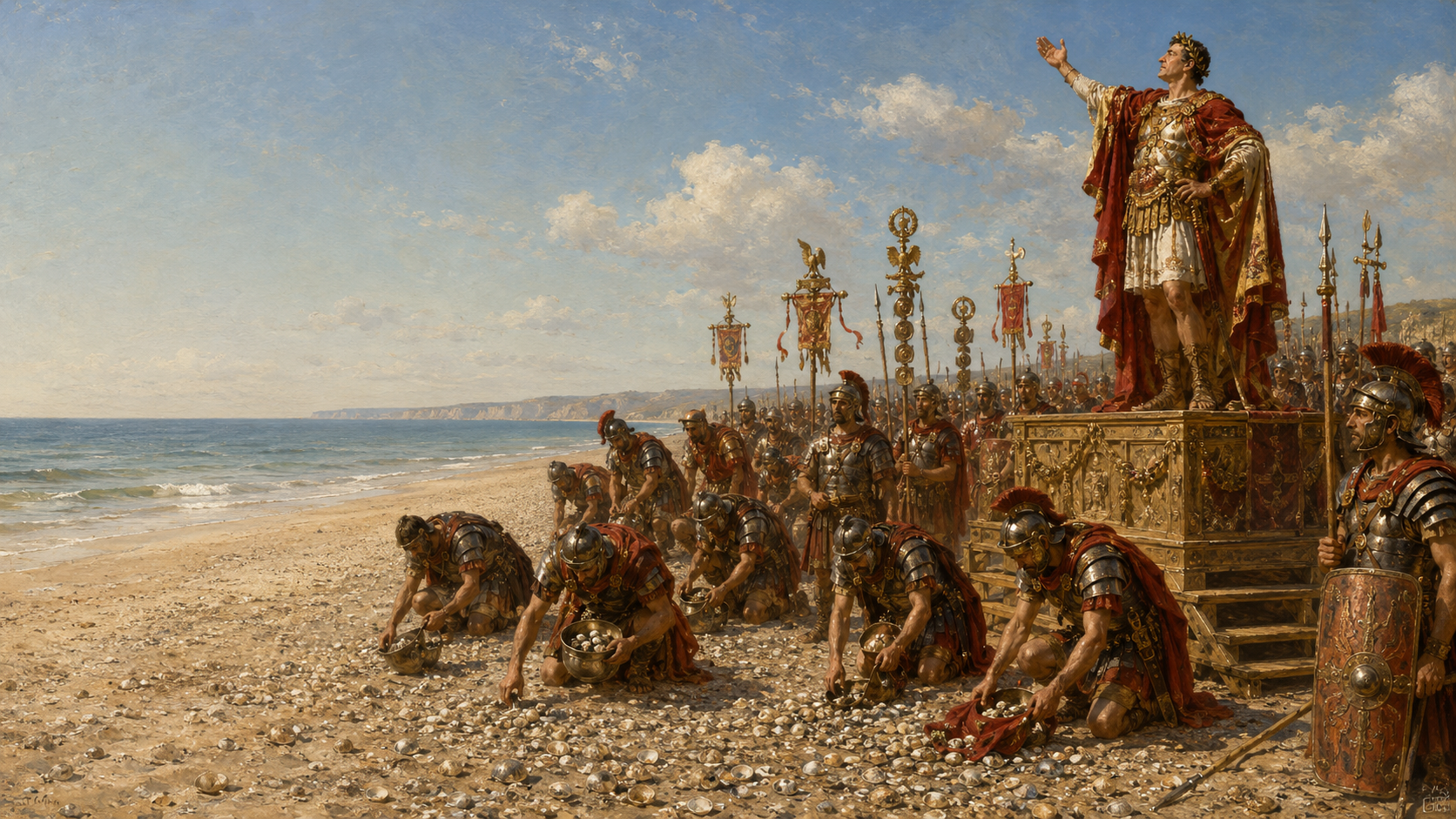
Our Island Story Chapter 4, Caligula Conquers Britain, tells how two Roman emperors set out to conquer the island. The emperor Caligula boasts that he will march over all of Britain, but he only leads a great army to the coast of France, has his sailors row him a short way out to sea and back, and orders his soldiers to kneel on the sand and gather shells. Then he thanks them as if they had conquered the ocean, calls the shells the spoils of war, and marches home. After him, the emperor Claudius sends generals and comes himself, but many Britons would rather die than be slaves of Rome. Among them is the brave Caractacus, who leads the Britons until, after fierce fighting on his hill, he is taken prisoner and led in chains to Rome with his family. Brought before Claudius and the Empress Agrippina, he speaks so proudly and nobly of fighting for his own land and freedom that Claudius sets him and his family at liberty.
Say what you remember!
Tell what you remember from the last chapter.
What happened in Our Island Story Chapter 3, The Romans Come Again?Have a look
In Chapter 3, The Romans Come Again, Julius Caesar returned to Britain the following year with eight hundred ships and many thousands of men. The quarreling British tribes joined together under a brave leader, Cassivellaunus, and fought so well that Caesar was glad to make peace. The Britons promised to pay him money every year and gave him some Britons to take back to Rome, but storms wrecked so many of his ships, and he left no soldiers behind, so Britain was not really conquered.
Read the previous lesson: The Romans Come Again →Show what you know!
Say what you think each word means, then click to check your answers and learn some new words today.
What are the difficult or advanced vocabulary words in Our Island Story Chapter 4, Caligula Conquers Britain?subdue, spoils, merciful, arrayHave a look
- subdue: to conquer and bring under your control
- spoils: goods or riches taken from an enemy
- merciful: showing mercy and willing to forgive
- array: soldiers lined up in order for battle
Locate it on the map!
Use an atlas to find the place if you can, then click to check your work on the map.
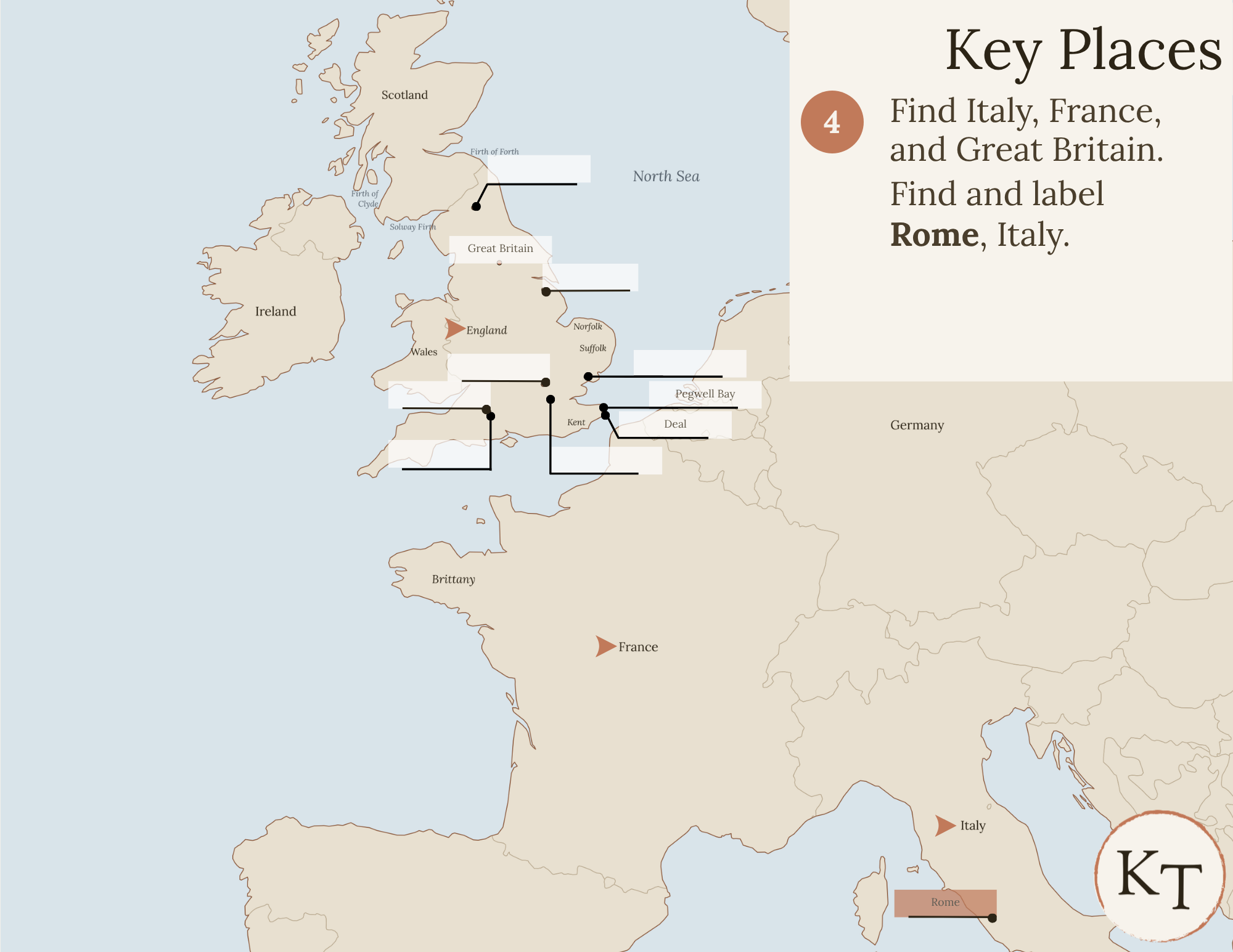
What important geographic locations connect with Our Island Story Chapter 4, Caligula Conquers Britain?
- Find
- Italy
- France
- Great Britain
- Find and Label
- Rome (Italy)
See it on the mapHave a look
The Books come Alive!
Read or listen to Chapter 4 of Our Island Story, the Kindred Thicket Revised Edition.
Read by Kindred Thicket from the Our Island Story Kindred Thicket Revised Edition.
What corrections are made in Chapter 4 of Our Island Story?Parent review
This is a Kindred Thicket Revised Edition. Factual and historical errors are corrected and dated wording is put right, and these notes tell you plainly what we changed and what we left as Marshall wrote it.
- About this sectionThroughout this section we brought Marshall’s British spellings to American English, keeping the original spelling inside quoted material. Punctuation, readability and grammar may also be adjusted. Where offensive or outdated terminology or descriptions were present in Marshall’s original text, with the exception of direct period quotations, we have made minimal revisions.
- Kindred Thicket Revised Edition UpdatesMarshall pairs Caligula’s expedition with a British king named Guilderius. There is no record of a Guilderius. Marshall may have confused him with Guiderius, a king in Geoffrey of Monmouth’s book, who refuses to pay tribute to Rome and fights against Claudius, not Caligula (see the Chapter 1 note on Geoffrey of Monmouth’s book). Marshall also suggests that Caligula was afraid of the British army, but the ancient sources say nothing about the Britons gathering a force. Instead, they say Caligula accepted the surrender of a British prince, Adminius, who had been banished by his father and crossed the Channel with a small band of followers. Caligula then sent a boastful letter to Rome as if the whole island had surrendered. The sources suggest he wanted to announce a victory to the Roman people without the trouble of actually invading. The text here is revised accordingly.
- Marshall's original text places Caractacus's last fortress on the borders of Shropshire, Cheshire, and Lancashire and says its walls can still be seen today. In truth the site of his final battlefield is unknown. The Roman writer Tacitus places it in the Ordovician territory. Though several sites have been suggested, historians have never agreed on one. We revised the text accordingly.
- Teacher's Notes“he could not thoroughly subdue the Britons”Marshall says Claudius could not thoroughly subdue the Britons. This understates the success of the Roman invasion. In AD 43, Claudius sent a large Roman force under Aulus Plautius. After the initial victories, Claudius himself came to Britain with reinforcements for the capture of Camulodunum, the Catuvellaunian capital. The invasion secured Roman control over a large part of south-central and southeastern Britain and laid the foundation for a durable Roman province. Although the whole island was never fully conquered, warfare and expansion continued for decades.
- “He called his soldiers together”Caractacus's stirring speech to his soldiers is written by Marshall from Tacitus' account.
- “his wife and daughter, and all his brothers were made prisoner”Marshall simplifies Caractacus’s capture. After his final defeat, the Romans captured his wife and daughter, while his brothers surrendered. Caractacus himself escaped and sought protection from Cartimandua, queen of the Brigantes, but she had him arrested and handed over to the Romans.
- “would walk in the Triumph”Marshall presents Caractacus’s appearance before Claudius as a formal Triumph. Claudius’s British Triumph took place in AD 44. Caractacus was captured and brought to Rome around AD 51. Tacitus describes this later occasion as a public display of prisoners before Claudius and the praetorian cohorts, without specifying whether or not it was a formal Triumph.
- “I fought for my own land and for freedom”Caractacus’s speech before Claudius in Rome is adapted by Marshall from Tacitus’s account, which presents it as direct speech. Direct speech in ancient historical accounts, however, should not automatically be treated as a verbatim quotation.
Memory becomes Action!
Use the names below to remember and spell tricky names. Choose one way to narrate.
What is the list of names, people, characters, and places that are important in Chapter 4 of Our Island Story?Caligula, Claudius, Caractacus (also Caratacus), Agrippina, The Romans, Rome, BritainHave a look
- Caligula: A Roman emperor who claimed to have conquered Britain.
- Claudius: The Roman emperor after Caligula.
- Caractacus (also Caratacus): A British war-leader who fought against Rome.
- Agrippina: Claudius's empress.
- The Romans: The people of the Roman Empire, set on ruling Britain.
- Rome: The capital of the Roman Empire.
- Britain: The island Rome wanted to rule.
Chapter 4 Q & A
This is a Kindred Thicket Revised Edition. Marshall’s 1905 history is beautiful but not always right, and here is what the record supports for this chapter.
Did Caligula really conquer Britain?
No, he never invaded. The Roman writers Suetonius and Cassius Dio say Caligula drew his soldiers up on the shore, sailed only a little way out to sea, and had them gather shells as spoils from the ocean.
Who was Guilderius?
There is no record of a British king called Guilderius. Marshall may have confused him with Guiderius, a king in Geoffrey of Monmouth’s book who fights against Claudius, not Caligula.
Did Claudius conquer Britain?
In large part, yes. From AD 43 Rome took control of much of southern and southeastern Britain and built a lasting province there, though the whole island was never fully conquered.
Who was Caractacus?
Caractacus, also spelled Caratacus, was a British war-leader who fought against Rome after the Roman invasion. Many Britons joined him and fought under his orders.
Where was Caractacus’s last battle?
No one knows the exact site. The Roman writer Tacitus places it in the territory of the Ordovices, and historians have never agreed on one place.
How was Caractacus captured?
He was betrayed. After his final defeat Caractacus escaped and sought protection from Cartimandua, queen of the Brigantes, but she had him arrested and handed over to the Romans.
Did Caractacus walk in a Roman Triumph?
Probably not. Claudius’s British Triumph was held in AD 44, and Caractacus was not brought to Rome until around AD 51, when Tacitus describes a separate public display of the prisoners before Claudius.