The Listening Grove · Our Island Story
Chapter 6: The Last of the Romans
A Charlotte Mason read-aloud lesson. Press play, with the lesson.
What is Our Island Story Chapter 6, The Last of the Romans, about?Parent review
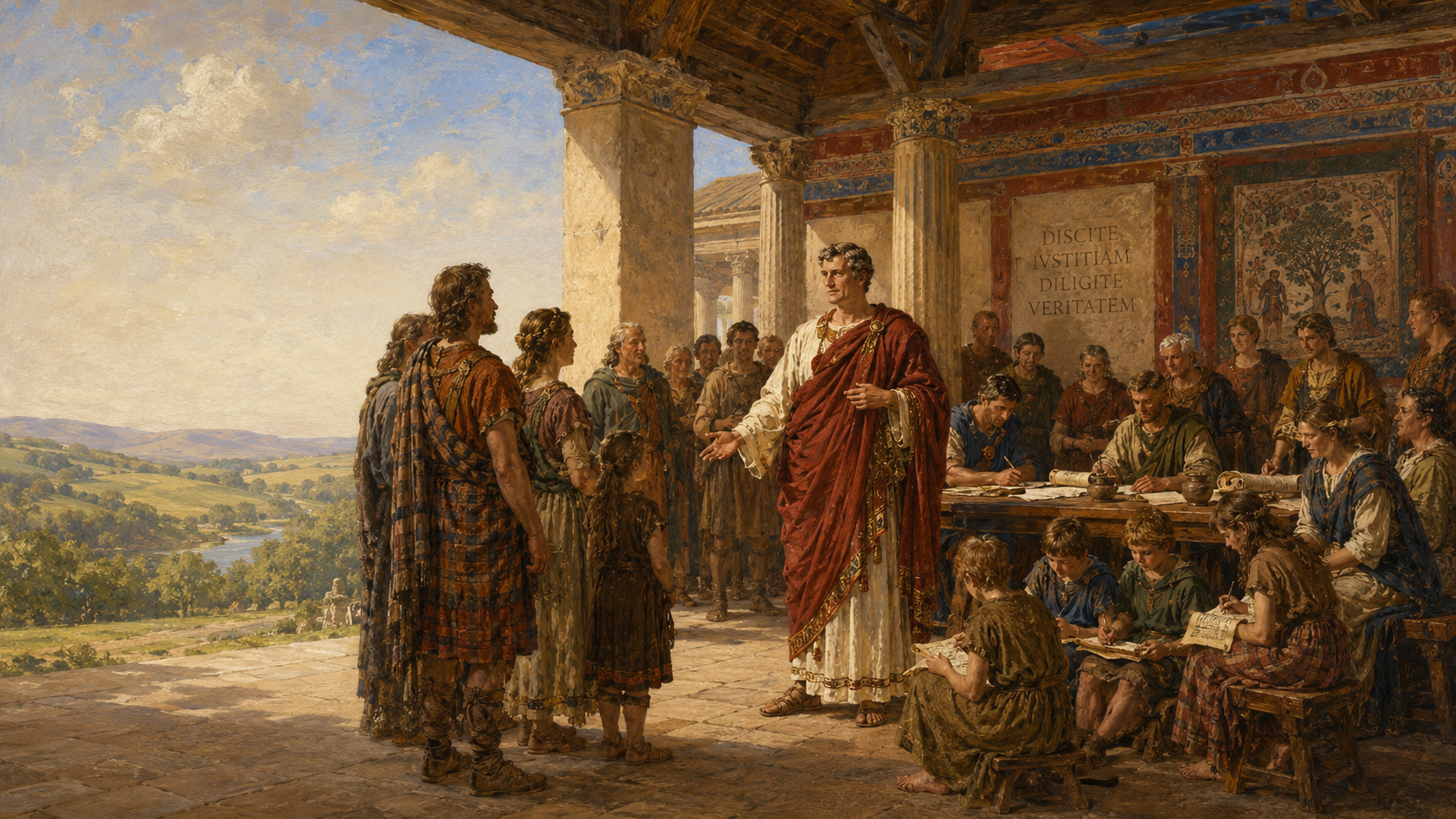
Our Island Story Chapter 6, The Last of the Romans, tells how Rome ruled Britain until the Romans at last went home. The emperor Vespasian sent the general Julius Agricola to govern the island, and Agricola tried what kindness would do. He took away many heavy taxes, built schools, public halls and courts, and built a line of forts from the Forth to the Clyde to keep back the Picts and Scots of the north. A jealous emperor called him back to Rome, and the Britons rebelled once more. Later the emperor Hadrian came to Britain himself and built a great wall from the Tyne to the Solway, which can still be seen today. About the year 410 the Romans left Britain altogether. The chapter also tells of the Druids, the priests of the ancient Britons, and of how the Christian faith came to Britain and slowly took their place.
Say what you remember!
Tell what you remember from the last chapter.
What happened in Our Island Story Chapter 5, The Story of Boadicea?Have a look
In Chapter 5, The Story of Boadicea, the Romans seized the wealth of the dead king of the Iceni and treated his queen, Boadicea, and her daughters cruelly. Boadicea called on the Britons to rise up and drive the Romans out, and with the queen herself leading them they destroyed Camulodunum, Londinium, and Verulamium. At last the better-armed Roman soldiers defeated the Britons, and the great queen chose death rather than fall again into the hands of the Romans.
Read the previous lesson: The Story of Boadicea →Show what you know!
Say what you think each word means, then click to check your answers and learn some new words today.
What are the difficult or advanced vocabulary words in Our Island Story Chapter 6, The Last of the Romans?parchment, obedience, woad, tidingsHave a look
- parchment: a writing material made from animal skin
- obedience: the act of obeying and doing as told
- woad: a plant that makes a blue dye
- tidings: a piece of news or information
Locate it on the map!
Use an atlas to find the place if you can, then click to check your work on the map.
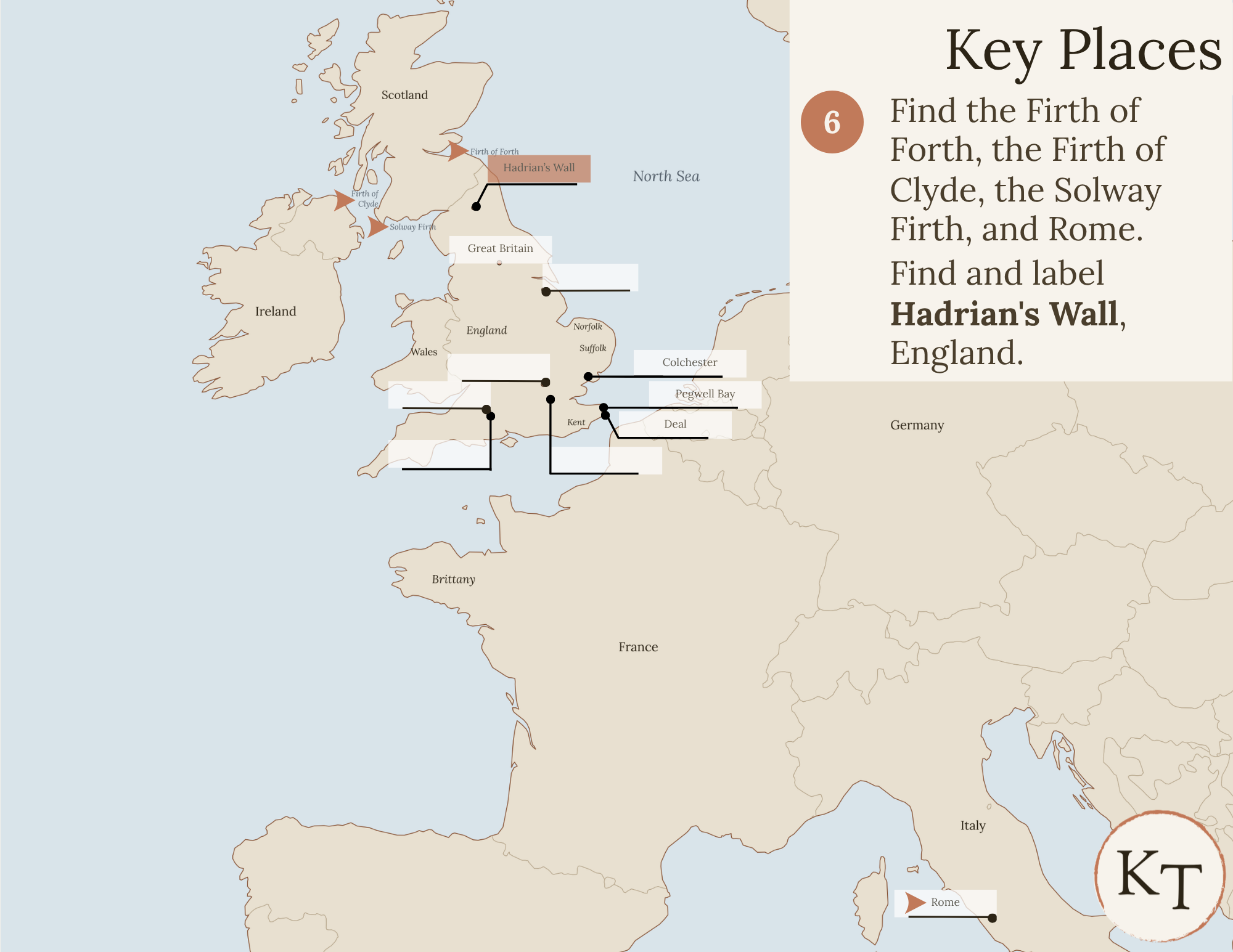
What important geographic locations connect with Our Island Story Chapter 6, The Last of the Romans?
- Find
- Firth of Forth
- Firth of Clyde
- Solway Firth
- Rome
- Find and Label
- Hadrian's Wall (England)
See it on the mapHave a look
The Books come Alive!
Read or listen to Chapter 6 of Our Island Story, the Kindred Thicket Revised Edition.
Read by Kindred Thicket from the Our Island Story Kindred Thicket Revised Edition.
What corrections are made in Chapter 6 of Our Island Story?Parent review
This is a Kindred Thicket Revised Edition. Factual and historical errors are corrected and dated wording is put right, and these notes tell you plainly what we changed and what we left as Marshall wrote it.
- About this sectionThroughout this section we brought Marshall’s British spellings to American English, keeping the original spelling inside quoted material. Punctuation, readability and grammar may also be adjusted. Where offensive or outdated terminology or descriptions were present in Marshall’s original text, with the exception of direct period quotations, we have made minimal revisions.
- Kindred Thicket Revised Edition UpdatesIn the original text, Marshall makes a sweeping statement that, before Agricola’s time, Britain had no schools, teachers, or books, and that no one in Britain could read or write. Pre-Roman Britain was not wholly illiterate. We have accounts of Druids using Greek letters, as well as archaeological evidence of styli (writing implements) from before the Roman conquest. Furthermore, Agricola was not promoting public education; he encouraged Roman education to the sons of elite British families. We revised the text to remove the overstatement.
- In the original text, Marshall briefly mentions a wall built by “Antonine” before describing Hadrian’s Wall later in the chapter. The historical sequence is as follows: Agricola’s forts came first, followed by Hadrian’s Wall, and then the Antonine Wall. The standard modern name of the emperor who ordered the construction of the Antonine Wall is Antoninus Pius. We revised the text accordingly.
- Marshall describes some Britons as wearing no clothes and coloring their skin with woad, and presents their education as limited to fishing, hunting, and killing. We revised this portrayal to avoid giving the impression that these descriptions represented British life generally. Although ancient writers such as Herodian describe nakedness and body coloring among some northern Britons, others, such as Julius Caesar, describe clothing as well as body coloring. Archaeological evidence shows that Iron Age communities wore clothing, farmed crops, raised animals, and practiced crafts including weaving, pottery-making, and metalworking. The identification of the body pigment as woad also remains uncertain.
- In the original text, Marshall says that the word "druid" was derived from king named "Druis". The likely root of the word points to "oak" or "to know". We revised the text accordingly.
- Marshall stated flatly that the Druids killed human beings in their sacrifices. It is important to understand that this account comes from Roman writers, who may have had political and military reasons to portray the peoples they conquered as barbaric. We revised the text accordingly.
- Marshall states that the Roman emperor ruling over Britain killed and tortured Christians who worshipped God and Jesus Christ. The statement implies this also occurred on British soil. The Great Persecution was decreed by the emperor Diocletian, but Britain was then governed by Constantius Chlorus, who enforced the edicts only minimally. Other rulers persecuted Christians far more severely in their own territories. After Constantius died in 306, Britain passed to his son Constantine, who favored Christians. We revised the text accordingly.
- Teacher's Notes“keep back the wild Picts and Scots, or people of the north”Marshall calls the northern Britons "Picts and Scots", however, those names were not yet in use. They were known to the Romans of Agricola’s time as Caledonians and other tribes. “Picts” first appears in Roman sources in the late third century, while “Scots” originally referred to Irish Gaels. Both terms were applied to peoples in northern Britain later.
- “This emperor was jealous of Agricola”Marshall is referring to Emperor Domitian, who ruled from AD 81 to 96. Domitian recalled Agricola from Britain around AD 84–85. Tacitus, Agricola’s son-in-law, says Domitian was jealous of Agricola’s success. Modern historians suggest the recall may instead have been due to the cost of the campaigns and their failure to secure lasting territorial gains.
- “from the Tyne to the Solway”The continuous rampart built from the Wallsend on the Tyne Estuary to Bowness on the Firth of Solway is known as Hadrian's Wall.
- “Gradually the Druids disappeared”Marshall's text may suggest that the Druids were cleanly replaced by Christianity. History is not quite so tidy. Roman authorities had already suppressed the Druids during the conquest of Britain. Christianity spread later under Roman rule and was established in Britain by the fourth century. Still later, missionaries such as Augustine, who arrived in 597, worked to convert the pagan Anglo-Saxons.
Memory becomes Action!
Use the names below to remember and spell tricky names. Choose one way to narrate.
What is the list of names, people, characters, and places that are important in Chapter 6 of Our Island Story?Julius Agricola, Vespasian, Hadrian, The Picts and Scots, The Druids, The Britons, RomeHave a look
- Julius Agricola: The Roman general sent to govern Britain.
- Vespasian: The Roman emperor who sent Agricola.
- Hadrian: The Roman emperor who built Hadrian's Wall.
- The Picts and Scots: The peoples of the north, beyond Rome's walls.
- The Druids: The priests of the ancient Britons.
- The Britons: The people of the island under Roman rule.
- Rome: The capital of the Roman Empire.
Chapter 6 Q & A
This is a Kindred Thicket Revised Edition. Marshall’s 1905 history is beautiful but not always right, and here is what the record supports for this chapter.
Who was Julius Agricola?
Julius Agricola was the Roman general whom the emperor Vespasian sent to govern Britain. He is remembered for ruling with kindness as well as force.
Did Agricola bring the first schools to Britain?
Not the first learning. Some people in Britain could write before the Romans came: there are accounts of Druids using Greek letters, and writing tools (styli) have been found from before the Roman conquest. What Agricola did was encourage a Roman education for the sons of leading British families.
Which emperor called Agricola back to Rome, and why?
The emperor Domitian called Agricola back around AD 84 to 85. Tacitus, Agricola’s son-in-law, says Domitian was jealous of his success. Modern historians suggest the real reason may have been the cost of the campaigns, which had not won lasting territory.
Where is Hadrian’s Wall?
Hadrian’s Wall runs across northern England, from Wallsend on the River Tyne to Bowness on the Solway Firth.
Who built the Antonine Wall?
The emperor Antoninus Pius ordered the Antonine Wall, which is why it carries his name. It was built after Hadrian’s Wall, along the line of Agricola’s old forts between the Forth and the Clyde.
Were the Picts and Scots in Britain in Agricola’s time?
Not by those names. The Romans of Agricola’s time called the northern peoples Caledonians and other tribal names. “Picts” first appears in Roman writing in the late third century, and “Scots” first meant Irish Gaels.
Did the ancient Britons paint themselves blue with woad?
Ancient writers, including Julius Caesar and Herodian, say that Britons colored their bodies. Whether the dye was woad is uncertain; historians have not been able to confirm it.
What does the word Druid mean?
The word Druid likely comes from roots meaning “oak” and “to know.”
Did the Druids make human sacrifices?
We cannot be sure. The accounts come from Roman writers, who may have had political and military reasons to make the peoples they conquered look barbaric.
Were Christians killed in Roman Britain?
Far fewer than in other parts of the empire. When the emperor Diocletian ordered the Great Persecution, Britain was governed by Constantius Chlorus, who enforced the edicts only lightly. After he died in 306, Britain passed to his son Constantine, who favored Christians.