The Listening Grove · This Country of Ours
Chapter 3: How Columbus Fared Forth Upon the Sea of Darkness
A Charlotte Mason read-aloud lesson. Press play, with the lesson.
What is This Country of Ours Chapter 3, How Columbus Fared Forth Upon the Sea of Darkness, about?Parent review
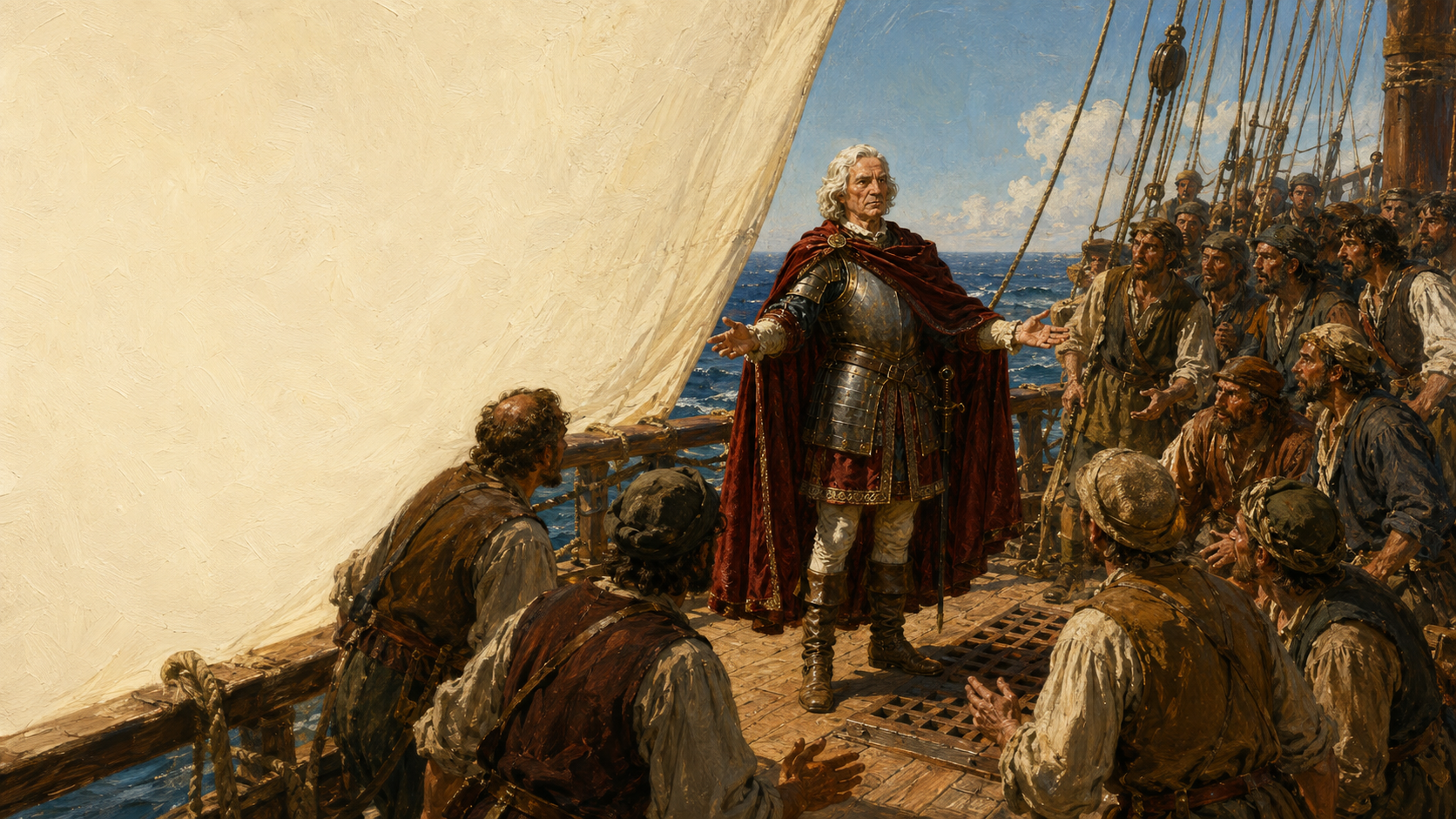
This Country of Ours Chapter 3, How Columbus Fared Forth Upon the Sea of Darkness, is the story of the first crossing. Columbus sails from Palos with three ships, and when the last familiar land drops out of sight behind them the men begin to be afraid. Week after week goes by with nothing but water. The crew mutter, then threaten, and Columbus faces them down and holds his course. There are false hopes: floating branches, birds, and once a cry of Land that proves to be only cloud. At last, in the small hours, a sailor sees a real shore, and in the morning they go ashore and give thanks. The people of the islands come down to meet them in wonder, and the Spaniards trade glass beads and little bells for gold. Columbus sails on from island to island, comes to Cuba, and believes he has reached the Indies. Then the Pinta slips away in the night and deserts him.
Say what you remember!
Tell what you remember from the last chapter.
What happened in This Country of Ours Chapter 2, The Sea of Darkness and the Great Faith of Columbus?Have a look
In Chapter 2, The Sea of Darkness and the Great Faith of Columbus, we learned why no one sailed west. The old trade routes to the East had closed, and the Atlantic was feared as the Sea of Darkness. Columbus believed he could reach the East by sailing west, but the King of Portugal refused him, and in Spain he waited seven years while a council of learned men rejected his plan. He had given up and set out for France when a messenger called him back, and Queen Isabella agreed at last. Even then no one would sail with him until the King gave him power to make them go.
Read the previous lesson: The Sea of Darkness and the Great Faith of Columbus →Show what you know!
Use your printable Lesson Guide. Fill in the vocabulary you know, then click to check your work and learn some new words today.
What are the difficult or advanced vocabulary words in This Country of Ours Chapter 3, How Columbus Fared Forth Upon the Sea of Darkness?mutiny, rigging, doublet, potentateHave a look
- mutiny: a revolt against the leader people are meant to obey
- rigging: the ropes and chains that work a ship's sails
- doublet: a man's close-fitting jacket worn long ago
- potentate: a ruler who holds great power
Locate it on the map!
Use your printable Lesson Guide. Use an atlas and fill in the blank map if you can find the geographic location, then click to check your work.
What important geographic locations connect with This Country of Ours Chapter 3, How Columbus Fared Forth Upon the Sea of Darkness?
- Find
- the Bahamas
- Cuba
- the Caribbean Sea
- Palos
- Find and Label
- San Salvador (the Bahamas)
See it on the mapHave a look
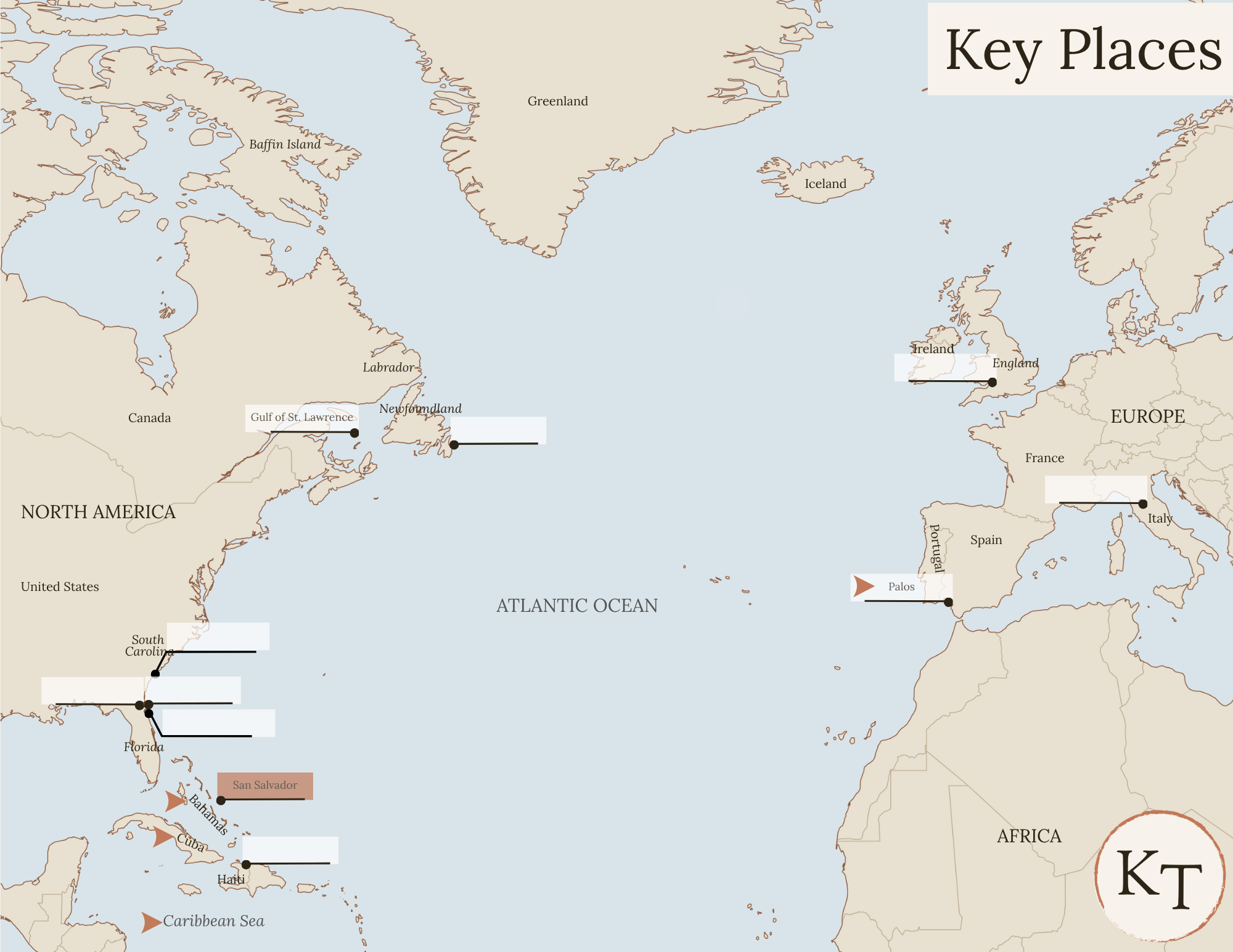
This matches the map in your Lesson Guide.
The Books come Alive!
Read or listen to Chapter 3 of This Country of Ours, the Kindred Thicket Revised Edition.
Read by Kindred Thicket from the This Country of Ours Kindred Thicket Revised Edition.
What corrections are made in Chapter 3 of This Country of Ours?Parent review
This is a Kindred Thicket Revised Edition. Factual and historical errors are corrected and dated wording is put right, and these notes tell you plainly what we changed and what we left as Marshall wrote it.
- About this sectionThroughout this section we brought Marshall’s British spellings to American English, keeping the original spelling inside quoted material.
- Kindred Thicket Revised Edition UpdatesIn This Country of Ours Chapter 3 we thoroughly examined and researched the chapter's contents. The history in it stands as Marshall told it, and only one thing needed changing. When Columbus and his men come ashore and meet the people of the islands, Marshall used a word for them, three times over, that is now considered derogatory. We replaced each one with plain description. Nothing else in the chapter changed. The wonder on both sides of that first meeting comes through exactly as Marshall wrote it.
- Teacher's Notes“finding everywhere gentle, kindly native people”Historians now believe the people Columbus met on these islands were the Taíno.
- “there came again a joyful shout of “Land! Land!”The first cry of Land proved a false alarm, and no source tells us who raised it. The sighting that counted came later, from a sailor named Rodrigo de Triana.
- “Land, land, my lord!” he cried. “I claim the reward.”The reward the King and Queen promised was not a sum of money but a pension of ten thousand maravedis a year, for life.
- “used for food a root which they dug out of the earth”The white potato comes from the Andes and reached Europe decades later. The root the islanders dug was most likely the sweet potato.
Memory becomes Action!
Use the Response Resource* to remember and spell tricky names. Choose one way to narrate.
*Materials in the Lesson Guide.
What is the list of names, people, characters, and places that are important in Chapter 3 of This Country of Ours?Columbus, Ferdinand and Isabella, The Santa Maria, the Pinta and the Nina, San Salvador, Cuba, Cipango, The Grand Khan, The IndiesHave a look
- Columbus: The Admiral in command of the voyage west.
- Ferdinand and Isabella: The king and queen of Spain, Columbus's patrons.
- The Santa Maria, the Pinta and the Nina: Columbus's three ships.
- San Salvador: The island of Columbus's first landing, also called Watling Island.
- Cuba: The large island Columbus believed was the mainland of Asia.
- Cipango: Europe's old name for Japan.
- The Grand Khan: The eastern leader Columbus hoped to reach.
- The Indies: The eastern lands Columbus believed he had reached.
Chapter 3 Q & A
This is a Kindred Thicket Revised Edition. Marshall’s 1917 history is beautiful but not always right, and here is what the record supports for this chapter.
Who first sighted land on Columbus's voyage?
A sailor named Rodrigo de Triana made the sighting that counted. An earlier cry of Land proved a false alarm, and no source tells us who raised it, so the book's account of that moment is left as Marshall wrote it with a note.
What reward was promised for sighting land?
Not a lump sum. The King and Queen had promised a pension of ten thousand maravedis a year, for life, to whoever saw land first.
Where did Columbus actually land?
On an island in the Bahamas that he named San Salvador, long identified with what was once called Watling Island. He then sailed on among the islands and reached Cuba, which he took for part of Asia.
Who were the people Columbus met?
Historians now believe they were the Taino. Marshall used a word for them three times over that is now considered derogatory, and we replaced each one with plain description. The wonder on both sides of that first meeting comes through exactly as she wrote it.
What was the root the islanders dug for food?
Most likely the sweet potato. The white potato comes from the Andes and did not reach Europe until decades later, so it cannot be what Marshall describes here.
Did the crew really try to mutiny?
The crew's fear and unrest are well attested; they had been weeks out of sight of land on an ocean no one had crossed. Marshall's account of Columbus facing them down and holding his course reflects the tradition, though the exact scene is dramatized.
What did Kindred Thicket change in this chapter?
Only one thing. The history stands exactly as Marshall told it. Where Columbus and his men come ashore and meet the people of the islands, she used a word for them, three times over, that is now considered derogatory, and we replaced each with plain description. Nothing else changed.