Skip to content
This Country of Ours by H. E. Marshall, a Kindred Thicket Revised Edition
HistoryKindred Thicket Revised Edition

This Country of Ours

A Kindred Thicket Revised Edition.

American history for the early years, the companion to Our Island Story, read aloud chapter by chapter with custom maps, copywork, key dates, and accuracy notes.

Ways to experience This Country of Ours

The reading is free, whichever way you use it. The guides work alongside it.

Watch

On YouTube

The read-aloud with the words and pictures, free, ready to play on your living room television. Each chapter is text-on-screen, with the text already brought up to date.

Watch the playlist
Listen

In the Listening Grove

The This Country of Ours audiobook on a page, structured the Charlotte Mason way, so you can listen together with no video to watch.

Browse the chapters
Take it anywhere

On Yoto

For the car or bedtime, a free Kindred Thicket audio pack compatible with the Yoto app, so the same narration travels with your family.

Get the Yoto pack

Starting This Country of Ours?

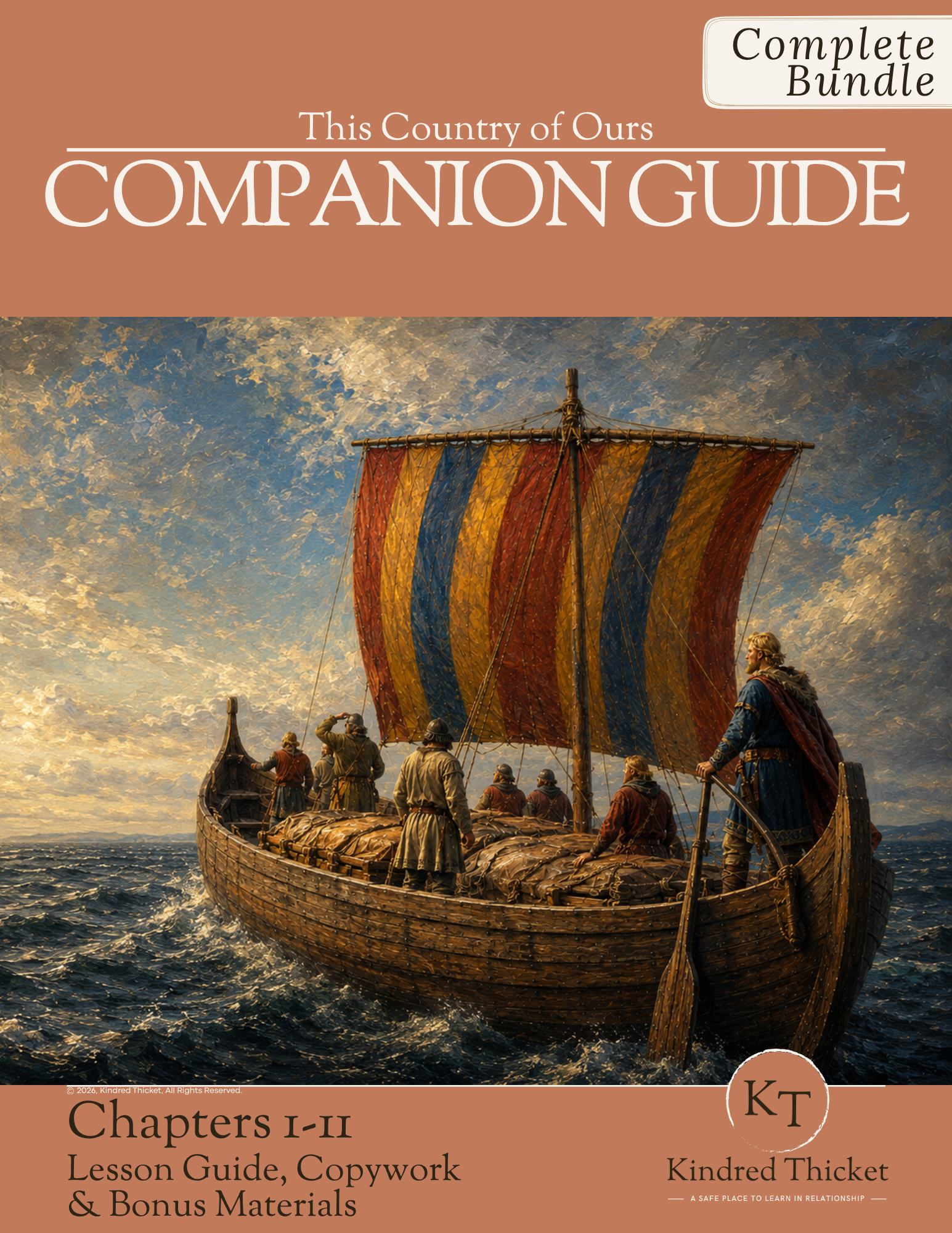
Get your Lesson Guide and Copywork ready before you begin.

Print them now so you have a prepared lesson for your kids this week, instead of scrambling to pull everything together as you go.
Teacher’s Notes & Research

Teacher’s Notes and research are maintained alongside the Kindred Thicket edition. Explore the current Teacher’s Notes for each completed section, or open a chapter below to see the research and editorial decisions behind the text.

Teacher’s Notes

Chapter 1 Teacher’s NotesHow the Vikings of Old Sought and Found New Lands

  • “went to Bjarni and bought his ship”The story here follows the Saga of the Greenlanders. In Erik the Red's Saga, Leif chances upon the land on his voyage home from Norway.
  • “and was indeed his foster father”The story calls Tyrker Leif's foster father. That comes from one saga tradition, and the sagas do not fully agree on his place in the household.
  • “set to work to build a house”The L'Anse Aux Meadows site features eight longhouses. They were constructed with wooden frames, sod and peat.
  • “they who go to explore must not go so far away”Leif used the house as a central base camp that the Norsemen departed from and returned to each day. Experts say the L'Anse Aux Meadows site operated as a base camp and “transshipment station” for resources gathered from the surrounding area.
  • “he called the land Vineland because of them”Vinland could mean "land of wine" or "land of grass". Butternuts were found at L'Anse aux Meadows, where they do not grow. This may indicate trade with or travel to southern areas where butternuts, and even grapes, may have grown.
  • “Until this time the Norsemen had seen no inhabitants of the land.”Philip Hayward, in Island Studies Journal, writes: “Of course the issue here is that for the indigenous inhabitants of the area the brief Viking stay was unconnected with significant discoveries about the universe. It was more akin to a brief visitation by unwelcome foreigners, who landed, proved hostile, were engaged in combat and departed soon after.”
  • “taking with him his wife Gudrid”A spindle whorl, a needle hone and a bone pin were excavated from L'Anse Aux Meadows archaeology site. Archaeologists say that the presence of these tools used for making and mending clothes suggest that women lived at the site.
  • “Thorfinn therefore gathered about sixty men”The sagas disagree on the exact number of Norsemen that were on each expedition, but the L'Anse Aux Meadow site lends credibility to the range of numbers for this type of venture. Experts say around 70-90 occupied the site.
  • “they saw a great troop of natives come out of the wood”"Skraelings" is the Norsemen's word for the native people they met. It is not a name those people used for themselves. Scholars believe they were ancestors of the Mi'kmaq, the Beothuk, or the Innu, most likely the Beothuk.
  • “he was the first white child to be born on the Continent”In the sagas, Thorvald was the first Norse man buried and Snorri was the first Norse child born in Vineland. Sources cannot verify that either was actually the first.
  • “Such are some of the old Norse stories of the first finding of America.”These voyages reach us through the Norse sagas, spoken aloud for generations before anyone wrote them down. The ruins at L'Anse aux Meadows show the sagas kept something true.
  • “But now wise men have read these tales with care”We now have more than just the written tales. In the 1960s, George Decker led Norwegian explorer Helge Ingstad to a cluster of overgrown ridges and humps in the local landscape. These features were the remains of the Viking longhouses at the L'Anse Aux Meadows site.

Chapter 2 Teacher’s NotesThe Sea of Darkness and the Great Faith of Columbus

  • “King John listened kindly enough”The book says King John of Portugal secretly sent ships west of his own. Modern historians say that this story lacks evidence.
  • “I will pawn my jewels to do it.”Bartolomé de Las Casas recorded that Queen Isabella offered to pawn her jewels. Financing for the voyage was managed without their sale, however.

Chapter 3 Teacher’s NotesHow Columbus Fared Forth Upon the Sea of Darkness and Came to Pleasant Lands Beyond

  • “In awed wonder these native people”Historians now believe the people Columbus met on these islands were the Taíno.
  • “once called Watlings Island”There are still reasonable questions about which island Columbus first reached. In 1926, Watlings Island was renamed San Salvador. Some historians favor Samana Cay instead.
  • “island of Cipango”Europeans at the time of Columbus called Japan by the name "Cipango." Columbus thought that Cuba was Japan.
  • “used for food a root which they dug out of the earth”The white potato comes from the Andes and reached Europe decades later. The root the islanders dug was most likely the sweet potato.

Chapter 4 Teacher’s NotesHow Columbus Returned in Triumph

  • “he asked for an egg to be brought to him”Benzoni first told the egg story about Columbus in 1565 after Columbus's death. An older version of the tale is tied to the architect Brunelleschi.
  • “At first no natives would come near the white men”Historians now believe the people Columbus met on these islands were the Taíno.

Chapter 5 Teacher’s NotesHow America Was Named

  • “Others think that he went at least four voyages and probably six.”Vespucci's voyages are still argued over. This telling gives four and perhaps six. Most historians today accept two as certain.
  • “that broad America must wear the name of a thief”The scornful names thrown at Vespucci are quotations from his critics, not the author's own view. The sharpest comes from the American writer Ralph Waldo Emerson.

Chapter 6 Teacher’s NotesHow the Flag of England Was Planted on the Shores of the New World

  • “a frail little vessel called the Matthew, with a crew of but eighteen men”The Matthew is given a crew of eighteen in the text. This is a number that is supported by some primary sources. There is also a primary source that states twenty men, by a merchant named John Day. The true number is not known.
  • “He called the land Prima Tierra Vista or First Land Seen”Sebastian Cabot's map of 1544 says Prima Tierra Vista. The Latin form, Prima Terra Vista is what histories usually carry.
  • “at Newfoundland, Labrador or Cape Breton”Historians have argued that Cabot first landed on Newfoundland, in Cape Breton, and on the coast of Labrador. It is unsettled.
  • “he set out again across the broad Atlantic, taking his sons with him”Cabot's sons are named in the patent of 1496 but not in the one of 1498. Whether they sailed on the second voyage is still debated.
  • “the first to plant the flag of England upon the Continent of North America”Cabot was the first to plant England's flag on North America. He was not the first European to reach it. Norse sailors had come and gone five hundred years before.

Chapter 7 Teacher’s NotesHow the Flag of France Was Planted in Florida

  • “I would fain see Father Adam's will”The retort about Father Adam's will is usually credited to an earlier French king, Francis I, rather than the boy king reigning in this story.

Chapter 8 Teacher’s NotesHow the French Founded a Colony in Florida

  • “As they saw his ship come the Indians ran down to the beach”The people of this chapter were the Timucua, who lived across northern Florida.
  • “as the native Chief Satouriona watched the fort grow”Satouriona is the spelling used in the French accounts of the time and was adopted by Marshall. Modern histories may write his name as Saturiwa.
  • “his great enemies the Thimagoes were near”"Thimagoes" is Marshall's form of "Thimagoa," the name Satouriona's people used for their upriver rivals. Modern historians sometimes refer to them by the name of their chief, "Utina".
  • “bringing with them twenty-four prisoners and many scalps”The warriors return with twenty-four prisoners. The French eyewitness Laudonnière, as retold by the historian Parkman, counted thirteen. Both numbers are on the record.

Chapter 9 Teacher’s NotesHow the Spaniards Drove the French Out of Florida

  • “I am Admiral of the fleet of the King of Spain.”Menendez is called Admiral and Viceroy. His actual title was Adelantado de la Florida, a Spanish rank with no English equal, joining military, civil and financial power in one man.
  • “he sent them home to end their lives as galley slaves”The last Frenchmen who were spared were taken to St. Augustine and Havana. It is not confirmed whether or not they ended their lives as galley slaves.

Chapter 10 Teacher’s NotesHow a Frenchman Avenged the Death of His Countrymen

  • “Even the boy King, Charles IX, Catholic though he was, demanded redress.”Charles IX is called a boy King. He had been declared of age at thirteen and was eighteen by this time, though his mother Catherine de' Medici held the real power.
  • “repaired the fort and now called it Fort Mateo”After the Spanish captured the fort, they renamed it "San Mateo". Fort Mateo is the English form of that name.
  • “the whole beach was crowded with natives armed with bows and arrows”The people of this chapter were the Timucua, who lived across northern Florida.
  • “who was no other than Satouriona”Satouriona is the spelling used in the French accounts of the time and was adopted by Marshall. Modern histories may write his name as Saturiwa.

Chapter 11 Teacher’s NotesThe Adventures of Sir Humphrey Gilbert

  • “Thus began the long two hundred years' struggle between the French and English”The two hundred years' struggle is a round figure. Different starting points give different totals; from the first French colonies to the fall of New France is nearer a hundred and fifty.
  • “The French had already planted a colony on the St. Lawrence”Cartier and Roberval established a settlement on the St. Lawrence forty years earlier, at Cap-Rouge. By the time Gilbert sailed, it had been abandoned.
  • “he landed and solemnly took possession of the country for two hundred leagues north, south, east and west”Newfoundland is claimed here as though no one lived there. The Beothuk and the Mi'kmaq were already living on that coast, and had been for a very long time.
  • “it is the oldest colony of the British Empire”Gilbert left no settlement behind in Newfoundland. Continuous English colonization began in 1610 in Canada at Cupers Cove (now Cupids).

Teacher’s Notes may be updated as new research or questions arise. The web edition is the current version.

Research

About this edition

Throughout this section we brought Marshall’s British spellings to American English, keeping the original spelling inside quoted material. Punctuation may also be adjusted. Where offensive terminology or descriptions were present in Marshall’s original text, with the exception of direct period quotations, we have made minimal revisions.

In this section, numerous facts were researched and verified. Where the original text required correction, clarification, or further context, we documented our treatment here. Every item below was checked against the historical and archaeological record before we touched a word. We also note what we chose to leave standing and address some common inquiries.

Chapter 1 Research and Editorial NotesHow the Vikings of Old Sought and Found New Lands

Corrected in the Revised Edition

IssueEditorial ResponseSources
“there dwelt in Greenland a chieftain named Eric the Red”The original text calls Eric the Red a king. He was a Norse chieftain who founded Greenland's first settlement around AD 985, and he held no royal title.Corrected the title in the revised edition. The text now names him a chieftain.
“The country which Leif called Helluland was most likely Baffin Island”The original text places the three lands the Norsemen found at Labrador, Newfoundland, and Nova Scotia. The Norse settlement uncovered at L'Anse aux Meadows in 1960 changed what scholars understand about these voyages.Updated the identifications: Helluland as Baffin Island, Markland as Labrador, and Vineland as northern Newfoundland, possibly extending south into the Gulf of St. Lawrence.
“set their vessel in order”The original text gives Leif a dragon-headed vessel. The sagas have him sail a knarr, a broad cargo ship built for goods and cattle rather than for war, and the chapter itself has him buy the ship of Bjarni the Traveler, a trader.Removed the ornamental detail. The text now calls it simply his vessel.

Kept as It Stands, with a Note for the Parent

IssueEditorial ResponseSources
“went to Bjarni and bought his ship”The story here follows the Saga of the Greenlanders. In Erik the Red's Saga, Leif chances upon the land on his voyage home from Norway.Kept as written, with a note for the parent.
“and was indeed his foster father”The story calls Tyrker Leif's foster father. That comes from one saga tradition, and the sagas do not fully agree on his place in the household.Kept as written, with a note for the parent.
“set to work to build a house”The L'Anse Aux Meadows site features eight longhouses. They were constructed with wooden frames, sod and peat.Kept as written, with a note for the parent.
“they who go to explore must not go so far away”Leif used the house as a central base camp that the Norsemen departed from and returned to each day. Experts say the L'Anse Aux Meadows site operated as a base camp and “transshipment station” for resources gathered from the surrounding area.Kept as written, with a note for the parent.
“he called the land Vineland because of them”Vinland could mean "land of wine" or "land of grass". Butternuts were found at L'Anse aux Meadows, where they do not grow. This may indicate trade with or travel to southern areas where butternuts, and even grapes, may have grown.Kept as written, with a note for the parent.
“Until this time the Norsemen had seen no inhabitants of the land.”Philip Hayward, in Island Studies Journal, writes: “Of course the issue here is that for the indigenous inhabitants of the area the brief Viking stay was unconnected with significant discoveries about the universe. It was more akin to a brief visitation by unwelcome foreigners, who landed, proved hostile, were engaged in combat and departed soon after.”Kept as written, with a note for the parent.
“taking with him his wife Gudrid”A spindle whorl, a needle hone and a bone pin were excavated from L'Anse Aux Meadows archaeology site. Archaeologists say that the presence of these tools used for making and mending clothes suggest that women lived at the site.Kept as written, with a note for the parent.
“Thorfinn therefore gathered about sixty men”The sagas disagree on the exact number of Norsemen that were on each expedition, but the L'Anse Aux Meadow site lends credibility to the range of numbers for this type of venture. Experts say around 70-90 occupied the site.Kept as written, with a note for the parent.
“they saw a great troop of natives come out of the wood”"Skraelings" is the Norsemen's word for the native people they met. It is not a name those people used for themselves. Scholars believe they were ancestors of the Mi'kmaq, the Beothuk, or the Innu, most likely the Beothuk.Kept as written, with a note for the parent.
“he was the first white child to be born on the Continent”In the sagas, Thorvald was the first Norse man buried and Snorri was the first Norse child born in Vineland. Sources cannot verify that either was actually the first.Kept as written, with a note for the parent.
“Such are some of the old Norse stories of the first finding of America.”These voyages reach us through the Norse sagas, spoken aloud for generations before anyone wrote them down. The ruins at L'Anse aux Meadows show the sagas kept something true.Kept as written, with a note for the parent.
“But now wise men have read these tales with care”We now have more than just the written tales. In the 1960s, George Decker led Norwegian explorer Helge Ingstad to a cluster of overgrown ridges and humps in the local landscape. These features were the remains of the Viking longhouses at the L'Anse Aux Meadows site.Kept as written, with a note for the parent.

Common Inquiries

InquiryEditorial ResponseSources
Some resources identify the people the Norsemen met as the Thule. We researched this carefully and could not support it. The Thule moved east from Alaska into the Canadian Arctic and Greenland around AD 1200, roughly two centuries after Leif's voyage, and they were an Arctic people, while Vinland lies in northern Newfoundland and the Gulf of St. Lawrence. We found no scholarly source placing the Thule in Vinland at this time.Kept the Norsemen's own word, Skraelings, in the text, since that is what the sagas record and no source can tell us with certainty which people they met. The note above carries this for parents, and the character card in our materials is drawn from imagery researched for the Beothuk.

Chapter 2 Research and Editorial NotesThe Sea of Darkness and the Great Faith of Columbus

Corrected in the Revised Edition

IssueEditorial ResponseSources
“which for many years he had made his home”Marshall writes that Columbus lived in Portugal for more than ten years. According to the sources, he likely arrived in 1476 and departed for Spain in 1485, which is a little less than ten years. We cannot precisely give a number of years, but it is likely that "more than ten years" overstates his residence.The text now says he had made it his home for many years.
“When Columbus thus fled from Portugal, penniless and in debt”Marshall calls Columbus a man over forty at the time he left Portugal. He was born around 1451, which would have made him about thirty-four in 1485.We removed the age rather than replace one uncertain number with another.

Kept as It Stands, with a Note for the Parent

IssueEditorial ResponseSources
“King John listened kindly enough”The book says King John of Portugal secretly sent ships west of his own. Modern historians say that this story lacks evidence.Kept as written, with a note for the parent.
“I will pawn my jewels to do it.”Bartolomé de Las Casas recorded that Queen Isabella offered to pawn her jewels. Financing for the voyage was managed without their sale, however.Kept as written, with a note for the parent.

Chapter 3 Research and Editorial NotesHow Columbus Fared Forth Upon the Sea of Darkness and Came to Pleasant Lands Beyond

Corrected in the Revised Edition

IssueEditorial ResponseSources
“once called Watlings Island”Marshall names the island where Columbus first landed by the name it carried in her own day. When she wrote, the island we call San Salvador today was known as Watlings Island, and the name San Salvador belonged to the island now called Cat Island. In 1926, what was once Watlings Island assumed the name of San Salvador. Cat Island is called Cat Island.The text now says the landfall island was once called Watlings Island, and it no longer says that Cat Island still carried the name San Salvador.
“Then from Rodrigo de Triana, the lookout on the Pinta, there came again”Marshall does not say who raised the shout that proved to be land. Columbus's journal names the lookout on the Pinta who sighted it.The text now names Rodrigo de Triana, the lookout on the Pinta.

Kept as It Stands, with a Note for the Parent

IssueEditorial ResponseSources
“In awed wonder these native people”Historians now believe the people Columbus met on these islands were the Taíno.Kept as written, with a note for the parent.
“once called Watlings Island”There are still reasonable questions about which island Columbus first reached. In 1926, Watlings Island was renamed San Salvador. Some historians favor Samana Cay instead.Kept as written, with a note for the parent.
“island of Cipango”Europeans at the time of Columbus called Japan by the name "Cipango." Columbus thought that Cuba was Japan.Kept as written, with a note for the parent.
“used for food a root which they dug out of the earth”The white potato comes from the Andes and reached Europe decades later. The root the islanders dug was most likely the sweet potato.Kept as written, with a note for the parent.

Chapter 4 Research and Editorial NotesHow Columbus Returned in Triumph

Corrected in the Revised Edition

IssueEditorial ResponseSources
“he chose thirty-nine, appointing one of them, Diego de Arana, as Governor”Marshall says forty-four men were left at La Navidad. Most sources indicate thirty-nine men were left there.The text now says thirty-nine.
“Thus ended the first colony from Spain ever planted in Western lands”Marshall calls the little settlement at La Navidad the first white colony ever planted in Western lands. Norse sailors had reached these lands and built there some five hundred years earlier, at L'Anse aux Meadows, so the claim as she made it does not hold.The text now calls it the first colony from Spain ever planted in Western lands.
“gave a New World to the Old, died in neglect”Marshall writes that Columbus died in poverty and neglect. The neglect is true, and it is the heart of the passage, but the poverty is a long-lived myth. He died on the twentieth of May, 1506, reasonably provided for and cared for by his family, stripped of the honors he had been promised rather than of his living.The text now says he died in neglect.
“He called the fort La Navidad or The Nativity”Marshall writes the name of Columbus's little fort as La Navida. The Spanish word is La Navidad, meaning the Nativity, or Christmas, which is exactly what Columbus was naming it for: the Santa Maria ran aground in the night between Christmas Eve and Christmas Day, and the fort was raised from her timbers. Marshall's own sentence gives the translation, so the missing letter reads as a slip of the pen rather than a choice.The text now says La Navidad.

Kept as It Stands, with a Note for the Parent

IssueEditorial ResponseSources
“he asked for an egg to be brought to him”Benzoni first told the egg story about Columbus in 1565 after Columbus's death. An older version of the tale is tied to the architect Brunelleschi.Kept as written, with a note for the parent.
“At first no natives would come near the white men”Historians now believe the people Columbus met on these islands were the Taíno.Kept as written, with a note for the parent.

Chapter 5 Research and Editorial NotesHow America Was Named

Corrected in the Revised Edition

IssueEditorial ResponseSources
“Waldseemüller's 1507 map, which accompanied Ringmann's book”Marshall wrote that the name America appears for the first time on a map made about 1514. The name was in fact in print in 1507, and the map, the globe and the little book that argued for the name were issued together that year, so no one of the three can be called the first.The text now dates Waldseemüller's map to 1507 and no longer says the name appeared first on a map.
“Then one day a professor from Alsace named Matthias Ringmann came to St. Dié in Lorraine to join a group of scholars”Marshall presents the naming as the work of one man alone, a professor who taught geography at the Monastery of St. Dié in Alsace. It was the work of a group of scholars whom Duke René II and his secretary Walter Lud had gathered at St. Dié, which is in Lorraine and not in Alsace, around a printing press rather than a monastery. The scholar usually credited with writing the book, Matthias Ringmann, was the one who came from Alsace, and he was twenty-five.The text now names Matthias Ringmann, says he came from Alsace to join a group of scholars at St. Dié in Lorraine, distinguishes his book from Martin Waldseemüller's map and globe, and credits the naming to the scholars together.
“in South America the Republic of Colombia”Marshall points to the United States of Colombia in South America as one of the places still carrying Columbus's name. That federation became the Republic of Colombia in 1886, so the name she used has since changed.The text now uses the modern name.
“Whether they intended to or not, the scholars at St. Dié with their book, map and globe had christened the New World”Marshall placed the writer of the book in a quiet Alsatian College. There was no college. The scholars at St. Dié worked as a circle around Duke René II's press, and the book was first published in the name of that group, the Gymnasium Vosagense, rather than under any one man's name. Marshall also calls the writer old; Ringmann was twenty-five in 1507.The text no longer places him in a college and no longer calls him old. It now says the scholars at St. Dié christened the New World with their book, map and globe.

Kept as It Stands, with a Note for the Parent

IssueEditorial ResponseSources
“Others think that he went at least four voyages and probably six.”Vespucci's voyages are still argued over. This telling gives four and perhaps six. Most historians today accept two as certain.Kept as written, with a note for the parent.
“that broad America must wear the name of a thief”The scornful names thrown at Vespucci are quotations from his critics, not the author's own view. The sharpest comes from the American writer Ralph Waldo Emerson.Kept as written, with a note for the parent.

Common Inquiries

InquiryEditorial ResponseSources
Readers often arrive wondering why the continents carry Amerigo Vespucci's name rather than Columbus's, since Columbus crossed first.The Cosmographiae Introductio was the little geography book written by Matthias Ringmann at St. Dié in 1507. It suggested calling the new land after Amerigo Vespucci. Ringmann's book, and Waldseemüller's world map and globe were issued together that year.

Chapter 6 Research and Editorial NotesHow the Flag of England Was Planted on the Shores of the New World

Corrected in the Revised Edition

IssueEditorial ResponseSources
“at Newfoundland, Labrador or Cape Breton”Marshall gives only two possibilities for Cabot's landfall, Cape Breton and the coast of Labrador. Newfoundland is the third, and it is the one with the largest body of scholarship behind it.The text now names Newfoundland alongside Labrador and Cape Breton.

Kept as It Stands, with a Note for the Parent

IssueEditorial ResponseSources
“a frail little vessel called the Matthew, with a crew of but eighteen men”The Matthew is given a crew of eighteen in the text. This is a number that is supported by some primary sources. There is also a primary source that states twenty men, by a merchant named John Day. The true number is not known.Kept as written, with a note for the parent.
“He called the land Prima Tierra Vista or First Land Seen”Sebastian Cabot's map of 1544 says Prima Tierra Vista. The Latin form, Prima Terra Vista is what histories usually carry.Kept as written, with a note for the parent.
“at Newfoundland, Labrador or Cape Breton”Historians have argued that Cabot first landed on Newfoundland, in Cape Breton, and on the coast of Labrador. It is unsettled.Kept as written, with a note for the parent.
“he set out again across the broad Atlantic, taking his sons with him”Cabot's sons are named in the patent of 1496 but not in the one of 1498. Whether they sailed on the second voyage is still debated.Kept as written, with a note for the parent.
“the first to plant the flag of England upon the Continent of North America”Cabot was the first to plant England's flag on North America. He was not the first European to reach it. Norse sailors had come and gone five hundred years before.Kept as written, with a note for the parent.

Common Inquiries

InquiryEditorial ResponseSources
Marshall follows the ten pound reward King Henry gave Cabot with a comparison to money values in her own day, written in 1917. A reader holding a public domain copy alongside this edition will find that the comparison figure is not the same.Kindred Thicket carries a comparison meant for a reader today in place of Marshall's 1917 one, and the ten pound payment itself stands exactly as the record has it.

Chapter 7 Research and Editorial NotesHow the Flag of France Was Planted in Florida

Corrected in the Revised Edition

IssueEditorial ResponseSources
“In the end nearly thirty men were chosen to remain”Marshall writes that thirty men were chosen to stay behind at Charlesfort. The French accounts of the expedition put the number at twenty-seven or twenty-eight.Kindred Thicket changed the wording so the text now says nearly thirty.

Kept as It Stands, with a Note for the Parent

IssueEditorial ResponseSources
“I would fain see Father Adam's will”The retort about Father Adam's will is usually credited to an earlier French king, Francis I, rather than the boy king reigning in this story.Kept as written, with a note for the parent.

Chapter 8 Research and Editorial NotesHow the French Founded a Colony in Florida

Kept as It Stands, with a Note for the Parent

IssueEditorial ResponseSources
“As they saw his ship come the Indians ran down to the beach”The people of this chapter were the Timucua, who lived across northern Florida.Kept as written, with a note for the parent.
“as the native Chief Satouriona watched the fort grow”Satouriona is the spelling used in the French accounts of the time and was adopted by Marshall. Modern histories may write his name as Saturiwa.Kept as written, with a note for the parent.
“his great enemies the Thimagoes were near”"Thimagoes" is Marshall's form of "Thimagoa," the name Satouriona's people used for their upriver rivals. Modern historians sometimes refer to them by the name of their chief, "Utina".Kept as written, with a note for the parent.
“bringing with them twenty-four prisoners and many scalps”The warriors return with twenty-four prisoners. The French eyewitness Laudonnière, as retold by the historian Parkman, counted thirteen. Both numbers are on the record.Kept as written, with a note for the parent.

Chapter 9 Research and Editorial NotesHow the Spaniards Drove the French Out of Florida

Corrected in the Revised Edition

IssueEditorial ResponseSources
“and St. Augustine was founded”Marshall calls St. Augustine the oldest town in the United States. Towns stood on this land long before any European arrived, and among Spanish foundings San Juan in Puerto Rico is older still, so the claim as she made it does not hold.We removed the claim, and St. Augustine keeps its place in the story as the settlement Menendez founded.

Kept as It Stands, with a Note for the Parent

IssueEditorial ResponseSources
“I am Admiral of the fleet of the King of Spain.”Menendez is called Admiral and Viceroy. His actual title was Adelantado de la Florida, a Spanish rank with no English equal, joining military, civil and financial power in one man.Kept as written, with a note for the parent.
“he sent them home to end their lives as galley slaves”The last Frenchmen who were spared were taken to St. Augustine and Havana. It is not confirmed whether or not they ended their lives as galley slaves.Kept as written, with a note for the parent.

Content consideration

Chapter 9 tells of French soldiers put to death after they surrendered. The account is brief and not graphic, but you may wish to preview it and decide how much to say about why it happened.

Chapter 10 Research and Editorial NotesHow a Frenchman Avenged the Death of His Countrymen

Corrected in the Revised Edition

IssueEditorial ResponseSources
“not as unto Spaniards, but as unto liars, thieves, and murderers”The inscription Gourgues burned into the tablets he nailed above the hanged Spaniards has come down to us in more than one English rendering. The historian Francis Parkman gives traitors and robbers where the Florida sources give liars and thieves.The text gives the rendering recorded in the Florida sources: This is done, not as unto Spaniards, but as unto liars, thieves, and murderers.
“His name was Dominique de Gourgues”The Frenchman who led this expedition was Dominique de Gourgues, and the text spelled his family name de Gourges.We corrected the spelling to de Gourgues throughout the chapter.

Kept as It Stands, with a Note for the Parent

IssueEditorial ResponseSources
“Even the boy King, Charles IX, Catholic though he was, demanded redress.”Charles IX is called a boy King. He had been declared of age at thirteen and was eighteen by this time, though his mother Catherine de' Medici held the real power.Kept as written, with a note for the parent.
“repaired the fort and now called it Fort Mateo”After the Spanish captured the fort, they renamed it "San Mateo". Fort Mateo is the English form of that name.Kept as written, with a note for the parent.
“the whole beach was crowded with natives armed with bows and arrows”The people of this chapter were the Timucua, who lived across northern Florida.Kept as written, with a note for the parent.
“who was no other than Satouriona”Satouriona is the spelling used in the French accounts of the time and was adopted by Marshall. Modern histories may write his name as Saturiwa.Kept as written, with a note for the parent.

Common Inquiries

InquiryEditorial ResponseSources
The chapter puts about three hundred Spaniards in the garrison at San Mateo. Parkman, working from the French account, counts two hundred and sixty.Marshall's figure stands in the text and the difference is recorded here as an open question in our research.

Chapter 11 Research and Editorial NotesThe Adventures of Sir Humphrey Gilbert

Corrected in the Revised Edition

IssueEditorial ResponseSources
“Sir Walter Raleigh who was Gilbert's half-brother”Marshall calls Walter Raleigh Gilbert's step-brother. The two shared a mother, Catherine Champernowne, and had different fathers, which makes them half-brothers.The text now calls Raleigh Gilbert's half-brother.
“Master Edward Hayes who commanded the Golden Hind”Edward Hayes commanded the Golden Hind and wrote the account this chapter is based on. Records sometimes spell his name as Haies, and Marshall uses Hay, a spelling we could not find in other records.The text now says Hayes.

Kept as It Stands, with a Note for the Parent

IssueEditorial ResponseSources
“Thus began the long two hundred years' struggle between the French and English”The two hundred years' struggle is a round figure. Different starting points give different totals; from the first French colonies to the fall of New France is nearer a hundred and fifty.Kept as written, with a note for the parent.
“The French had already planted a colony on the St. Lawrence”Cartier and Roberval established a settlement on the St. Lawrence forty years earlier, at Cap-Rouge. By the time Gilbert sailed, it had been abandoned.Kept as written, with a note for the parent.
“he landed and solemnly took possession of the country for two hundred leagues north, south, east and west”Newfoundland is claimed here as though no one lived there. The Beothuk and the Mi'kmaq were already living on that coast, and had been for a very long time.Kept as written, with a note for the parent.
“it is the oldest colony of the British Empire”Gilbert left no settlement behind in Newfoundland. Continuous English colonization began in 1610 in Canada at Cupers Cove (now Cupids).Kept as written, with a note for the parent.

These notes are maintained as a living research record and may be updated as new scholarship or reader inquiries warrant.

Questions about This Country of Ours

What is This Country of Ours about?

This Country of Ours is a living-book history of the United States, told as a connected narrative chapter by chapter. It is the American companion to Our Island Story and is also titled The Story of the United States. Kindred Thicket reads it aloud, clearly and accurately, with the Charlotte Mason lesson rhythm woven around the reading.

Who wrote This Country of Ours?

This Country of Ours was written by H. E. Marshall, the same author as Our Island Story. It is a beloved living-book history in the Charlotte Mason world, and Kindred Thicket prepares the read-aloud and the companion guide around it.

Is This Country of Ours historically accurate?

The original is an older American history and carries some dated framing, wording, and perspective. The version Kindred Thicket reads aloud is the Revised Edition, in which factual and historical errors are corrected and dated wording is put right, with claims checked against primary sources and reputable history. Where the question is one of perspective, how an event is framed or whose part of the story is told, we leave the passage and flag it, so you decide what to discuss.

What did the Kindred Thicket Revised Edition change?

For This Country of Ours, we corrected factual and historical errors and put dated wording right, checking claims against primary sources, while keeping the beauty of the original. Matters of perspective are left in place and flagged for you, and every change is explained in plain accuracy notes in the companion guide. We will not quietly rewrite the past, and we will not hand you a single verdict.

Is there an updated or corrected audiobook?

Yes. What families hear is the corrected Revised Edition, not the uncorrected original. The read-aloud is free on YouTube, and a Kindred Thicket playlist compatible with the Yoto app is on the way for screen-free listening in the car or at bedtime.

Which chapters and curriculum years use This Country of Ours?

This Country of Ours suits Form 1 and Form 2, roughly the early through middle years. Many AmblesideOnline families read it for their American history, often with several ages gathered together, one reading serving the whole group while each child narrates in her own way.

How does the map work relate to the chapters?

Map work in the companion guide pairs custom maps, drawn and keyed to each chapter's own events, with a basic atlas, and adds discussion questions laddered from kindergarten through the upper years. The geography grows out of the story rather than a worksheet, so it is ready chapter by chapter without piecing it together.

What should parents know about older language and historical perspectives?

This Country of Ours reflects the framing of its time on some points, especially where American history touches conflict and the peoples already living on the land. In the Revised Edition, factual and historical errors and dated wording are corrected. Where a matter is one of perspective rather than fact, we leave the passage and flag it plainly, so you decide what to discuss with your child. You stay the one who decides.

Is it free?

Yes. The read-aloud is free on YouTube, and the printable Bonus Set is free with the Kindred Thicket email list. The Lesson Guide and Complete Companion Guide are the paid part, where the rest of the lesson is prepared for you: the custom maps, copywork, key dates, composition, and accuracy notes.

Do I need to prepare anything before we start?

No. These are open-and-go lessons. The hook, the vocabulary, and the narration support are already prepared and woven into the reading, so you press play and read along together.

Can I use this with several ages at once?

Yes. One reading serves the whole gathering, and each child narrates in her own way, whether she is five or thirteen.

What is a Kindred Thicket Revised Edition?

We keep the beauty of the original living book and correct its factual errors and dated wording, with every change explained in plain accuracy notes, so you can see exactly what we changed and decide what to share.

We do the planning. The books come alive. Your child does the learning.

Last updated August 23, 2026