The Listening Grove · This Country of Ours
Chapter 5: How America Was Named
A Charlotte Mason read-aloud lesson. Press play, with the lesson.
What is This Country of Ours Chapter 5, How America Was Named, about?Parent review
This Country of Ours Chapter 5, How America Was Named, is about how two continents came to carry the wrong man's name. After Columbus opened the way, many others followed him west, and among them was Amerigo Vespucci of Florence, who sailed several times but never as leader of an expedition. Vespucci wrote lively accounts of what he saw, and those accounts were widely read. A professor of geography published a little book proposing that the new land be called America, after Amerigo. Map-makers picked up the name, and once it was on the maps nothing could get it off again. Other names were suggested and failed. Columbus, who had found the way, was left with only a scattering of places carrying his name, and no one had planned it so.
Say what you remember!
Tell what you remember from the last chapter.
What happened in This Country of Ours Chapter 4, How Columbus Returned in Triumph?Have a look
In Chapter 4, How Columbus Returned in Triumph, the Santa Maria ran aground on Christmas Eve, and Columbus built a little fort from her timbers, named it La Navidad, and left men there. He sailed home through storms to a hero's welcome in Spain, and answered a scoffing courtier at a banquet with an egg. When he came back with a greater fleet he found the fort destroyed and every man dead. In his last years the honors he had been promised were taken from him, and he died in neglect.
Read the previous lesson: How Columbus Returned in Triumph →Show what you know!
Use your printable Lesson Guide. Fill in the vocabulary you know, then click to check your work and learn some new words today.
What are the difficult or advanced vocabulary words in This Country of Ours Chapter 5, How America Was Named?leisure, astronomer, braggart, diligentHave a look
- leisure: free time away from work or duties
- astronomer: someone skilled at studying the stars
- braggart: a loud boaster who shows off
- diligent: working with steady, earnest effort
Locate it on the map!
Use your printable Lesson Guide. Use an atlas and fill in the blank map if you can find the geographic location, then click to check your work.
What important geographic locations connect with This Country of Ours Chapter 5, How America Was Named?
- Find
- Spain
- Italy
- Europe
- Find and Label
- Florence (Italy)
See it on the mapHave a look
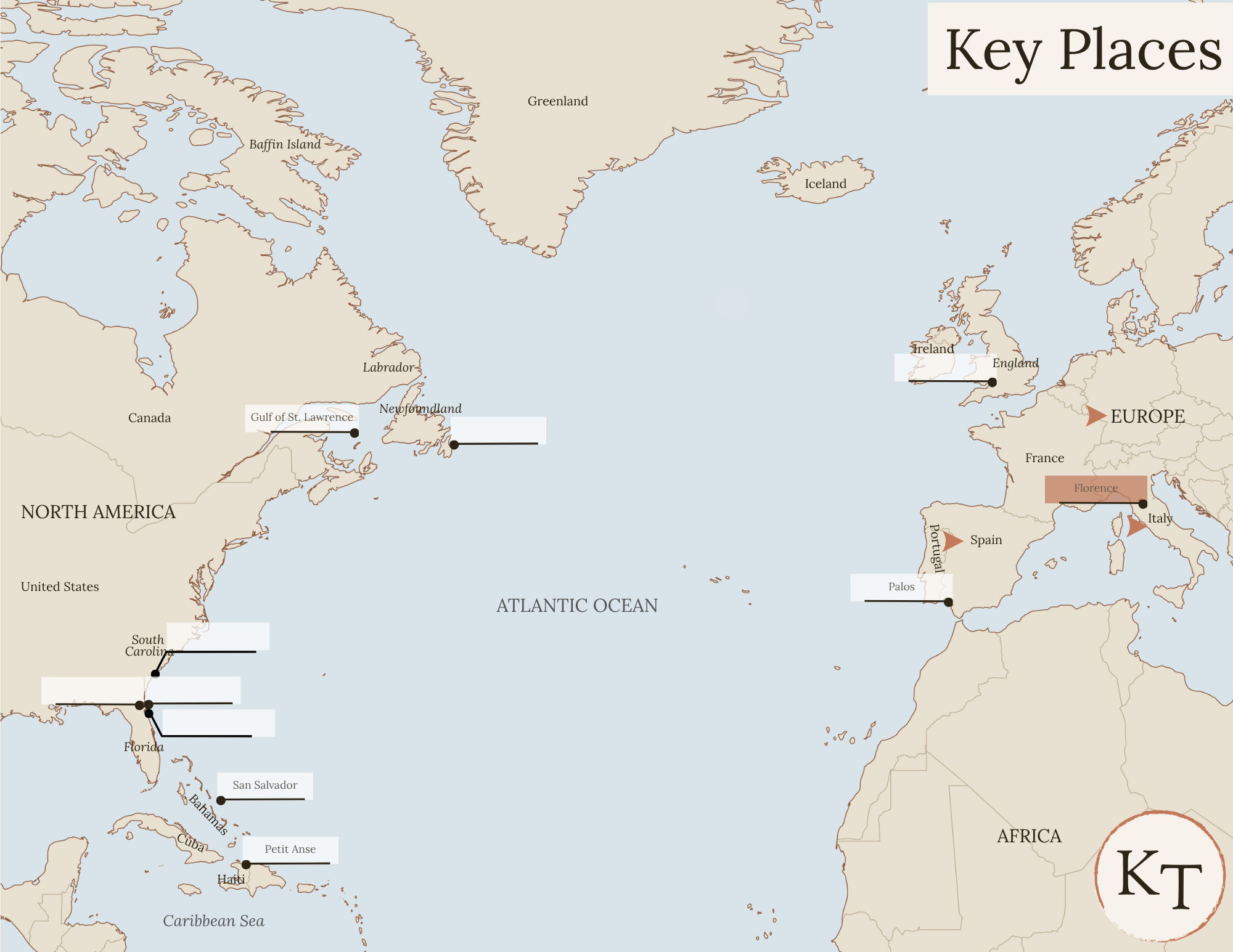
This matches the map in your Lesson Guide.
The Books come Alive!
Read or listen to Chapter 5 of This Country of Ours, the Kindred Thicket Revised Edition.
Read by Kindred Thicket from the This Country of Ours Kindred Thicket Revised Edition.
What corrections are made in Chapter 5 of This Country of Ours?Parent review
This is a Kindred Thicket Revised Edition. Factual and historical errors are corrected and dated wording is put right, and these notes tell you plainly what we changed and what we left as Marshall wrote it.
- About this sectionThroughout this section we brought Marshall’s British spellings to American English, keeping the original spelling inside quoted material. Punctuation may also be adjusted. Where offensive terminology or descriptions were present in Marshall’s original text, with the exception of direct period quotations, we have made minimal revisions.
- Kindred Thicket Revised Edition UpdatesMarshall wrote that the name America appears for the first time on a map made about 1514. The name was in fact in print in 1507, and the map, the globe and the little book that argued for the name were issued together that year, so no one of the three can be called the first. The text now dates Waldseemüller's map to 1507 and no longer says the name appeared first on a map.
- Marshall presents the naming as the work of one man alone, a professor who taught geography at the Monastery of St. Dié in Alsace. It was the work of a group of scholars whom Duke René II and his secretary Walter Lud had gathered at St. Dié, which is in Lorraine and not in Alsace, around a printing press rather than a monastery. The scholar usually credited with writing the book, Matthias Ringmann, was the one who came from Alsace, and he was twenty-five. The text now names Matthias Ringmann, says he came from Alsace to join a group of scholars at St. Dié in Lorraine, distinguishes his book from Martin Waldseemüller's map and globe, and credits the naming to the scholars together.
- Marshall points to the United States of Colombia in South America as one of the places still carrying Columbus's name. That federation became the Republic of Colombia in 1886, so the name she used has since changed. The text now uses the modern name.
- Marshall placed the writer of the book in a quiet Alsatian College. There was no college. The scholars at St. Dié worked as a circle around Duke René II's press, and the book was first published in the name of that group, the Gymnasium Vosagense, rather than under any one man's name. Marshall also calls the writer old; Ringmann was twenty-five in 1507. The text no longer places him in a college and no longer calls him old. It now says the scholars at St. Dié christened the New World with their book, map and globe.
- Teacher's Notes“Others think that he went at least four voyages and probably six.”Vespucci's voyages are still argued over. This telling gives four and perhaps six. Most historians today accept two as certain.
- “that broad America must wear the name of a thief”The scornful names thrown at Vespucci are quotations from his critics, not the author's own view. The sharpest comes from the American writer Ralph Waldo Emerson.
Memory becomes Action!
Use the Response Resource* to remember and spell tricky names. Choose one way to narrate.
*Materials in the Lesson Guide.
What is the list of names, people, characters, and places that are important in Chapter 5 of This Country of Ours?Amerigo Vespucci, Columbus, America, The Medici, Florence, The Equator, Venezuela, The Republic of ColombiaHave a look
- Amerigo Vespucci: A Florentine clerk turned explorer, America's namesake.
- Columbus: The Genoese sailor who first crossed the Sea of Darkness (the Atlantic Ocean).
- America: The New World's name, taken from Amerigo Vespucci.
- The Medici: The great merchant house of Florence, Vespucci's employers.
- Florence: The Italian city where Vespucci was born.
- The Equator: The imaginary line around the middle of the Earth.
- Venezuela: The South American coast Vespucci helped explore.
- The Republic of Colombia: The South American country named for Columbus.
Chapter 5 Q & A
This is a Kindred Thicket Revised Edition. Marshall’s 1917 history is beautiful but not always right, and here is what the record supports for this chapter.
Why is America named after Amerigo Vespucci and not Columbus?
Because of a little geography book. A professor proposed the name America after Amerigo Vespucci, whose written accounts of the new lands were widely read, and the map-makers adopted it. Once a name is on the maps it is very hard to change. Nobody set out to slight Columbus; it simply happened.
When did the name America first appear on a map?
In 1507, on the world map published by Martin Waldseemuller, the same year as the little geography book that proposed the name. Marshall gives about 1514, and we corrected it.
How many voyages did Vespucci really make?
It is still argued over. Marshall's telling gives four and perhaps six. Most historians today accept two as certain.
Was Vespucci a thief who stole the credit?
The scornful names thrown at him are quotations from his critics, not Marshall's own view, and the sharpest comes from the American writer Ralph Waldo Emerson. Vespucci did not name the continents or ask for the honor; a geographer did it, and the maps did the rest.
Where did the professor who named America teach?
At a college at Saint-Die, which lies in Lorraine. Marshall describes him as teaching at the Monastery of St. Die in Alsace, which is wrong on both counts, so we removed the description and left him simply a professor who taught geography.
Do any places still carry Columbus's name?
Yes, a scattering of them, including Colombia in South America, British Columbia, and the District of Columbia. Marshall points to the United States of Colombia, which became the Republic of Colombia in 1886, so the text now uses the modern name.